Guides / Materials
Inconel Heat Exchanger and Chemical Plant Components: Tubesheets, Flanges and Fittings
October 21, 2026
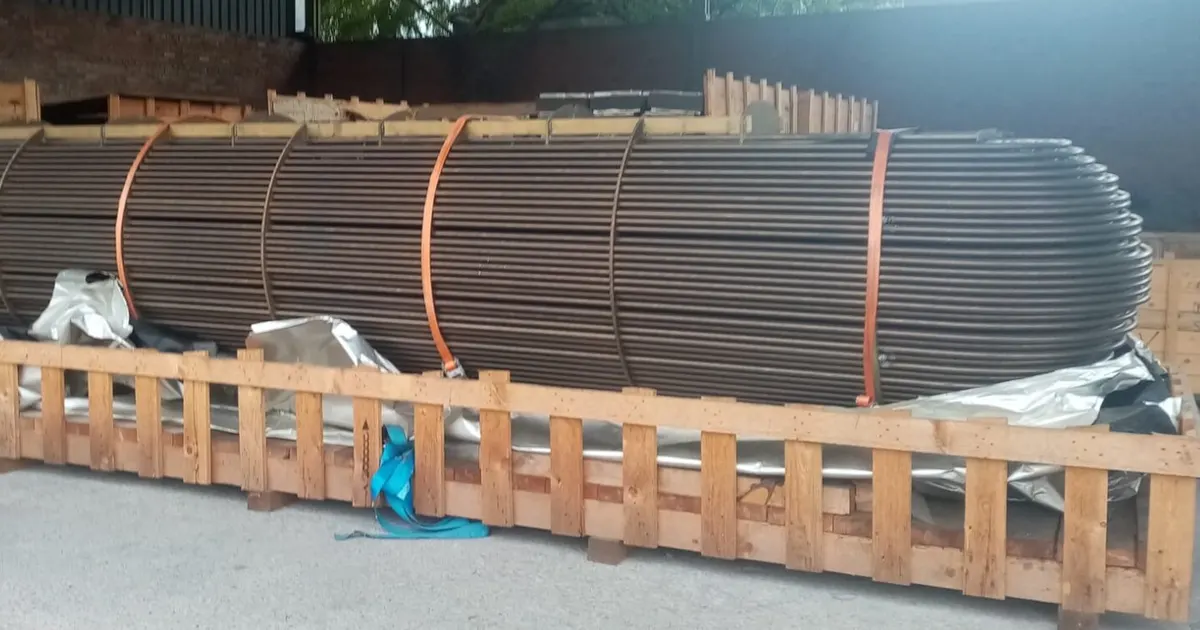
Heat exchangers and process vessels in chemical plants handle fluids that are hot, corrosive or both, often for decades. Where carbon steel and stainless steel lose to corrosion or heat, designers specify nickel alloys such as Inconel. For a buyer, that creates orders for tubesheets, flanges, baffles, fittings and bellows made from expensive material in precise patterns. This guide explains the main components, the alloys behind them and what a shop needs to know to quote them.
Why nickel alloys in process equipment
Chemical and process fluids attack metals in many ways. Chlorides cause pitting and stress corrosion cracking in stainless steel. Hot acids dissolve carbon steel. High temperature oxidizes and weakens ordinary alloys. Nickel alloys resist these in different combinations, so a process engineer picks the alloy that fits the fluid. Inconel 625 resists chlorides, seawater and high temperature well. Alloy 825, sold as Incoloy 825, suits sulfuric and phosphoric acid service. Inconel 600 and 690 handle high-temperature water and steam, and Incoloy 800H serves in hot hydrocarbon heaters. Our guide to Inconel 825 vs 625 compares two of these grades in detail, and our page on Inconel in oil and gas covers related service.
The main components
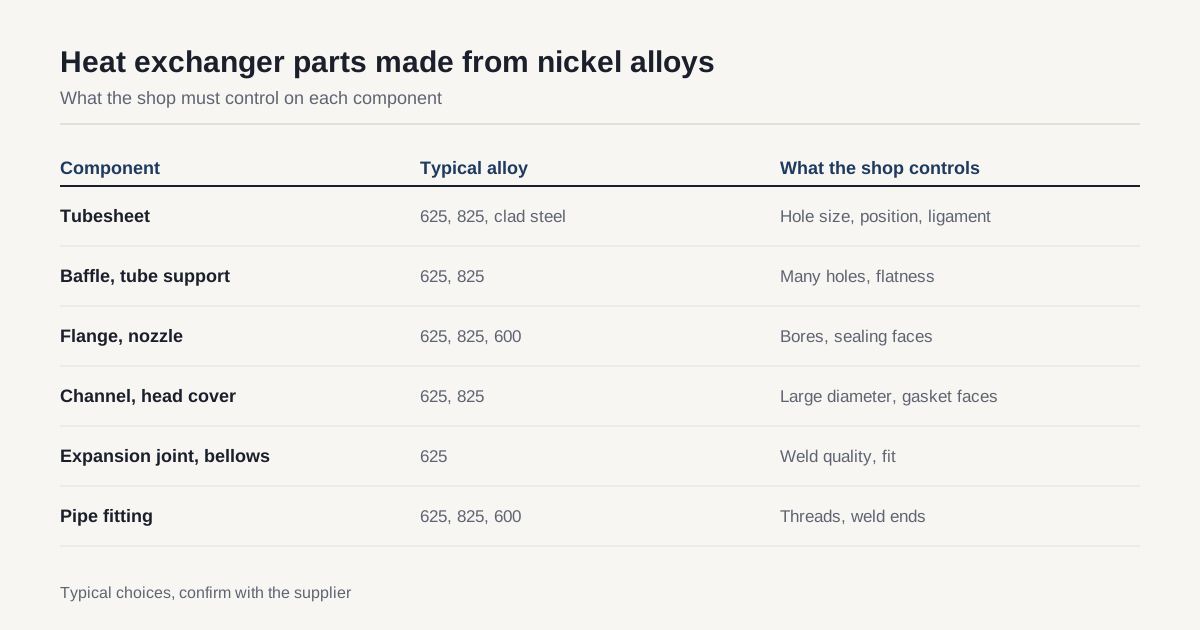
| Component | Typical alloy | Typical form | What the shop must control |
|---|---|---|---|
| Tubesheet | 625, 825, clad steel | Thick plate or forging | Hole size, position, ligament, flatness |
| Baffle and tube support | 625, 825 | Plate | Many holes, flatness, stack drilling |
| Flange and nozzle | 625, 825, 600 | Forging or plate | Bores, sealing faces, bolt pattern |
| Channel and head cover | 625, 825 | Plate or forging | Large diameters, gasket faces |
| Expansion joint or bellows | 625 | Formed and welded sheet | Weld quality, fit |
| Pipe fitting | 625, 825, 600 | Forging, bar | Threads, welding ends |
Tubes themselves usually come from tube mills in standard sizes, so a machine shop rarely makes them, but it makes the parts that hold and connect them.
Tubesheets in detail
A tubesheet is a thick plate, commonly 25 to 150 millimeters, drilled with a pattern of holes that hold the ends of the tubes. It seals one fluid from the other, so holes must be accurate, and the metal between adjacent holes, called the ligament, must be thick enough to stay strong. A bundle may have a few hundred to over a thousand tubes, so one tubesheet carries that many deep holes.
The challenge is deep drilling in a work-hardening alloy. Drills wear quickly, and in deep holes they can wander off line, narrowing the ligament to less than the minimum allowed. Shops use rigid drilling machines, carbide or indexable drills made for deep holes, high-pressure coolant and tool-life limits. Holes are then reamed or finish-bored to the tube fit, and many designs add grooves for expanded joints. Industry standards such as those from the Tubular Exchanger Manufacturers Association (TEMA) set hole size and ligament rules that the drawing will reference. Our note on drilling and tapping Inconel covers the general rules for holes.
Solid or clad
Solid nickel alloy tubesheets are costly because they are thick. A common alternative is a clad tubesheet, a carbon steel plate with a layer of nickel alloy on the side that meets the corrosive fluid. Cladding is done by explosion bonding, roll bonding or weld overlay. The shop drills through both layers and must control the bond line and the finish on the cladding face. If the drawing says clad, say which method, the thickness of the cladding and the base metal, because they affect machining and weld preparation.
Baffles, supports and flanges
Baffles and tube supports are thinner plates with many holes, which are stack drilled in a bundle to get the holes to line up. Flatness matters because a warped plate will not slide onto the tubes. Flanges and nozzles are machined from forgings or plate, with bores, raised faces, gasket grooves and bolt holes. Sealing face finish is specified, commonly in the range of Ra 1.6 to 3.2 micrometers for spiral-wound gaskets. Our page on achievable tolerances in Inconel shows what is realistic for diameters and flatness on large parts.
Tube-to-tubesheet joints
How the tubes are joined to the tubesheet decides what the holes must look like. In an expanded joint, a roller or hydraulic tool presses the tube against the hole wall, and the hole finish and diameter set the grip. Grooves cut into the hole add holding strength. In a welded joint, the tube end is welded to the face of the tubesheet, and the hole edge must be clean and square. Strength-welded joints and seal-welded joints have different prep. In many designs, both are used: the weld seals and the expansion adds strength. The drawing should state the joint type and any grooving, because a shop quoting plain holes will price a different job from one that cuts grooves and prepares weld faces.
Testing before shipment
Components often get tested at the shop or at the next stage of fabrication. Dimensional inspection checks hole size and position with gauges or a coordinate measuring machine, and for large patterns shops use pin gauges and templates. Penetrant inspection checks weld preparations and finished welds. Hydrostatic tests pressurize the finished exchanger with water, and they may happen at the fabricator and not the machine shop. Say who performs which test on the RFQ, since a missing test becomes an argument at delivery.
Size and temperature effects
Large nickel alloy plates and rings change size with temperature. A tubesheet a meter across grows measurably when it warms a few degrees, and it also moves when stress is released during machining. Shops handle this by roughing, letting the plate rest, finishing with light cuts and measuring in a stable room. If hole position tolerance is tight across a big plate, ask what temperature the dimensions apply at, which is normally 20 degrees Celsius, and ask each shop how it controls temperature during measurement.
Welding and fabrication
Most heat exchanger work involves welding. Tubes are welded or expanded into the tubesheet, shells and channels are rolled and welded from plate, and nozzles are welded on. Welds follow qualified procedures with matching filler metal. For machining, that means weld preparation edges, such as bevels and lands, must be cut accurately and kept clean, because dirt or oil on a nickel alloy edge causes weld defects. Our note on welding Inconel for buyers explains what to ask a fabricator. Many shops machine only, and the fabricator welds, so confirm who does what.
Materials, codes and documents
Plate, bar and forgings come under ASTM specifications such as B443 for 625 plate and B424 for 825 plate, with matching specifications for tube, pipe and forgings. Pressure vessels are designed under codes such as ASME Section VIII, which sets allowed materials, stresses and testing. Documents typically include mill certificates with heat numbers, material test reports and, for pressure parts, traceability of every piece to its heat. Positive material identification is common for nickel alloys, as our guide to mill certificates and PMI for Inconel explains.
Surface condition and cleaning
Process equipment must be clean, and nickel alloys must not pick up iron or contaminants that start corrosion. Shops use dedicated tools and brushes, avoid carbon steel contact and often pickle or passivate parts afterwards. Cutting oils and marking pens containing sulfur, chlorine or lead can cause cracking in later welding or heat treatment, so shops clean parts before any welding or heat treatment. If the equipment sees acids or chlorides, say so, and name the cleaning or passivation requirement on the drawing.
Cost and lead time
Solid Inconel tubesheets and flanges cost a great deal in material, and machining time is long, so clad plate is common. Lead time depends on plate and forging availability and on drilling time for large patterns. A tubesheet with a thousand holes can take days of machine time. Our guide to Inconel stock forms explains how form affects cost and lead time.
What to include on the RFQ
- Drawing with hole pattern, diameter, tolerance, ligament and flatness.
- Alloy, specification, form and whether the plate is solid or clad.
- Reference standard such as TEMA or the pressure vessel code.
- Weld preparation details and who performs the welding.
- Cleaning, passivation, inspection and certificate requirements.
- Quantity, size limits and schedule.
Closing checklist
Check that the drawing states alloy, specification and cladding, that the hole pattern has tolerance and ligament requirements and that cleaning and certificates are listed. When you are ready, send an RFQ and we match you with up to three shops that already machine nickel alloy plate and forgings. Ask each shop for the thickest plate it has drilled and the largest hole count.
Frequently asked questions
Which Inconel alloys are used in heat exchangers?
Inconel 625 is common where chlorides, seawater or high temperature are present. Inconel 825 suits sulfuric and phosphoric acid service. Inconel 600 and 690 are used for high-temperature water and steam generator tubing, and 800H or 800HT for hot hydrocarbon service. The process engineer picks the alloy from the fluids and temperatures.
What is a tubesheet?
A tubesheet is a thick plate drilled with a pattern of holes that holds the ends of the tubes in a shell and tube heat exchanger. It separates the fluid inside the tubes from the fluid outside. Holes must be accurate in size and position so tubes fit and seal and the metal between holes stays strong enough.
Why is tubesheet drilling difficult in nickel alloys?
A tubesheet can be 50 to 150 millimeters thick with hundreds of deep holes, and the alloy work-hardens and wears drills quickly. Drills tend to wander in deep holes, so spacing between holes can shrink below the allowed minimum. Shops use rigid machines, high-pressure coolant and drills made for deep nickel alloy holes.
Need a quote for this part?
Send the drawing. We match you with up to 3 Inconel-capable shops and reply within 24 business hours.
Get matched with an Inconel shop