Guides / Materials
Inconel X-750 vs 718: Which Alloy for Springs and High-Temperature Fasteners
October 25, 2026
Inconel X-750 and Inconel 718 look alike on a supplier’s list. Both are nickel-chromium alloys that harden by aging, both go into jet engines, nuclear plants and oil and gas equipment, and both machine with the same difficulty. They are not interchangeable. The question comes up most often with springs and fasteners, where each alloy has a clear job and a clear way to fail when it is used for the other.
The two alloys in brief
Inconel 718 (UNS N07718) contains roughly 52 percent nickel, 19 percent chromium, 18 percent iron, 5 percent niobium and 3 percent molybdenum, with small amounts of titanium and aluminum. Niobium forms the fine precipitates that harden it during aging. 718 is the most widely used nickel superalloy in aerospace because it combines high strength with good fabricability, including welding.
Inconel X-750 (UNS N07750) contains roughly 73 percent nickel, 15 percent chromium and 7 percent iron, with titanium, aluminum and niobium as the hardening additions. It is hardened by a different precipitate based on aluminum and titanium. X-750 is lower in strength than 718 but keeps its spring force and bolt preload better over long periods at temperature.
Our comparison of Inconel 625 and 718 places 718 among the other common grades. This article places it next to X-750.
Strength versus relaxation
Strength is the load a part can carry. Relaxation is the loss of load a part holds over time. A bolt tightened to a set preload at room temperature may lose some of that preload when it sits hot for months, and a spring compressed to a set height may lose force the same way. The loss is stress relaxation, and it is a creep process.
718 is stronger than X-750 at room temperature and at moderate heat. Its precipitates, however, are stable only to about 650 degrees Celsius for long exposures, and beyond that they coarsen, with a loss in strength. X-750 has lower peak strength but resists relaxation better, so a spring made from it keeps its force longer in a hot environment. For this reason X-750 is a long-standing choice for springs, hold-down hardware and similar parts in hot service.
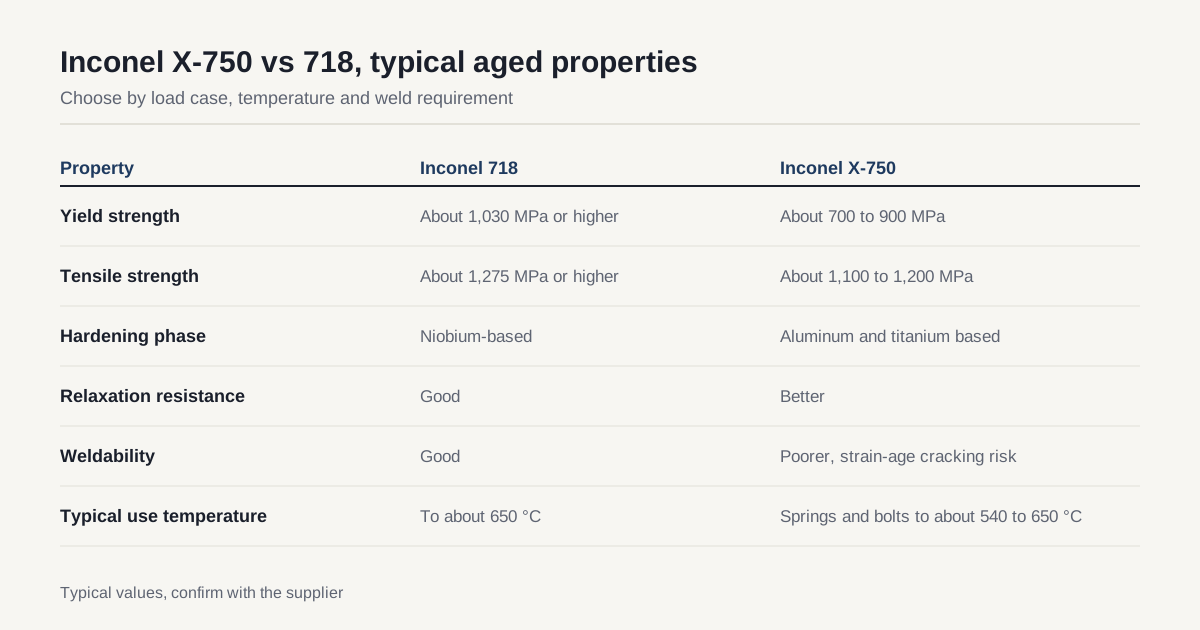
| Property | Inconel 718 | Inconel X-750 |
|---|---|---|
| Typical yield strength, aged | About 1,030 MPa or higher | About 700 to 900 MPa |
| Typical tensile strength, aged | About 1,275 MPa or higher | About 1,100 to 1,200 MPa |
| Hardening phase | Niobium-based | Aluminum and titanium based |
| Relaxation resistance | Good | Better |
| Weldability | Good | Poorer, strain-age cracking risk |
| Typical use temperature | To about 650 °C | Springs and bolts to about 540 to 650 °C |
| Hardness, aged | About 36 to 44 HRC | About 30 to 40 HRC |
Values are typical. The specification and the heat treatment decide what a given lot delivers.
Springs
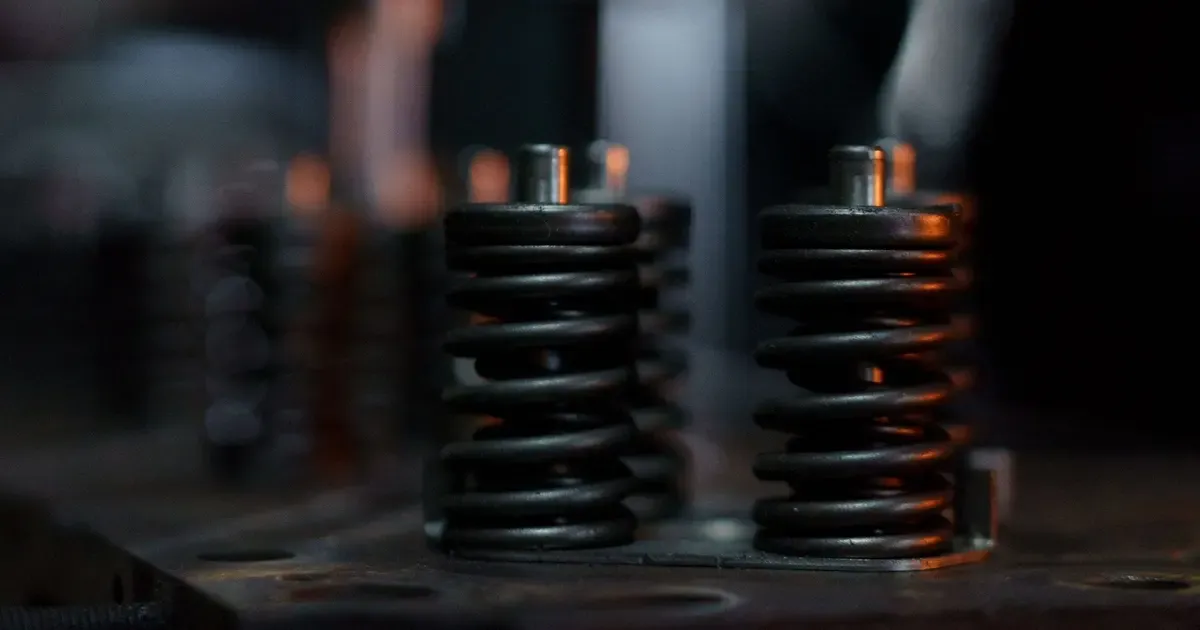
Springs are made from cold-drawn wire, coiled and then aged. Cold work raises strength before aging, and the age then locks it in. X-750 wire is available in spring temper and has a long record in valve springs, seals and nuclear hold-down springs. Spring makers set the age cycle with care, often a long soak at around 700 to 730 degrees Celsius, because spring force depends on both the cold work and the age.
718 springs are used where the load is high and the temperature moderate, such as in some downhole and aerospace mechanisms. The higher strength allows a smaller spring for the same force. If the spring runs hot and long, relaxation can eat that advantage. The choice belongs to the spring designer and the application engineer, not to the purchasing team.
Fasteners
Bolts, studs and nuts for high-temperature service come in both alloys. 718 fasteners are the common choice in aerospace, turbomachinery and downhole tools because of their high strength and wide availability. X-750 fasteners are chosen where preload retention matters more than peak strength, as in some hot flanges and nuclear service. The ASTM B637 specification covers precipitation-hardening nickel alloy bars and forgings, including both alloys, for moderate and high-temperature use.
For custom fasteners, the buyer and the shop both need the specification and the heat treatment. Our page on custom Inconel bolts, studs and nuts covers threads, galling and coatings.
Heat treatment is not interchangeable
718 uses a solution treatment followed by a two-step age, and the exact cycle comes from the specification. X-750 has its own cycles, which can include an equalizing or stabilizing step at high temperature before a long age, and the cycle depends on the form and the required properties. A shop that heat treats X-750 with a 718 cycle ends up with a part that does not meet either specification.
If you ask a shop to machine X-750, confirm that the heat treat route is stated on the drawing and who performs it. Our note on heat treatment sequencing for 718 shows how timing relative to machining works for 718, and the same principle applies to X-750 with a different cycle.
Machining
Both alloys are difficult to machine, for the reasons covered in our note on why Inconel work hardens. Aged 718 is harder than aged X-750, so it wears tools faster at the same speed. Both alloys punish tool dwell. In both cases, shops machine in the solution-treated condition when possible and finish after aging for tight tolerances. Expect similar cutting parameters and tooling, with speeds set by the shop’s tested values.
Weldability differs. 718 resists strain-age cracking and welds well. X-750 is prone to strain-age cracking, so welded X-750 assemblies need special procedures or are avoided. If your part includes a weld, that difference alone can decide the alloy.
Environment and corrosion
Both alloys resist oxidation and general corrosion well, and neither is the first choice for a severe chemical process. The environment still shapes the choice. In sour oil and gas service, the hardness of the finished part is limited by NACE MR0175 and ISO 15156, and 718 is usually capped near 40 HRC for that service, which affects the age cycle. In nuclear water service, X-750 has a long history in springs and hold-down hardware, though the temper and heat treatment matter for resistance to stress corrosion cracking, and nuclear specifications fix them. In hot air or exhaust, both oxidize slowly, and the choice turns on load and temperature instead.
Where each alloy shows up
| Application | Common alloy | Why |
|---|---|---|
| Aerospace bolts and studs at moderate heat | 718 | High strength, wide supply |
| Downhole tool fasteners | 718 | Strength and corrosion resistance, hardness capped |
| Valve springs and seal springs in hot service | X-750 | Relaxation resistance, spring-temper wire |
| Nuclear hold-down springs | X-750 | Long service record, qualified tempers |
| Turbine casing bolts under thermal cycling | Either | Depends on preload and temperature |
| Welded hot-section fittings | 718 | Resists strain-age cracking |
How to decide
Start with the load case. If the part carries a high load at room temperature to moderate heat and is not welded, 718 is the default. If it must hold a spring force or a bolt preload for a long time at a higher temperature, X-750 deserves a close look. Check the specification the design already uses, because an existing drawing or customer standard may fix the alloy. And ask the designer before asking the shop, since the shop quotes what the drawing says.
Cost and availability
X-750 is made in smaller volume than 718, so stock sizes are fewer and lead times can be longer. Spring-temper wire in particular may need to be ordered from a specialist mill. Price per kilogram is in the same broad range for both, and the difference between a quote and another is more often driven by form, certification and quantity than by alloy.
Documentation to ask for
Because the two alloys are easy to mix up in a stockroom, traceability matters. Ask for the mill certificate for each lot, showing the heat number, chemistry and mechanical properties, and for a statement of the heat treatment cycle that was applied. Positive material identification (PMI) with a handheld analyzer confirms the alloy on the finished part. Nickel content and the ratio of niobium to titanium separate the two quickly. Our guide to mill certificates and PMI for Inconel explains what each document proves.
For springs, request load testing at a stated height, and for critical bolts, request hardness and tensile results on the lot. These records protect the buyer if a field failure ever leads to questions about the material.
What to include on the RFQ
- Alloy and UNS number, with the specification such as an AMS or ASTM standard.
- Heat treatment condition and cycle reference.
- For springs: wire diameter, free length, rate and temperature of service.
- For fasteners: thread class, strength class and coating or lubricant.
- Test and certification requirements, including mill certificates and PMI.
Closing checklist
Check that the drawing names one alloy with a specification and heat treatment, that service temperature and load are stated, and that no substitution is assumed. When you are ready, send an RFQ and we match you with up to three shops that already machine nickel alloys. Ask each whether it has run both X-750 and 718 and how it handles the different heat treatments. For the full route from service condition to grade, read our guide to nickel alloy selection.
Frequently asked questions
Which is stronger, X-750 or 718?
Inconel 718 is stronger. In the aged condition it typically reaches yield strengths above 1,000 MPa, while X-750 usually sits at roughly 700 to 900 MPa depending on temper. X-750 is chosen when a part must hold its load over time at temperature, which is a different property from peak strength.
Why is X-750 used for springs?
Springs must keep their force under constant load and heat. X-750 resists stress relaxation well, so a spring made from it loses less force over time at elevated temperature. It is also available as spring-temper wire, which suits coiling. 718 is used for springs where higher strength matters more than relaxation.
Can I swap 718 for X-750 on an existing drawing?
Not without engineering approval. The two alloys have different strength, heat treatment, weldability and creep behavior, and the drawing or specification names one of them for a reason. Ask the design authority before accepting a substitute, even if both are Inconel.
Need a quote for this part?
Send the drawing. We match you with up to 3 Inconel-capable shops and reply within 24 business hours.
Get matched with an Inconel shop