Guides / Materials
Inconel Bar, Plate or Forging: How to Choose the Right Stock Form
October 19, 2026
Before a lathe or mill touches an Inconel part, someone decides what shape of raw metal to start from. A round bar, a flat plate, a ring or a forged blank can all end up as the same finished part, and the choice changes the price, the lead time and in some cases the strength. Buyers often leave this decision to the shop, but it belongs in the RFQ, because the stock form drives the quote.
The four common forms
Bar is a long length of round, hex or square section, made by hot rolling, forging or extrusion and then sometimes finished by peeling or grinding. It is the most common starting point for turned parts, shafts, pins, valve bodies and fasteners.
Plate and sheet are flat products. Plate suits flanges, tubesheets, brackets, rings cut by waterjet or laser and rectangular blocks. Sheet is thinner and is used mostly for fabrication.
Forgings are blanks shaped by hammering or pressing the hot metal. Open-die forgings are made between flat dies, closed-die forgings in shaped dies, and ring forgings by rolling a pierced blank into a ring. Forgings come close to the final shape and have grain that follows the contour.
Castings and near-net shapes are another route, but cast nickel alloys have different properties and specifications, and this article leaves them aside.
What the specifications say
Inconel 718 products have standard specifications. AMS 5662 covers solution-treated bar, forgings and rings, AMS 5663 covers bar, forgings and rings in the aged condition and AMS 5664 covers a second aged-condition product with its own heat treatment. AMS 5596 covers sheet, strip and plate in the solution-treated condition. Other alloys have their own, such as the ASTM B166 and B168 specifications for 600, 601 and 617 forms. Our guide to AMS specifications on Inconel drawings explains how to read them.
The specification fixes chemistry, mechanical properties, heat treatment, grain size limits and often ultrasonic inspection. A drawing that names the alloy but not the specification leaves the shop to guess the form and quality.
How the forms compare
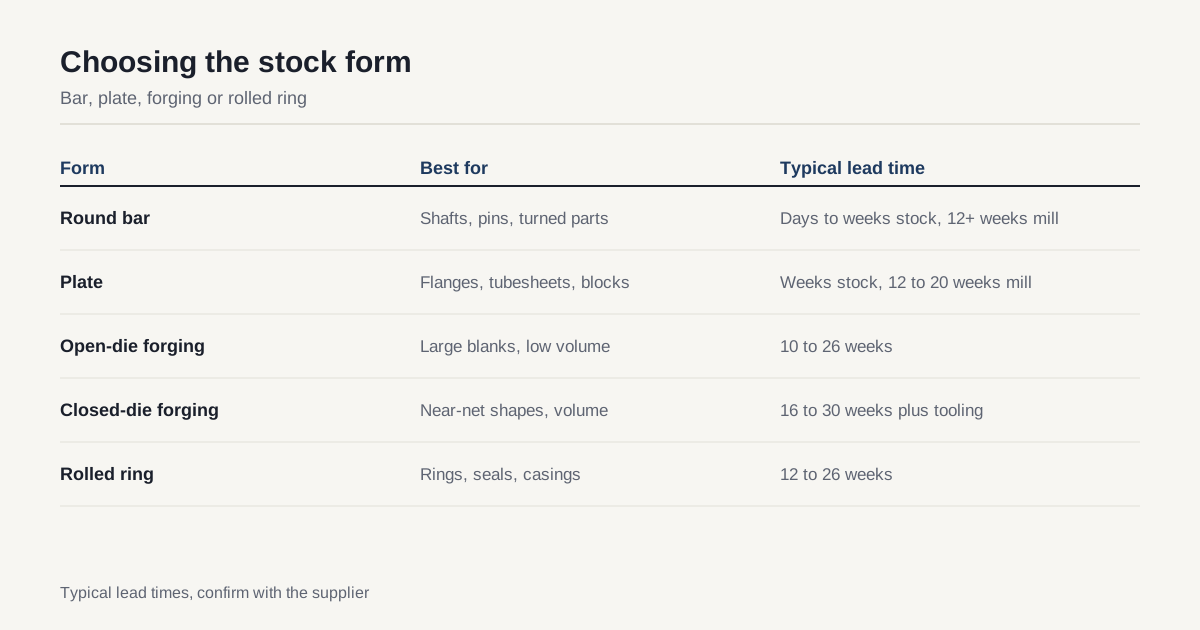
| Form | Best for | Typical lead time | Trade-off |
|---|---|---|---|
| Round bar | Shafts, pins, turned parts, small valve bodies | Days to weeks from stock, 12 weeks or more from mill | Much waste on shapes far from round |
| Plate | Flanges, tubesheets, brackets, blocks | Weeks from stock, 12 to 20 weeks from mill | Limited thickness, cutting cost for rings |
| Open-die forging | Large blanks, one-off or low volume | 10 to 26 weeks | Longer wait, minimum quantity at some mills |
| Closed-die forging | Higher volume, near-net shapes | 16 to 30 weeks, plus tooling | Die cost needs volume |
| Rolled ring | Rings, seals, casings | 12 to 26 weeks | Fixed diameter options |
These are typical ranges. Market conditions change them, so ask each supplier for a current date.
Waste, weight and the buy-to-fly ratio
The cost of metal depends on the weight bought, not the weight shipped. A ring cut from a solid round bar turns most of the bar into chips. A ring forging or rolled ring starts closer to the finished shape and wastes much less. The ratio of raw weight to finished weight is the buy-to-fly ratio, a term from aerospace. For simple turned parts from bar it can be 2 to 1 or higher. For complex parts it can reach 10 to 1 or more.
The price of metal per kilogram is only half the story. A forged blank that costs twice as much per kilogram may still be cheaper overall if it saves hours of roughing on a material that wears tools quickly. Our page on why Inconel 718 costs so much to machine explains how those hours add up.
A worked example
Take a ring with a 300 mm outside diameter, a 250 mm inside diameter and a height of 50 mm, made from Inconel 718, which has a density of about 8.19 grams per cubic centimeter. The finished ring weighs roughly 9 kilograms. Cut from a solid round of 300 mm diameter and 50 mm thick, the blank weighs roughly 29 kilograms, so about 20 kilograms of metal become chips, and the shop spends hours boring out the center. A rolled ring blank, with a little machining stock on every face, might weigh 14 or 15 kilograms and save most of that cutting. If the quantity is one piece, the solid blank may still win on lead time. If it is twenty, the ring is likely to win on cost. The point is to compare blank weight and machining hours, not just a price per kilogram.
Cutting and cut-to-size stock
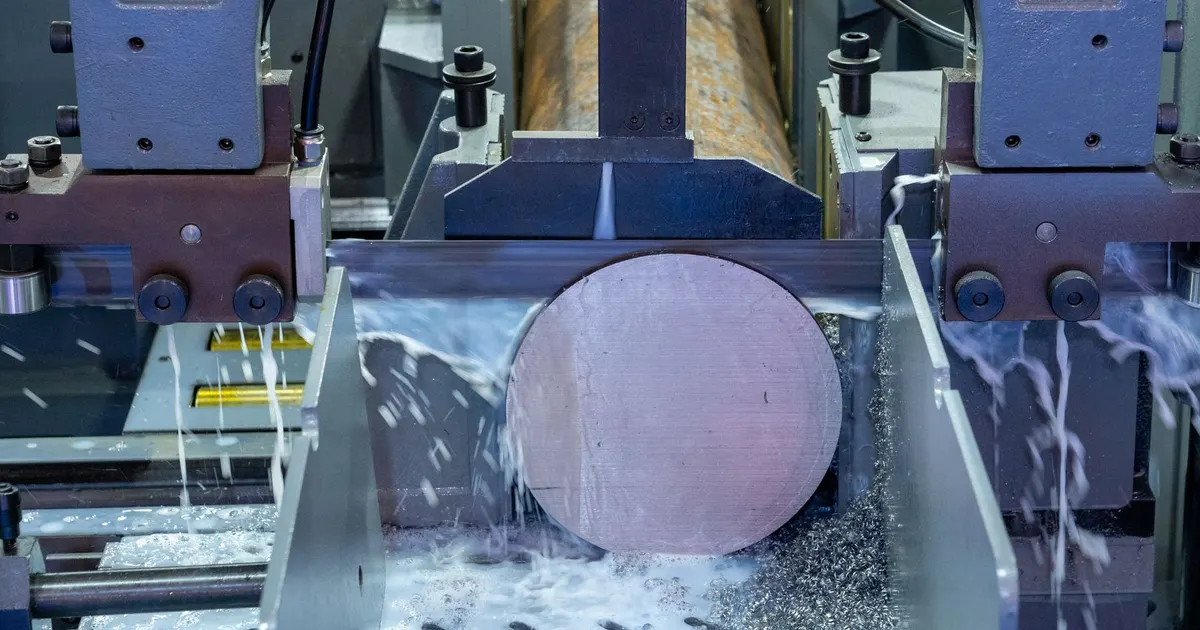
Most bar is sold in long lengths and cut to size. Band sawing is the common method, and sawing Inconel is slow, because the blade dulls quickly and the cut work-hardens. Distributors charge a cutting fee, and the shop may add a saw allowance on each end. When you quote small parts, ask whether the price includes cut pieces or full lengths, and how much stock is left over. Leftover bar from a one-off job can be useful on a later repeat order, if the heat lot is recorded and the certificate stays with it.
Grain flow and part strength
Strength depends on form as well as alloy. A forging has grain lines that follow the shape of the part, so a shaft with a collar has grain wrapping around the collar. A part machined from bar has grain running straight along the bar, and cutting the collar from a large bar cuts across the grain. For static parts the difference is minor. For rotating parts, parts under cyclic load and parts with sharp section changes, grain flow affects fatigue life, which is why aerospace drawings commonly call for forgings or rolled rings.
Large-diameter bar has its own concern. The center of a large bar cools and works differently from the outside, so properties and grain size vary across the section. Specifications set limits for this, and a rotating part from large bar often requires ultrasonic inspection of the stock.
Inspection of the stock
Ultrasonic inspection is the standard way to find internal flaws in bar, billet and forgings before machining. AMS 2154 sets classes of ultrasonic inspection for wrought metals, from stricter to looser, and the drawing or purchase order names the class. Rotating parts commonly call for the strictest classes. Buyers should state the class on the RFQ, since it affects the price and the supplier.
Mill certificates list the heat number, chemistry and mechanical test results, and many buyers also ask for positive material identification on the finished part. Our note on mill certificates and PMI for Inconel covers what to ask for.
Condition: solution treated or aged
Stock can be bought solution treated, aged or as hot rolled. Solution-treated bar is softer and easier to rough. Aged bar arrives at full hardness, which suits parts with tight tolerances that cannot see further heat treatment but wears tools faster. Many shops buy solution-treated stock, rough, age and then finish. Our page on heat treatment sequencing for 718 explains the choices. State the required condition at delivery, not only the alloy.
Thickness and size limits
Each form has practical size limits. Round bar is available in many diameters, but very large diameters cost more and are harder to get with uniform properties. Plate in nickel alloys is made in thicknesses up to a few inches, and thicker pieces are usually forged instead of rolled. Rings come in a range of diameters set by the mill’s rolling equipment. If your part is near the edge of what is available, tell the shops early, since a blank that is slightly too small leads to a scrapped order and one that is slightly too large adds weeks of cutting.
Minimums and availability
Mills sell in minimum quantities, often hundreds of kilograms per size, and stockists cut smaller pieces from larger stock at a premium. For small orders, the shop usually buys cut-to-length bar or plate from a distributor, with a cert. For large or special items, the shop or the buyer orders from a mill and waits. Ask each shop where it sources, whether the stock is on the shelf and how long it will hold a price.
What to include on the RFQ
- Alloy, specification and condition at delivery.
- Preferred stock form, or permission for the shop to propose one.
- Whether ultrasonic inspection of the stock is required, and to what class.
- Certificate requirements, including heat lot traceability.
- Quantity, and whether repeat orders are likely.
- Whether the buyer supplies the material or the shop buys it.
Closing checklist
Check that the drawing names the alloy, specification and condition, and say whether bar, plate or forging is required or open to proposals. Compare quotes on the weight of the blank as well as the price. When you are ready, send an RFQ and we match you with up to three shops that already machine nickel alloys from bar, plate and forgings.
Frequently asked questions
When should I choose bar instead of a forging?
Choose bar when the part is round or close to round, the quantity is small to medium and the load is not extreme. Bar is faster to buy and cheaper. Choose a forging when the part is large, carries a high load or rotates or when the shape is close enough to a forging that buying one removes a lot of machining.
Is plate cheaper than bar?
Per kilogram the two are usually close, and the difference depends on size and market. Plate suits flat parts, flanges and rectangular blocks, while bar suits shafts and round parts. The cheaper form is the one that wastes the least metal, so compare the weight of the blank, not the price per kilogram.
What does grain flow mean on a forging?
As a forging is shaped, the metal grains stretch along the part contour. Grain that follows the shape resists fatigue cracking better than grain cut across, as happens when a shape is machined from bar. For rotating or fatigue-critical parts, designers often specify forgings for this reason.
Need a quote for this part?
Send the drawing. We match you with up to 3 Inconel-capable shops and reply within 24 business hours.
Get matched with an Inconel shop