Guides / Process
Drilling and Tapping Inconel: How to Get Good Holes and Reliable Threads
October 11, 2026
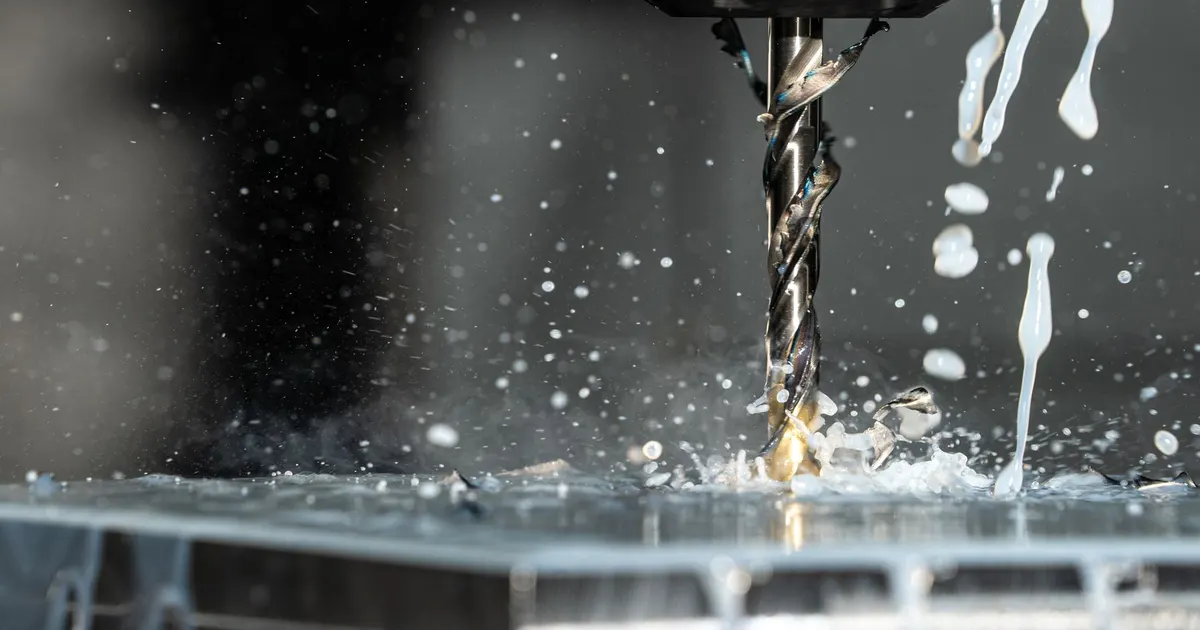
A drilled hole looks like the simplest feature on a drawing, and in Inconel it is often the one that causes the most scrap. The drill is buried in the cut, the chip has to leave through a narrow flute and the alloy hardens in front of every edge that stops cutting. Threads add a second risk, because a tap that breaks in a finished part cannot be repaired the way a broken drill in a plate can.
Why holes are harder than turning or milling
In turning and milling, the tool edge is at least partly in the open, where coolant can reach it and chips can fall away. A drill works inside the hole. Heat has fewer places to go, the chip has to travel back out along the flute, and any chip that jams raises torque and heat at once. Nickel alloys such as Inconel 718 and 625 also work-harden, so a drill that rubs at the bottom of the hole instead of cutting leaves a hardened floor, and the next revolution is harder than the last.
Our overview of why Inconel work hardens covers the material side. For drilling, the practical result is that the tool must always be cutting, the feed must be positive and steady and the tool must be sharp. Dull drills are the main cause of both broken tools and out-of-tolerance holes.
Choosing the drill
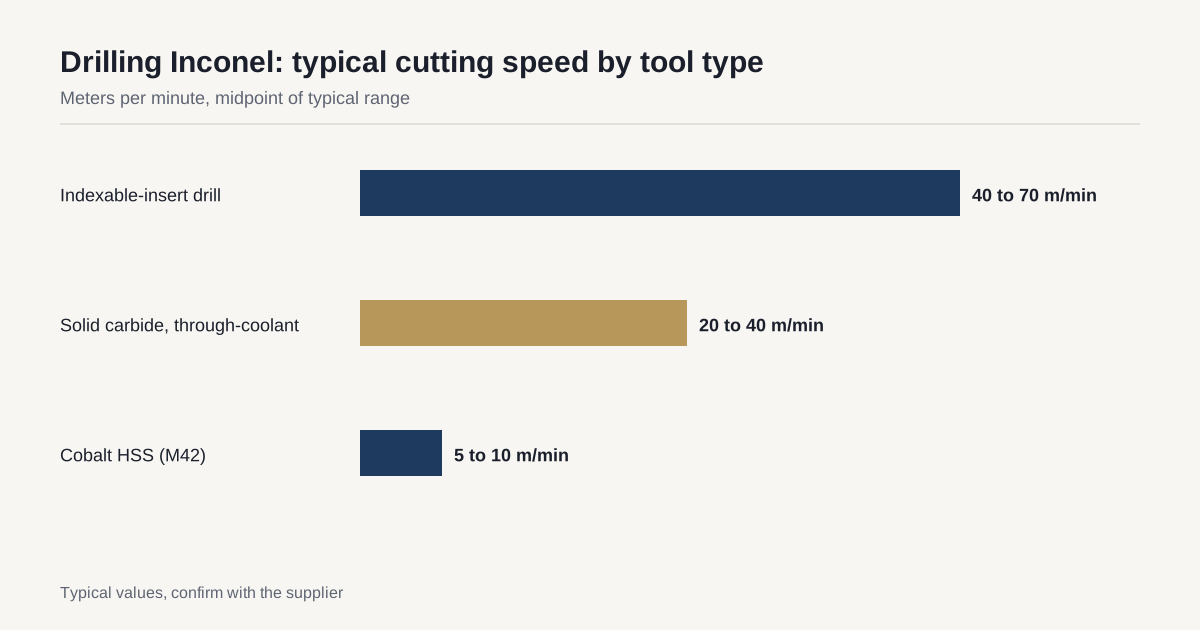
Three tool types show up on Inconel work. Solid carbide drills with through-tool coolant are the first choice for most holes up to about five diameters deep. They hold size well and run at higher speeds than steel drills, but they are brittle and need a rigid machine. Cobalt high-speed steel drills, such as M42 grade, tolerate vibration better and are common on older machines and manual setups, but they run at much lower speeds. Indexable-insert drills handle larger diameters and are common above roughly 16 mm.
Point geometry matters. A split point of around 135 to 140 degrees centers the drill without walking and reduces thrust. Through-tool coolant, delivered at high pressure, cools the edge and flushes the chip out of the flute. Peck drilling is avoided with carbide where possible, because each retract and re-entry is a chance to chip the edge. Where pecking is needed on a deep hole, shops use short, controlled pecks that clear the chip without breaking contact for long.
Typical drilling parameters
| Tool | Typical speed | Typical feed | Notes |
|---|---|---|---|
| Solid carbide, through-coolant | 20 to 40 m/min | 0.04 to 0.10 mm/rev for 6 to 12 mm | Keep depth under about 5 times diameter |
| Cobalt HSS (M42) | 5 to 10 m/min | 0.03 to 0.08 mm/rev | Flood coolant, sharp edge, no dwell |
| Indexable-insert drill | 40 to 70 m/min | 0.05 to 0.12 mm/rev | Large diameters, needs a rigid machine |
| Gun drill | Set by the tool maker | Set by the tool maker | Deep holes, special machine |
Treat these as planning ranges. Real values depend on alloy condition, machine and tool maker data, and a shop that runs Inconel every week will have its own tested numbers.
Hole quality: what you can expect
A drilled hole is a roughing step. A typical drilled hole in Inconel holds a diameter tolerance of a few hundredths of a millimeter and a surface roughness around Ra 1.6 to 3.2 micrometers. If the drawing calls for a tighter fit, a reaming or boring step follows. Reaming in nickel alloys needs the right amount of stock left, usually a few tenths of a millimeter, because too little makes the reamer rub and harden the wall.
Holes with a tight position tolerance are usually drilled on a stable five-axis or machining center, then finished in the same setup. Moving the part between machines adds error. For small holes in the range of 0.5 to 2 mm, particularly deep ones, EDM drilling is common. It avoids tool deflection and work hardening, but it leaves a thin recast layer on the wall that some specifications require to be removed or checked. See our comparison of EDM and CNC machining in Inconel for when each process fits.
Burrs need attention too. A burr at the exit of a drilled hole in a nickel alloy is hard and tough, and removing it by hand takes time. The drawing should state the edge break on hole entries and exits, for example 0.2 to 0.4 mm, so the shop plans for it.
Deep holes and small holes
Depth changes the method. Past about five diameters, a standard twist drill struggles to clear chips, and the cost of a broken tool rises with every millimeter already cut. Gun drilling uses a single-flute tool with coolant fed through the shank at high pressure, and it makes straight, accurate holes at depth ratios of 20 to 1 or more. It needs a dedicated machine or setup, so many general machine shops subcontract it. Ask any shop quoting a deep hole whether it drills in house or outside, because that affects lead time.
Very small holes are a separate case. Below about 1 mm, a carbide drill in Inconel breaks easily, and a single failure leaves a broken tip in the part. EDM drilling, which burns the hole with an electrode, is the usual answer for cooling holes, orifices and instrument ports. Position accuracy is good and there is no tool force, but the recast layer must be addressed if the part sees fatigue loading. A drawing that says whether recast is acceptable saves a round of questions.
Tapping versus thread milling
Cutting a thread in Inconel is where schedules slip. Three methods are in common use.
Cut tapping. A spiral-flute or spiral-point tap, usually with a nitrided or coated finish, cuts the thread in one pass. It is fast, but torque is high, chips can pack in blind holes and a broken tap is hard to remove. Shops use cut taps in nickel alloys at low speeds, with plenty of coolant and often at reduced thread engagement.
Form tapping. A forming tap displaces the metal instead of cutting it, so there are no chips. It works in some nickel alloys, especially in the softer solution-treated condition, and produces strong threads. It needs a precisely sized hole and a lubricant made for the job. It is less common on aged, high-strength material.
Thread milling. A small cutter orbits in the hole and cuts the thread with light, interrupted passes. Torque is low, the cutter is cheap compared with the part and a broken cutter is easier to extract. It adds cycle time, but most shops treat thread milling as the default for blind holes, large threads and any thread in a high-value part.
If you need a thread class, call it out on the drawing. For aerospace-style threads, a UNJ form with a controlled root radius is common, and a drawing should say so. Threads that carry load in fatigue should also say whether the thread is cut before or after aging, because the heat treatment can shift pitch diameter slightly.
Thread engagement and inserts
Full thread engagement is rarely needed. A thread engaged at roughly 65 percent of full depth carries almost the same load as a 100 percent thread but takes much less torque to cut. Many shops drill the tap hole slightly larger to get there. If the design needs full engagement, say so.
Where a thread is exposed to wear or repeated assembly, a coiled thread insert is often used. The insert is stainless steel or a nickel alloy, and the tapped hole is cut to the insert maker’s specification instead of a standard thread. Specify whether an insert is required and which type. Our guide to achievable tolerances in Inconel lists what is realistic for hole size and position.
What to specify on the drawing
A shop prices a hole by its diameter, depth, tolerance and finish, and a thread by its class, engagement and method. Missing information gets priced as the worst case. Include:
- Hole diameter, tolerance, depth and whether the hole is blind or through.
- Surface roughness and any special requirements for hole walls, such as no recast.
- Thread size, class, depth of full thread and whether inserts are allowed.
- Edge break at entries and exits, and whether burrs must be removed.
- The condition of the material when the hole is made (solution-treated or aged).
Closing checklist
Before you send the drawing, check that deep holes are flagged with diameter and depth, that threads carry a class and that any critical hole is marked so the shop plans a finishing step. Mention how many holes there are per part, because a part with 200 holes is a different job from one with four. When the drawing is clean, send an RFQ and we match you with up to three shops that already drill and thread nickel alloys. Shops with a proven process will usually answer with a method and a lead time for each hole type.
Frequently asked questions
Is it better to thread-mill or tap Inconel?
Thread milling is the safer method for most Inconel parts. A small milling cutter takes light cuts, and a broken cutter is easy to remove from a hole, while a broken tap usually scraps the part. Tapping is still used for through holes and low-value parts when the shop has a proven tap and a stable process.
How deep can you drill Inconel before you need a different process?
Solid carbide drills with through-tool coolant commonly handle depths of about five times the diameter. Beyond that, shops move to gun drilling, which is built for deep holes, or to EDM for small deep holes and for holes in hardened material. Quote depth and diameter together, because the ratio decides the method.
What thread engagement should I call out on an Inconel drawing?
Many shops reduce thread engagement to roughly 60 to 75 percent in nickel alloys because a full-depth thread needs far more torque to cut and gains little holding strength. If the part carries a fastener under load, the drawing or the design standard should state the required engagement, since the shop will not guess.
Need a quote for this part?
Send the drawing. We match you with up to 3 Inconel-capable shops and reply within 24 business hours.
Get matched with an Inconel shop