Guides / Materials
Waspaloy and Rene 41 Machining: The Harder Superalloys Compared With Inconel
October 28, 2026

Inconel 718 is the alloy most buyers know, and many shops treat it as the benchmark for difficult metals. Waspaloy and Rene 41 sit above it in temperature capability, and they sit above it in machining difficulty as well. Both are used in jet engine and gas turbine hardware that runs hotter or carries more load than 718 can handle. A shop that machines 718 daily is not automatically ready for them.
The two alloys
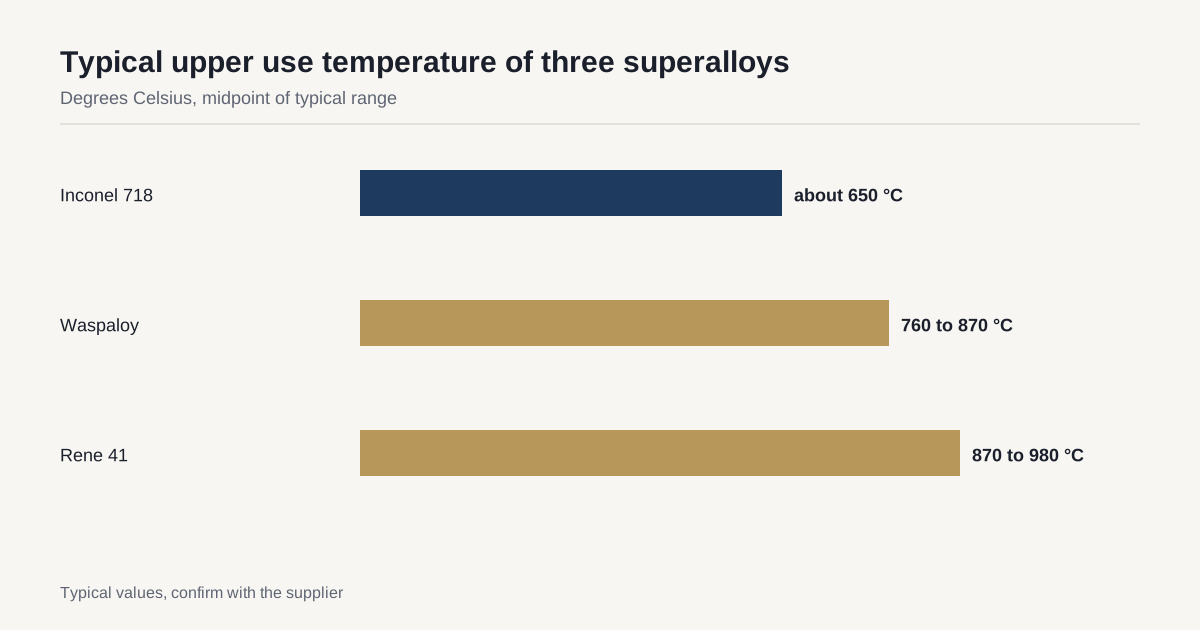
Waspaloy (UNS N07001) is a nickel-chromium-cobalt alloy with about 19 percent chromium, 13 percent cobalt, 4 percent molybdenum, 3 percent titanium and 1.4 percent aluminum. It is strengthened by gamma prime precipitates, small particles rich in nickel, aluminum and titanium that form during aging. It was developed for jet engine turbine disks and remains a standard alloy for rotating parts that run at up to roughly 760 to 870 degrees Celsius.
Rene 41 (UNS N07041, often written René 41) is a nickel-chromium-cobalt-molybdenum alloy with about 19 percent chromium, 11 percent cobalt and 10 percent molybdenum, plus higher titanium and aluminum than Waspaloy. That gives it a higher gamma prime content and strength at temperatures up to roughly 870 to 980 degrees Celsius. It appears in afterburner and exhaust parts, casings, rings, seals and bolts.
Both are hardened by gamma prime, unlike 718, which relies on a niobium-based precipitate. Our guide to Inconel 625 and 718 covers the more common grade, and this article covers what changes when you move up.
How they compare with 718
| Property | Waspaloy | Rene 41 | Inconel 718 |
|---|---|---|---|
| Hardening phase | Gamma prime | Gamma prime, higher fraction | Gamma double prime |
| Typical upper use temperature | About 760 to 870 °C | About 870 to 980 °C | About 650 °C |
| Typical aged hardness | About 36 to 42 HRC | About 36 to 42 HRC | About 36 to 44 HRC |
| Weldability | Limited | Poor, strain-age cracking | Good |
| Machining difficulty vs 718 | Higher | Higher still | Reference |
| Typical form | Bar, forging, ring | Bar, sheet, forging | Widest range |
Values are typical, and the specification sets limits for each lot.
What makes them harder to machine
Three features make Waspaloy and Rene 41 harder than 718 on tools. They hold a large share of their strength at the high temperatures reached in the cutting zone, so the force on the edge stays high. Their gamma prime precipitates are hard and abrasive, and in aged material they wear carbide quickly. And they work-harden strongly, so a rubbing cut leaves a hard skin. Our note on why Inconel work hardens explains the shared mechanism, and these alloys show it more strongly.
Tool life is shorter than on 718 at the same speed, so shops run lower speeds, change edges more often and budget more tooling per part. Typical cutting speeds with carbide fall in the range of 15 to 35 meters per minute, depending on condition. Ceramic inserts can rough solution-treated material at higher speeds on stable setups, as covered in our page on ceramic, carbide and cermet tooling.
Sequence of heat treatment and machining
Both alloys are normally machined in stages that follow the heat treatment. The solution-treated condition is softer and easier to rough. Aging then raises hardness and strength, and finishing follows, because aging causes small size changes and distortion. A typical Waspaloy cycle has a high-temperature solution treatment, a stabilizing step and a long age at a lower temperature, with times and temperatures set by the specification. Rene 41 has its own cycle.
The right sequence depends on the part. Parts with loose tolerances may be machined fully before aging. Parts with tight roundness, flatness or fit requirements are finish machined or ground after aging, with stock left for it. Our note on heat treatment sequencing for 718 explains the logic for 718, and the same principle applies to these alloys with different cycles.
Tooling and process choices
Shops that machine these alloys regularly share some practices:
- Rigid setups with short tool overhang to keep vibration out of the cut.
- Round or high-feed carbide inserts for roughing and sharp, fine-grain grades for finishing.
- High-pressure coolant to cool the edge and break chips, except with ceramics.
- Lower speed and light radial engagement in milling, with climb milling.
- Defined tool life limits, with edges changed before they fail.
- Grinding or EDM for features in aged material that cutting cannot reach economically.
Our comparison of EDM and CNC machining in Inconel shows when wire or sinker EDM is a better route for these harder alloys.
Typical parts and what each asks of the shop
| Part | Common alloy | What the shop must control |
|---|---|---|
| Turbine disk | Waspaloy | Grain flow, surface integrity, balance, ultrasonic-clean stock |
| Seal ring | Waspaloy or Rene 41 | Flatness, roundness, finish on sealing faces |
| Casing or frame | Waspaloy | Large diameter, distortion, bolt hole pattern |
| Afterburner or exhaust part | Rene 41 | Thin walls, welds, high-temperature oxidation |
| High-strength bolt | Waspaloy or Rene 41 | Thread form, root radius, heat treatment before threading |
Each part type carries its own risks. A disk is a rotating, fatigue-critical part, so surface integrity and traceability dominate the quote. A seal ring is mostly about geometry, where flatness and roundness change with every clamp and temperature swing. A thin-walled afterburner part moves under cutting force and welding. Shops that have made the same kind of part before can explain these risks without prompting, and their quotes usually reflect them.
Choosing between them
You rarely choose between Waspaloy and Rene 41 yourself. The designer picks the alloy from temperature, load and life, and the drawing names it. The buyer’s task is to quote the named alloy and to catch substitution mistakes. If a stockist offers 718 as an equivalent, treat that as a design change that needs the design authority’s approval, since 718 loses strength above about 650 degrees Celsius and may fail a part that runs hotter.
Material supply and cost
Waspaloy and Rene 41 contain cobalt and molybdenum, which keeps raw material cost above that of 718, and the volumes made are smaller. Bar and forging stock may be available from a few mills only, and lead times can run to months for special sizes. Many aerospace parts are made from forged rings or disks with controlled grain flow, ordered to a specification. Machining cost is higher than 718 because of slower speeds and higher tool use. Our guide to Inconel 718 pricing drivers covers the cost factors common to all of these alloys.
Material certificates, heat lot traceability and positive material identification are normally required, and rotating parts often call for ultrasonic inspection of the stock.
Lead time planning
Lead time on these alloys is set by material more than by machining. A standard bar size may ship from a distributor in a few weeks, while a forged ring or disk made to a customer specification can take months, because the mill schedules it with other nickel orders. Machining then adds weeks for roughing, heat treatment, finishing and inspection, and heat treatment and testing at outside vendors add queue time of their own. Ask each shop for a schedule that separates material arrival from shop time, and for an update the moment a mill date changes. A buyer who plans material early often saves more calendar time than one who pushes the shop to cut faster.
Welding and forming
Both alloys are hard to weld because of strain-age cracking, where the weld area cracks during post-weld aging as stress releases. Rene 41 is especially prone. Designers either avoid welding or use special procedures, such as welding in the solution-treated condition and controlling the cooling and heat treatment that follow. If your part includes a weld, the weld procedure must be qualified for the alloy. Do not assume a shop that welds 718 can weld these alloys.
Documentation and traceability
Parts made from these alloys usually carry a heavier paper trail than general nickel parts. Expect to supply or receive mill certificates showing heat number and chemistry, heat treatment records for each stage, inspection reports including penetrant results and, where required, process records for special processes performed by outside suppliers. Because the work often falls under aerospace or turbine specifications, buyers should state the governing specification on the first RFQ, and ask whether the shop has worked to it before.
What to include on the RFQ
- Alloy name, UNS number and specification, with product form and condition.
- Heat treatment cycle, who performs it and the sequence relative to machining.
- Tolerances, finish and any surface integrity requirements.
- Inspection, including penetrant and ultrasonic testing, plus documentation needs.
- Quantity and any repeat order plans.
Closing checklist
Before you send the drawing, confirm the alloy and specification, state the heat treatment sequence and mark critical features. Ask each shop how many Waspaloy or Rene 41 jobs it has run and what tooling it used. When you are ready, send an RFQ and we match you with up to three shops that already machine nickel superalloys. The guide to high temperature nickel alloys compares the gamma prime grades above 718.
Frequently asked questions
What is Waspaloy used for?
Waspaloy is used in rotating and static parts that run hot and carry high loads, mainly in aircraft and industrial gas turbines. Typical parts are turbine disks, shafts, seals, rings, casings and high-strength fasteners. It keeps strength at temperatures up to roughly 760 to 870 degrees Celsius.
Is Rene 41 stronger than Waspaloy?
At very high temperature, yes. Rene 41 carries more of the strengthening phase and keeps useful strength in the range of about 870 to 980 degrees Celsius, where Waspaloy is near its limit. It is also harder to weld and form, so designers choose it where the temperature calls for it.
Should these alloys be machined before or after aging?
Most shops rough in the solution-treated condition, where the metal is softer, then age and finish. Aging changes size slightly, so tight features are finished afterward. The drawing and the heat treat specification set the sequence, and it should be stated on the RFQ.
Need a quote for this part?
Send the drawing. We match you with up to 3 Inconel-capable shops and reply within 24 business hours.
Get matched with an Inconel shop