Guides / Materials
Inconel Exhaust Components for Motorsport and Performance Cars: Parts, Alloys and Machining
October 20, 2026
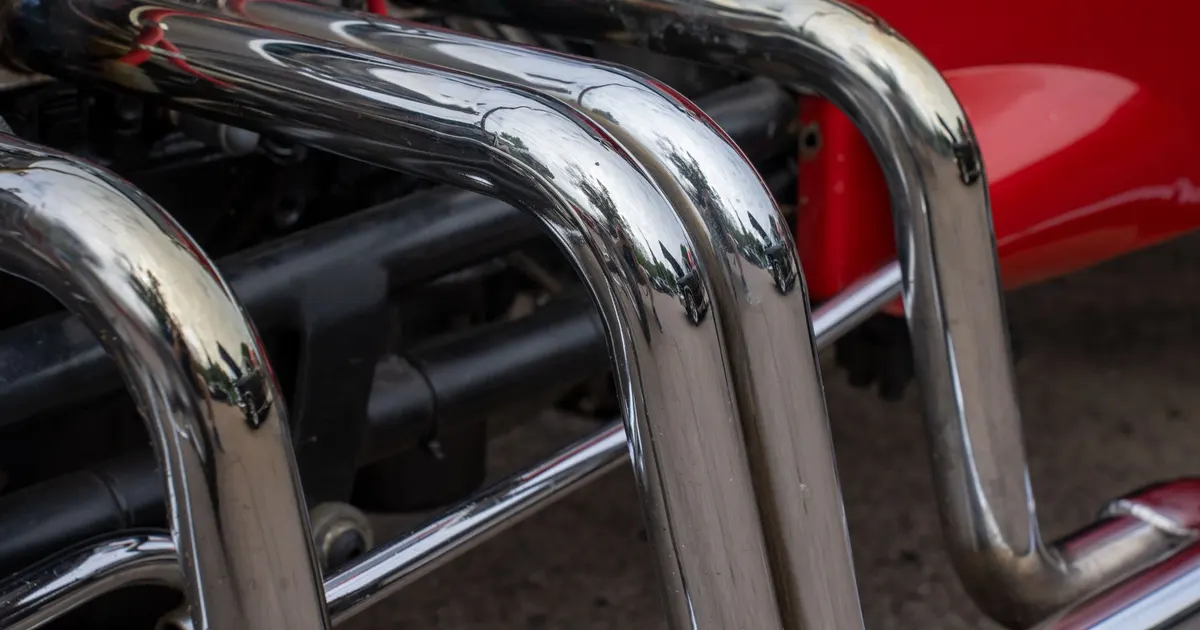
An exhaust system is a heat engine’s chimney, and on a turbocharged race car it is one of the hottest parts of the vehicle. Stainless steel, the normal material for road exhausts, starts to creep and crack when it sits near 900 degrees Celsius with repeated heating and cooling. That is where nickel alloys enter the picture. This guide explains which exhaust parts use Inconel, how they are made and what a buyer should tell a shop before asking for a quote.
Why exhaust parts need nickel alloys
Three conditions combine in a performance exhaust. Gas temperature is high, up to roughly 1,000 degrees Celsius in the manifold of a hard-driven turbo engine. The temperature cycles on every lift and every gear change, which fatigues the metal. And the gas is oxidizing and sometimes contains sulfur and unburnt fuel. Stainless steels such as 304 and 321 handle road use but lose strength quickly as temperature climbs, so builders who need thin, light walls move to nickel alloys.
Inconel 625 holds its strength and resists oxidation and thermal fatigue across the range an exhaust sees, and it welds well. That lets a team make a header from sheet only 0.5 to 1 millimeter thick and keep it intact through a season. The thin wall saves weight, and low weight high up on the car helps balance. Our guide to Inconel 625 and 718 compares the two grades most often found on race cars.
Which parts use Inconel
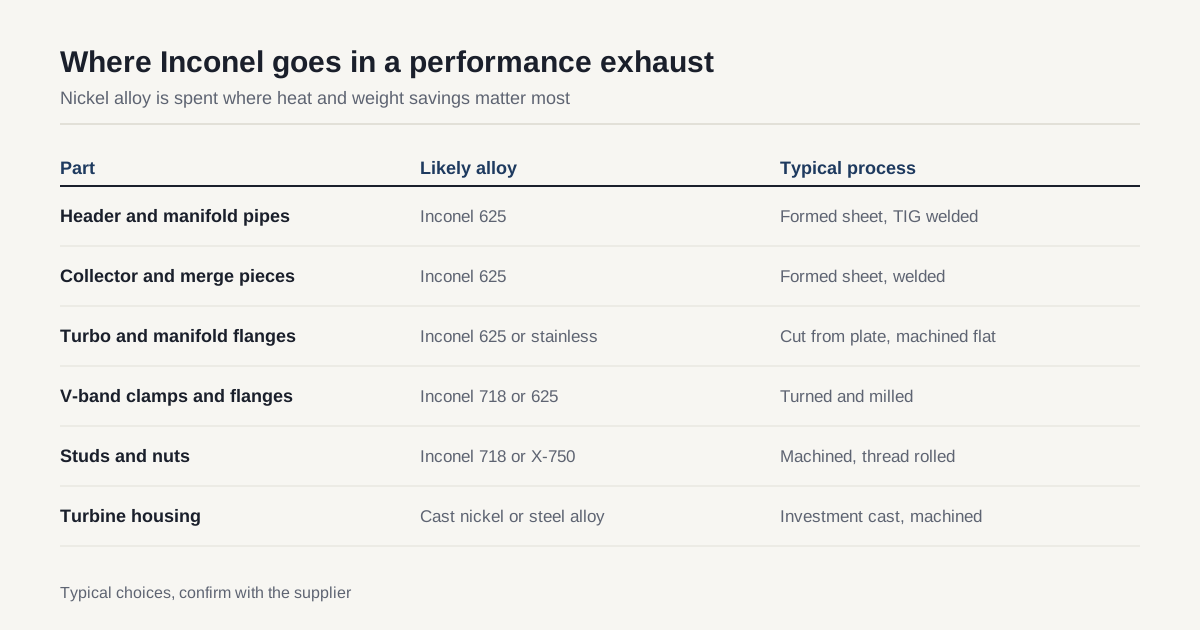
Not every exhaust part is made of Inconel. Teams spend nickel alloy where the temperature is highest and the weight saving is largest.
| Part | Likely alloy | Typical process | Notes |
|---|---|---|---|
| Header or manifold pipes | Inconel 625 | Sheet formed, bent or hydroformed, TIG welded | Thin wall, back-purged welds |
| Collector and merge pieces | Inconel 625 | Formed sheet, welded | Often hand-fabricated |
| Turbo and manifold flanges | Inconel 625 or stainless | Cut from plate, machined flat | Flatness matters for sealing |
| V-band clamps and flanges | Inconel 718 or 625 | Turned, milled | Strength at temperature |
| Wastegate parts | Nickel alloy | Machined | Wear and heat resistance |
| Turbine housing | Cast nickel or steel alloy | Investment cast, machined | Casting, not machined from bar |
| Studs and nuts | Inconel 718 or X-750 | Machined, thread rolled | Preload retention |
| Sensor bosses and bungs | Inconel 625 | Turned | Welded into pipes |
Cast turbine housings and wheels deserve a note. In many turbochargers they are investment cast in nickel alloys, so they are not machined from bar. Only the final features are machined. Additive manufacturing has also entered motorsport exhausts, with printed nickel alloy manifolds in some racing programs, which Inconel 625 and 718 suit.
Machining the parts
The machined parts in an exhaust are usually small and many are flat. Flanges are laser or waterjet cut from plate, then faced and drilled. Their sealing faces must be flat to a few hundredths of a millimeter, because a warped flange leaks and burns the gasket. Heat from welding distorts flanges, so shops often machine them after welding, or leave stock and finish them last.
Turned parts, such as bungs, V-band rings and wastegate components, follow normal nickel alloy practice: sharp carbide tools, steady feeds and no dwell. Our page on why Inconel work hardens covers the rules. Thin-walled parts need careful workholding, since a ring clamped too hard goes out of round when released.
Fabrication and welding
Most exhaust headers are fabricated, not machined. Sheet is rolled, bent or hydroformed into tube, cut and fitted, then TIG welded. Welding Inconel 625 uses matching or compatible filler and an argon shield, and the inside of the tube must be purged with argon, called back-purging, so the weld root does not oxidize. A poor purge leaves a rough, crystalline root that cracks in service. Our note on welding Inconel for buyers covers what to ask a fabricator.
A machine shop and a fabricator are often different businesses. Ask whether the shop will weld machined flanges to pipes, or only supply the flanges. Splitting the job adds a handoff and a fit-up step.
Material forms and specifications
Inconel 625 is sold as sheet, plate, tube, bar and forgings. Typical specifications include ASTM B443 for plate and sheet and ASTM B446 for bar, and AMS specifications for aerospace grade. Racing teams often buy by form and thickness without a formal specification, but a shop that wants a clear scope should name the alloy, the form and, ideally, the specification. Certificates and positive material identification confirm the alloy. Our guide to mill certificates and PMI explains what each shows.
Weight and design trade-offs
The weight saving from Inconel comes from wall thickness, not density. Inconel 625 weighs slightly more than stainless steel per volume, so the gain appears only if the wall can be thinner. A 304 stainless header may need 1.5 to 2 millimeters for durability, while an Inconel header can run at 0.5 to 0.8. Thinner walls bring their own problems. They dent more easily and vibrate and fatigue at the mounts, and they demand more careful welding. A designer weighs those points against the weight target, and a buyer who understands them can write a clearer RFQ.
Machined, fabricated or printed
There are three ways to make a complex exhaust part. Fabrication from sheet and tube is the traditional route, with the lowest tooling cost and the longest hand time. Machining from bar suits solid parts such as flanges, clamps and bosses. Additive manufacturing prints the whole manifold in one piece, with internal shapes that fabrication cannot reach, though it needs finishing: flanges are machined flat and bolt holes are cut after the part is printed and heat treated. Our note on machining 3D printed Inconel 718 explains the finishing steps for printed parts.
Choose by quantity and shape. A one-off header with a simple layout is cheapest fabricated. A complex manifold made in small batches may justify printing. A flange or clamp is a machined part in every case.
Fasteners, gaskets and sealing
Hot joints fail at fasteners and gaskets as often as at the pipe. Studs and nuts in nickel alloys such as 718 or X-750 hold preload at temperature better than carbon steel or most stainless, and they resist oxidation. Threads can gall when run hot, so anti-seize compound made for high-temperature use is standard. Gaskets in multilayer steel or graphite need a flat, smooth flange face, which loops back to the flange machining and flatness callout on the drawing. Our page on custom Inconel bolts, studs and nuts covers the fastener side in more detail.
Heat, discoloration and durability
Inconel exhausts change color with heat, from bronze to blue to dark gray, and the color tells you little about the part’s health. Cracks start at welds and at changes in section where thermal stress concentrates. Good design uses smooth transitions, support brackets with room for expansion and a slip joint or bellows where parts expand relative to each other. Fatigue life depends on both the alloy and the design, so a nickel alloy header with poor mounting will still crack.
Inspection and acceptance
Exhaust parts rarely come with a formal inspection package, but a few checks protect the buyer. Check flange flatness with a surface plate and feeler gauge before fitting, since a warped flange wastes a gasket and a race weekend. Check weld roots with a borescope where access allows, to confirm the back purge worked. Ask for dye penetrant inspection of welds on critical parts. And confirm the alloy with a handheld analyzer, because 625 and a look-alike stainless are easy to confuse once polished. A short written acceptance list, agreed before production, avoids arguments on delivery.
Cost and lead time
Inconel 625 sheet costs many times what stainless sheet does per kilogram, and thin-wall forming and welding are skilled work. A set of headers is therefore an expensive part, justified by weight saving and durability. Lead time depends on sheet availability and fabricator workload. Machined flanges and fittings are quicker, a matter of days to weeks if stock is available. Our guide on Inconel lead times shows how material arrival affects the schedule.
What to include on the RFQ
- Drawing or 3D model, and the part type: flange, fitting, header or collector.
- Alloy, form, thickness and any specification.
- Flatness and sealing-face finish for flanges.
- Welding and back-purge requirements, if fabrication is included.
- Quantity, including spares, and the competition schedule.
- Inspection needs, such as dye penetrant on welds.
Closing checklist
Check that the drawing names the alloy and thickness, that flange flatness and finish are stated and that welds and purge requirements are clear. Say whether you need machined parts only or a welded assembly. When you are ready, send an RFQ and we match you with up to three shops that already machine and fabricate nickel alloys. Mention your competition date so shops can answer with a realistic schedule.
Frequently asked questions
Why is Inconel used for race car exhausts?
Exhaust gas on a turbocharged engine can reach roughly 900 to 1,050 degrees Celsius, hot enough to weaken and crack stainless steel under thermal cycling. Nickel alloys such as Inconel 625 keep their strength and resist oxidation at those temperatures, so a thin, light wall lasts. The saving is weight and durability, at a higher material price.
Which Inconel alloy is typical for exhaust headers?
Inconel 625 is the common choice for formed and welded sheet headers and collectors. Inconel 600 and 601 appear in some heat-resistant fabrications, and 718 is used for machined and printed parts and fasteners where more strength is needed. The designer chooses the alloy based on temperature, thickness and weight targets.
Are Inconel exhausts legal on road cars?
The alloy is not the issue. Emissions, noise and inspection rules depend on the country and the vehicle, and replacing an exhaust can affect approval. Race parts are usually sold for competition use. Check local rules before fitting any aftermarket exhaust to a road vehicle.
Need a quote for this part?
Send the drawing. We match you with up to 3 Inconel-capable shops and reply within 24 business hours.
Get matched with an Inconel shop