Guides / Materials
Custom Inconel Bolts, Studs and Nuts: What to Specify When You Order
October 10, 2026
Fasteners hold hot, high-pressure and corrosive equipment together, and a failure in one often shuts down a whole line. When the service is too hot or too corrosive for steel or stainless, the answer is an Inconel fastener. Standard sizes in nickel alloys are limited and expensive, so many buyers end up ordering custom bolts, studs and nuts made to a drawing. This guide explains what to specify to get fasteners that fit, hold their preload and pass inspection.
Why use Inconel fasteners
Steel fasteners lose strength and oxidize at high temperature, and many stainless grades creep or corrode in aggressive fluids. Nickel alloys keep their strength at temperatures where steel gives up and resist corrosion in sour gas, seawater and chemical process streams. The grades used most for fasteners are Inconel 718, which is the strongest of the common ones, X-750 for hot service where preload retention matters, and 625 where corrosion resistance matters more than strength. Our comparison of X-750 and 718 for springs and fasteners explains how to choose between the first two.
Typical uses are flange bolting on hot or sour lines, turbine casings, wellhead and subsea equipment, high-temperature furnaces and exhaust systems. A stud and two nuts hold most flanges together, so a custom set is often a stud of a special length with matching nuts.
Fastener types and how they are made
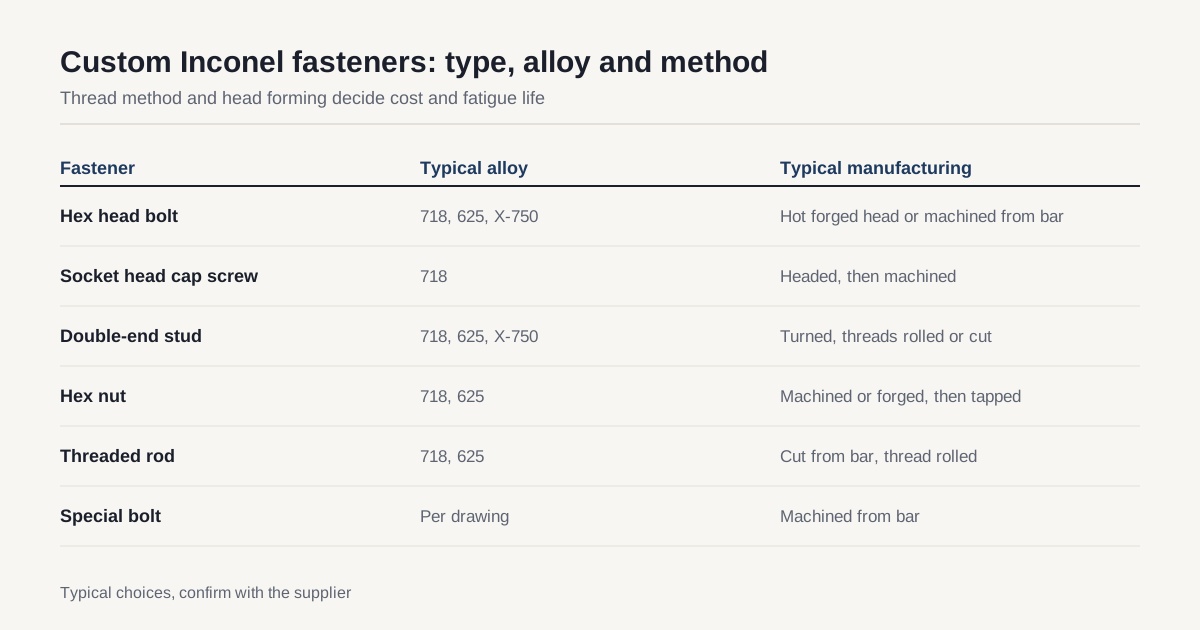
| Fastener | Typical alloy | Typical manufacturing | Notes |
|---|---|---|---|
| Hex head bolt | 718, 625, X-750 | Hot forged head or machined from bar | Forged heads have better grain flow |
| Socket head cap screw | 718 | Cold or hot headed, then machined | Head strength needs checking |
| Double-end stud | 718, 625, X-750 | Turned from bar, threads rolled or cut | Common for flanges |
| Hex nut | 718, 625 | Machined or forged, then tapped | Hardness and coating matter |
| Threaded rod | 718, 625 | Cut from bar, thread rolled | Cut to length by the user |
| Special bolt | Per drawing | Machined from bar | Low volume, high cost per piece |
Hot forging the head gives grain flow around the head-to-shank junction, which helps fatigue strength, but it needs tooling that pays off only at volume. For small batches, shops machine fasteners from round bar, accepting more waste and more machining time. Our guide to Inconel stock forms explains how bar compares with forging.
Threads: cut or rolled
Thread form and method matter more for fasteners than for most parts. Threads can be cut by turning or milling, or rolled by pressing hardened dies into the surface, which displaces metal into the thread form and leaves compressive stress at the root. Rolled threads give better fatigue life, and critical bolts commonly call for them, often after the final heat treatment so the compressive layer is preserved.
Aerospace and high-performance threads often use a UNJ or MJ form, which has a controlled, rounded root radius that reduces stress concentration. A standard UN form with a sharp root is more prone to crack from fatigue. If the bolt sees cyclic load, state the thread form and the method on the drawing. Our note on drilling and tapping Inconel covers the matching internal threads.
Galling and thread protection
Nickel alloys gall easily. Under the pressure of tightening, mating threads can weld together and tear, which ruins the fastener and sometimes the part it holds. A few practices reduce the risk. A nut and bolt of different hardness or alloy gall less than a matched pair. A silver plating or a dry film lubricant on the nut gives a low-friction surface. High-temperature anti-seize compound reduces friction and eases removal after heating. And smooth thread finishes lower the chance of tearing.
The drawing should say what coating or lubricant applies, because torque and preload depend on friction. A bolt tightened to a torque with a different lubricant from the one assumed in the design can end up with the wrong preload.
Heat treatment and strength
718 fasteners are usually supplied solution treated and aged, with a typical tensile strength of at least 1,240 megapascals for aerospace and high-performance grades. Sour service standards limit hardness, commonly to about 40 HRC for 718, so the final hardness may be lower than the maximum the alloy can reach. X-750 follows its own cycle. Our note on heat treatment sequencing for 718 explains how machining, thread rolling and aging fit together.
The sequence for a custom stud is typically bar in solution-treated condition, machining to size, aging and then final thread rolling or finishing, though specifications vary. State the heat treatment and the order on the drawing or reference the specification, so the shop does not guess.
Specifications and testing
Bar for fasteners is bought to a specification such as AMS 5662 or 5663 for 718, or ASTM B637 for precipitation-hardening nickel alloy bars for moderate and high-temperature service. Finished fasteners may need to meet a fastener specification from the customer, an oil and gas standard such as API 6A or a company standard. Testing normally includes hardness and tensile tests on the lot, and for critical parts may include stress rupture, microstructure and penetrant inspection of finished bolts. Our page on mill certificates and PMI for Inconel explains the paperwork.
Traceability matters. Each lot should be tied to a heat number and a certificate, and finished fasteners often carry head markings that identify the manufacturer and material. Say whether markings are required and how.
Preload, torque and fit
A fastener works by stretching slightly and clamping the joint with the force of that stretch, called preload. The preload a bolt reaches for a given torque depends on thread friction, so the lubricant or coating decides the result. Nickel alloy bolts have a lower modulus than steel, so they stretch a little more per unit load, which affects joint design but not the purchase. For the buyer, the practical point is to match the fastener and the installation procedure. If the joint design assumes one friction coefficient and the fasteners arrive with a different coating, the torque value will not deliver the intended preload.
Length and grip matter too. A stud that is too short leaves too few threads engaged in the nut, and one that is too long can bottom out. Drawings should give the overall length, the thread length on each end and the tolerance, and they should state whether the stud ends are chamfered or domed.
Nuts: hardness and fit
A nut must be hard enough to carry the thread load but not so hard that it damages the bolt thread. In nickel alloys, nuts are commonly made from the same alloy as the bolt, sometimes at a slightly lower hardness, or from a different alloy to reduce galling. A silver-plated or lubricated nut is common on high-temperature joints. Heavy hex nuts are common for flange work because they carry higher loads. State the nut style, grade and finish with the bolt, since a mismatched pair can fail even when each part is correct on its own.
Inspecting finished fasteners
Inspection of finished fasteners covers several checks. Thread gauges confirm the thread class, and go and no-go gauges are used in production. Dimensional checks cover length, diameter and head size. Hardness testing on a sample from each lot confirms the heat treatment, and tensile testing of sample bolts confirms strength. For critical fasteners, penetrant inspection looks for laps and cracks, and a microstructure check confirms grain flow in the head. Documents normally include a certificate of conformance and test reports. Our note on first article inspection for Inconel parts shows how a first lot is released before a larger run.
Cost and lead time
Custom fasteners cost more than their weight suggests. Setup, tooling, thread dies, heat treatment and testing are shared across the lot, so small orders are expensive per piece. Quantities of 50 to 500 pieces get far better pricing than 5. Lead time depends on bar availability, heat treatment and the test program. It ranges from a few weeks to a few months for large or tested lots. Our guide to Inconel lead times shows how those pieces add up.
What to include on the RFQ
- Drawing with diameter, length, thread form, class and pitch.
- Alloy, specification, condition and hardness limits.
- Thread method (cut or rolled) and when it is done relative to heat treatment.
- Coating, plating or lubricant on bolts and nuts.
- Lot testing, certificates, markings and traceability.
- Quantity and expected repeat orders.
Closing checklist
Before you request quotes, confirm that the drawing states thread form and class, alloy and condition, coating and testing. Check that matching nuts are included. When you are ready, send an RFQ and we match you with up to three shops that already make fasteners and threaded parts in nickel alloys. Ask whether each makes threads in house and which tests it can run.
Frequently asked questions
When do I need custom Inconel fasteners instead of catalog ones?
When the size, length, thread pitch, head style or material condition is not in a standard catalog. Common cases are special stud lengths, long grip bolts, fine pitch threads and flange sets made to a drawing. Catalog fasteners in nickel alloys are limited, and many buyers need a small batch made to order.
Why do Inconel threads gall?
Nickel alloys have a surface that welds easily to a mating surface under pressure and sliding, so threads can seize or tear when they are tightened. Shops and users reduce it with anti-seize compounds, plated or coated nuts, differences in hardness between bolt and nut and smooth thread finishes.
Are threads cut or rolled on Inconel bolts?
Both are used. Rolled threads, formed by pressing the thread into the surface, leave compressive stress and give better fatigue life, so critical bolts often call for them. Cut threads, made by turning or milling, suit small batches, special pitches and large diameters. The drawing or specification states which is required.
Need a quote for this part?
Send the drawing. We match you with up to 3 Inconel-capable shops and reply within 24 business hours.
Get matched with an Inconel shop