Guides / Materials
Inconel for Industrial Gas Turbines: Seals, Rings and Hot-Section Parts
October 13, 2026
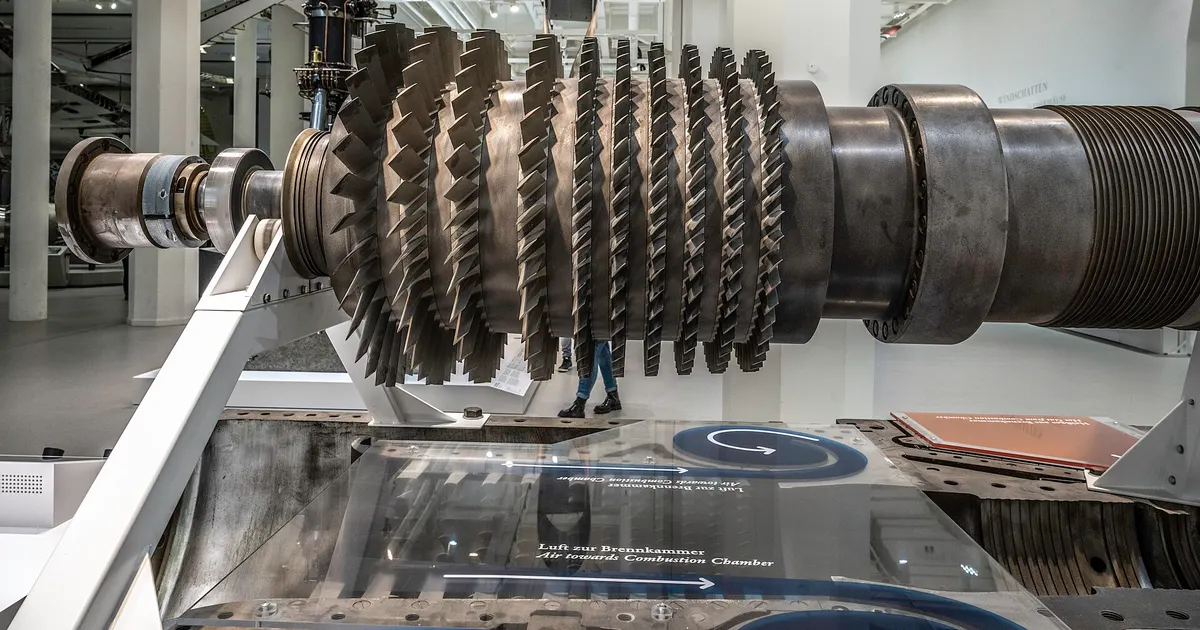
An industrial gas turbine burns fuel at high pressure and sends hot gas through rows of blades to turn a generator or a compressor. The gas leaving the combustor is far hotter than most metals can survive, so the hot section depends on nickel alloys, cooling air and coatings. Buyers of spare and replacement parts meet Inconel and related alloys in seals, rings, casings and combustor hardware. This guide explains the common parts, the alloys behind them and what to tell a shop before it quotes.
The hot section in brief
A gas turbine has three main sections. The compressor squeezes air, the combustor burns fuel in it and the turbine extracts energy from the hot gas. Metal temperatures are highest in the combustor and the first turbine stages. Gas there can exceed 1,200 degrees Celsius, well above the melting point of many alloys, so engineers use internal cooling air, thermal barrier coatings and nickel-based superalloys that keep strength at high temperature.
Industrial turbines run for tens of thousands of hours between overhauls, often at steady load, so creep, oxidation and fatigue are the failure modes designers manage. Replacement parts during overhauls create demand for machined components in nickel alloys.
Common parts and alloys
| Part | Typical alloy | Typical form | Machining note |
|---|---|---|---|
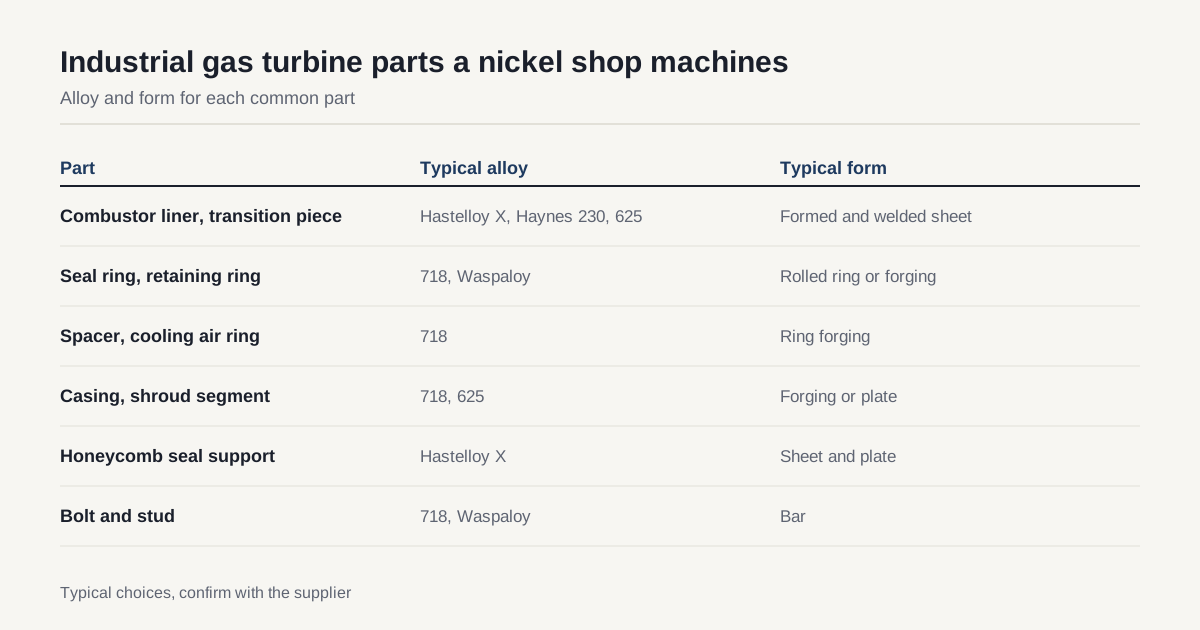
| Combustor liner and transition piece | Hastelloy X, Haynes 230, Inconel 625 | Sheet formed and welded | Fabrication with machined flanges and rings |
| Seal ring and retaining ring | Inconel 718, Waspaloy | Rolled ring or forging | Flatness, roundness, face finish |
| Spacer and cooling air ring | Inconel 718 | Ring forging | Many holes, balance |
| Casing and shroud segment | Inconel 718, Inconel 625 | Forging or plate | Large diameter, distortion |
| Honeycomb seal support | Hastelloy X | Sheet and plate | Thin walls, brazing prep |
| Bolt and stud | Inconel 718, Waspaloy | Bar | Thread form and fatigue |
Blades, vanes and nozzles are usually investment cast or forged in specialized alloys by dedicated makers, and they carry cooling passages and coatings that general machine shops do not produce. Seals, rings, casing sections, spacers, hardware and many flanges and support parts are where general nickel machining shops work. Our guide to Inconel in aerospace describes the related jet engine side.
Seals and rings
Seal rings and retaining rings sit between rotating and stationary parts and hold air or gas pressure. Typical features include flat or stepped sealing faces, knife edges, grooves and bolt holes. These are mostly turned parts, from rolled ring forgings or from forged blanks, made on vertical turning lathes for large diameters.
The key challenges are geometry and distortion. A thin ring clamped in a chuck springs out of round when released, and a ring that changes temperature changes size. Shops control this with soft jaws or expanding fixtures, light final cuts and measurement at a stable temperature. Our page on achievable tolerances in Inconel shows realistic numbers for roundness and flatness on rings.
Casings, spacers and supports
Casings and shroud segments are large, thick parts that surround the turbine stages. They are machined from forgings or plates and need accurate bores, flanges and bolt patterns. Spacers and cooling air rings route air inside the rotor, with many holes of different sizes and an accuracy that affects balance and flow. These parts are heavy and take many hours to machine, so shops with large machines and cranes are required.
Heat treatment fits into the sequence. Rough machining, stress relief or aging and finish machining follow a defined order, and our note on heat treatment sequencing for 718 outlines the logic for the most common alloy.
Combustor hardware
Combustor liners and transition pieces are fabricated from sheet in alloys such as Hastelloy X, Haynes 230 or Inconel 625, formed and welded, with machined rings and flanges at the ends. Machine shops make the machined rings, mounting parts and fittings and sometimes the whole assembly. Dimensional control after welding is hard because welding distorts thin sheet, so many assemblies are fixtured and checked on a coordinate measuring machine. Our note on welding Inconel for buyers explains what to ask a fabricator.
Replacement and reverse engineering
Many turbine parts are bought as spares during outages, often from a drawing, and sometimes from a worn sample when the drawing is unavailable. A shop can measure the sample, rebuild the nominal geometry and make a replacement, but the buyer takes on responsibility for fit and function. Rotating and fatigue-critical parts usually need approval from the turbine’s design authority, and warranty terms may restrict non-original parts. Check these points before ordering, since the shop cannot decide them for you.
Machine capacity and shop size
Large turbine parts demand large equipment. A casing ring of a meter or more in diameter needs a vertical turning lathe with enough swing and table capacity, and it needs cranes and handling that smaller shops do not have. Parts also weigh hundreds of kilograms, and one scrapped part wastes months of material lead time. Ask each shop for its largest machine swing and table load, and whether it has run parts of your size in nickel alloys. A shop with the right machine but no nickel experience may still struggle, and a nickel specialist with the wrong machine cannot start.
Balance and rotating parts
Parts that rotate with the rotor, such as spacers, seal carriers and disks, must be balanced, and the machining affects the balance. Holes and pockets cut for weight or flow need accurate position and symmetry, and machined faces must run true to the axis. Some drawings call for balance checks at the shop and others leave it to the turbine builder. State which applies, since balancing takes machine time and equipment. Our page on surface integrity in Inconel explains why finishing quality matters on rotating parts in particular.
Inspecting large parts
Large parts are measured with large tools. Coordinate measuring machines handle many parts, while portable arms and laser trackers reach those that do not fit. Roundness and flatness of rings are checked at a stable temperature, since a ring several hundred millimeters across grows noticeably with a few degrees of warming. Penetrant inspection of large surfaces takes time and floor space, and thick forgings may need ultrasonic checks before machining. Ask each shop how it measures parts of your size and whether it has the equipment on site or sends the part out.
Why the blank matters
Seals and rings from rolled ring forgings have grain that runs around the circumference, which suits parts loaded in hoop stress. Rings cut from plate or bar have different grain direction and can have lower fatigue strength in the loaded direction. The specification for the part usually names the blank form, and a shop should not swap it without approval. Our guide to Inconel stock forms explains how form affects strength and cost.
Coatings and surface treatments
Many hot-section parts carry coatings after machining. Thermal barrier coatings insulate the metal from the gas, and diffusion or overlay coatings resist oxidation. Masking protects surfaces that must stay bare, such as sealing faces and bolt holes, and coating adds thickness that machining must allow for. The drawing should state the coating specification, thickness and which surfaces are masked, and say whether finishing happens before or after the coating. A shop that machines the part should coordinate with the coating vendor, since a mistake in sequence can scrap the part.
Documentation
Hot-section parts come with substantial records. Typical requirements include mill certificates with heat numbers, heat treatment records, dimensional inspection reports, penetrant inspection results and process certificates from outside vendors. Our page on first article inspection for Inconel parts describes a typical release package. Name the documents you need on the first RFQ, because adding them later changes the price.
Cost and lead time
Large forged rings and casings take months to arrive from the mill, and they set the schedule. Machining is measured in days to weeks for large parts. Outage dates drive urgency, and buyers who plan material ahead of the shutdown save the most time. Our guide on Inconel lead times shows how the pieces of a schedule add up.
What to include on the RFQ
- Drawing, or a sample and measurement scope for reverse engineering.
- Alloy, form, specification and heat treatment.
- Flatness, roundness, finish and balance requirements.
- Coating, masking and sequence relative to machining.
- Inspection, certificates and records needed.
- Outage date and any approval required from the turbine’s design authority.
Closing checklist
Check that the drawing states alloy, form and condition, that critical tolerances are marked and that coatings and documents are listed. Confirm whether approval from the original manufacturer is needed. When you are ready, send an RFQ and we match you with up to three shops that already machine large nickel alloy rings and casings. For the temperature limits and coatings behind these parts, see our guide to high temperature nickel alloys.
Frequently asked questions
Which parts of an industrial gas turbine are made of nickel alloys?
Most of the hot section. That includes combustor liners and transition pieces, turbine nozzles and blades, disks, seal rings, retaining rings and casings in the hottest zones. The compressor and the cooler sections use steels and titanium. Nickel alloys such as Inconel 718, Waspaloy and Hastelloy X are common.
Can a shop make replacement parts for an existing turbine?
Often yes, from a drawing or from a worn sample measured and reverse engineered. The buyer is responsible for making sure the part meets the turbine's requirements and any warranty or regulatory terms. Rotating parts and fatigue-critical parts need special care and documentation, and some require approval from the turbine's design authority.
What tolerances do seal rings need?
Seal faces typically need flatness and finish held to a few hundredths of a millimeter or better, and ring diameters need roundness and concentricity controls. The tolerances come from the design, and the drawing states them. Large thin rings move when clamped or heated, so shops plan machining and measurement around that.
Need a quote for this part?
Send the drawing. We match you with up to 3 Inconel-capable shops and reply within 24 business hours.
Get matched with an Inconel shop