Guides / Cost
Inconel 718 Price per Kilogram: What Really Drives the Material Cost
October 18, 2026
Buyers who search for the price of Inconel 718 per kilogram are usually trying to answer one of two questions. Is the quote I received fair? And how much of the part cost is metal and how much is machining? The honest answer to the first is that no price list exists, because the price changes with the market, the form and the order. The second question can be answered with a few measurements and a clear view of what moves the price.
Why there is no fixed price
Inconel 718 is a specialty alloy made in a small number of mills against orders and stock programs. Unlike stainless steel, it is not traded in large spot volumes. Distributors quote from their own stock, from mill price lists and from current raw material costs. Two quotes for the same bar on the same day can differ because one distributor bought its stock months earlier at a different nickel price. That is why a quote carries a validity date, often only a few days.
As a general guide, 718 bar costs many times more per kilogram than 316 stainless, and the difference is large enough that blank weight matters on almost every part. Our page on why Inconel 718 costs so much to machine covers the other half of the cost, which is the machining time.
What is in the metal
Inconel 718 contains about 52 percent nickel, 19 percent chromium, 18 percent iron, 5 percent niobium and 3 percent molybdenum, with small amounts of titanium and aluminum. Nickel and niobium are the main cost drivers. Nickel trades on the London Metal Exchange and moves with global demand, and niobium prices are set mainly by long-term contracts from a few producers. Chromium and molybdenum add to the total.
Mills pass this on through an alloy or raw material surcharge, recalculated each month or quarter from the metal prices, and added to a base price for conversion. Distributors build their own margin on top. A rising nickel price therefore reaches your quote after a delay that depends on how much stock the distributor holds.
The cost layers
| Layer | What it covers | Typical effect |
|---|---|---|
| Raw materials | Nickel, niobium, chromium, molybdenum | Largest share, moves with markets |
| Melting | Vacuum melting, remelting for cleanliness | Higher for aerospace grades |
| Conversion | Forging, rolling, heat treatment | Higher for small and very large sizes |
| Finishing | Peeling, grinding, straightening | Higher for close-tolerance bar |
| Inspection and certs | Ultrasonic testing, test reports | Higher for rotating-grade stock |
| Distribution | Stocking, cutting, handling, margin | Higher for small cut lengths |
Melt practice and certification
Aerospace rotating grades are usually made by a double or triple melt route. A vacuum induction melt is followed by one or two remelting steps, which clean the metal and control its structure. Those extra steps cost money and show up in the price. General-purpose 718 for static parts may come from a single or double melt route at lower cost. The specification on the drawing decides which is required, so buying the cheaper grade for a rotating part is not an option, and paying for rotating grade on a static bracket is a waste.
Certification adds cost too. Ultrasonic inspection of the bar to a stated class, full test reports and heat lot traceability each add a small premium. Our page on mill certificates and PMI for Inconel explains what these documents cover.
Size, form and quantity
Price per kilogram changes with the shape of the product. Small bar diameters carry more conversion cost per kilogram, and cut-to-length pieces carry a cutting fee and handling. Very large bar and forgings cost more because of the heavy equipment and tighter inspection they need. Plate and ring forgings each have their own pricing. Our guide on choosing between bar, plate and forging explains how form affects both price and lead time.
Quantity matters twice. Mills have minimum orders, so small quantities come from distributors at a premium. And a longer cut-to-length order spreads the sawing and handling cost over more pieces.
Estimating the blank weight
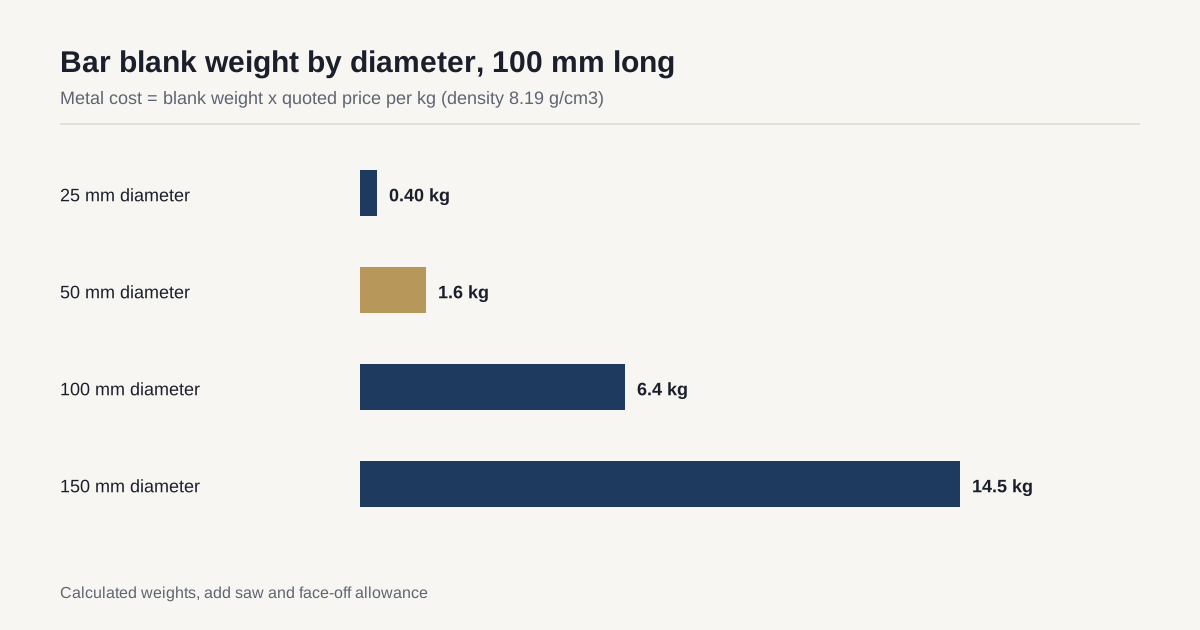
The most useful number to calculate is the weight of the blank. For a round bar, the weight in kilograms is about 0.0064 times the diameter in millimeters squared, times the length in meters, for a density near 8.19 grams per cubic centimeter. In practice, use a calculator and add allowance for the saw cut and face-off stock at each end.
| Bar diameter | Length | Approx. weight |
|---|---|---|
| 25 mm | 100 mm | 0.40 kg |
| 50 mm | 100 mm | 1.6 kg |
| 100 mm | 100 mm | 6.4 kg |
| 150 mm | 100 mm | 14.5 kg |
Multiply the weight by the quoted price per kilogram to get the metal cost of a blank, then compare it with the weight of the finished part. A part that weighs 0.4 kilograms from a 1.6 kilogram blank wastes three quarters of the metal, so a lower blank weight from a better stock form saves more than a small change in price per kilogram would.
Metal cost against machining cost
On a small, complex part, machining time usually costs more than the metal. A part that needs ten hours on a five-axis machine and weighs half a kilogram is mostly a machining quote. On a large, simple part, such as a heavy ring or a thick flange, metal is a large share, and a change in blank weight moves the total clearly. A useful habit is to ask each shop to split the quote into material, machining, inspection and finishing. The split shows where the price comes from and where a change in design or stock form can save money.
Cheaper metal does not always lower the total. A bar that arrives in the wrong condition or without the right certificate can cost far more than it saves, because the shop spends hours on rework or has to buy the material again.
Chips, scrap and recovery
Nickel alloy chips have real scrap value, and recyclers pay by alloy. Shops that machine large volumes of 718 sort and sell chips, and some pass part of the value back, though it seldom appears on a quote. If you supply the bar, ask for the chips back or a credit in writing. Mixed chips, contaminated with oil or other alloys, are worth less, so a clean, sorted process helps the shop recover value and, in turn, may keep its pricing sharper.
Timing the purchase
Because nickel moves with the market, timing affects price. A distributor with old stock may quote below current mill prices, while a shop buying fresh from a mill pays the current surcharge. For a project with a long schedule, ask the shop whether it can lock a material price when the order is placed, or whether the quote is subject to an alloy surcharge adjustment. A written statement of how material price changes are handled prevents disputes after the order ships. Our page on Inconel lead times for prototypes and production shows how material arrival fits into the schedule.
Why quotes differ between shops
Two shops can quote the same part with different material costs for good reasons. One may hold stock of the right diameter and the other must order. One may buy from a mill and the other from a distributor. One may include a premium for certified rotating-grade stock because it assumed the drawing needed it, while the other assumed general grade. When quotes differ widely, ask each shop what stock form, size and specification it assumed. The gap often closes after one email.
Controlling material cost
A few steps control cost without cutting quality. Name the specification clearly so every shop prices the same grade. Allow the shop to choose a stock size close to your part. Combine orders to reach a mill minimum. Avoid specifying certification beyond what the part needs. Consider supplying material only if you can buy it at a clear advantage, since material you supply can cause delays and dispute over responsibility if it fails inspection.
What to include on the RFQ
- Alloy, specification, condition and any required melt practice.
- Required certificates, ultrasonic class and traceability.
- Quantity and whether repeat orders are likely.
- Whether the shop supplies the material or you do.
- A request for the stock form, size and blank weight assumed in the quote.
Closing checklist
Before you compare quotes, confirm that each shop priced the same specification, form and certification. Ask for the blank weight and the machining hours separately. When you are ready, send an RFQ and we match you with up to three shops that already machine nickel alloys. We reply within 24 business hours, and each matched shop confirms its own material source and lead time.
Frequently asked questions
What is the price of Inconel 718 per kilogram?
There is no single price. Quotes vary with the nickel market, bar diameter, quantity, certification level and the supplier's stock. As a rule of thumb, 718 bar costs many times more per kilogram than 316 stainless steel. The only reliable number is a written quote for your size and quantity from a stockist or mill.
Why does a small bar cost more per kilogram than a large one?
Small-diameter bar needs more rolling and finishing steps for each kilogram, and distributors cut and handle it in small lots. Very large bar costs more for a different reason: it needs heavy forging and stricter inspection. Mid-range sizes from a stockist are often the cheapest per kilogram.
Does the buyer get credit for the chips?
Usually not. Nickel alloy scrap has real value, and shops or recyclers collect it, but quotes seldom show a credit. If you buy the material and supply it to the shop, ask whether the shop returns the chips or credits them.
Need a quote for this part?
Send the drawing. We match you with up to 3 Inconel-capable shops and reply within 24 business hours.
Get matched with an Inconel shop