Guides / Materials
Inconel Valve Components: Stems, Seats and Trim Parts and How They Are Made
October 24, 2026
Valves look like simple machines, but the parts inside them live in harsh conditions. A stem slides through packing thousands of times, a seat must seal against high pressure and the trim sits in the fluid itself, which may be hot, corrosive or full of sand. Nickel alloys such as Inconel earn their place in these parts. This guide covers which valve components use Inconel, how they are made and what a buyer should specify.
Where Inconel goes in a valve
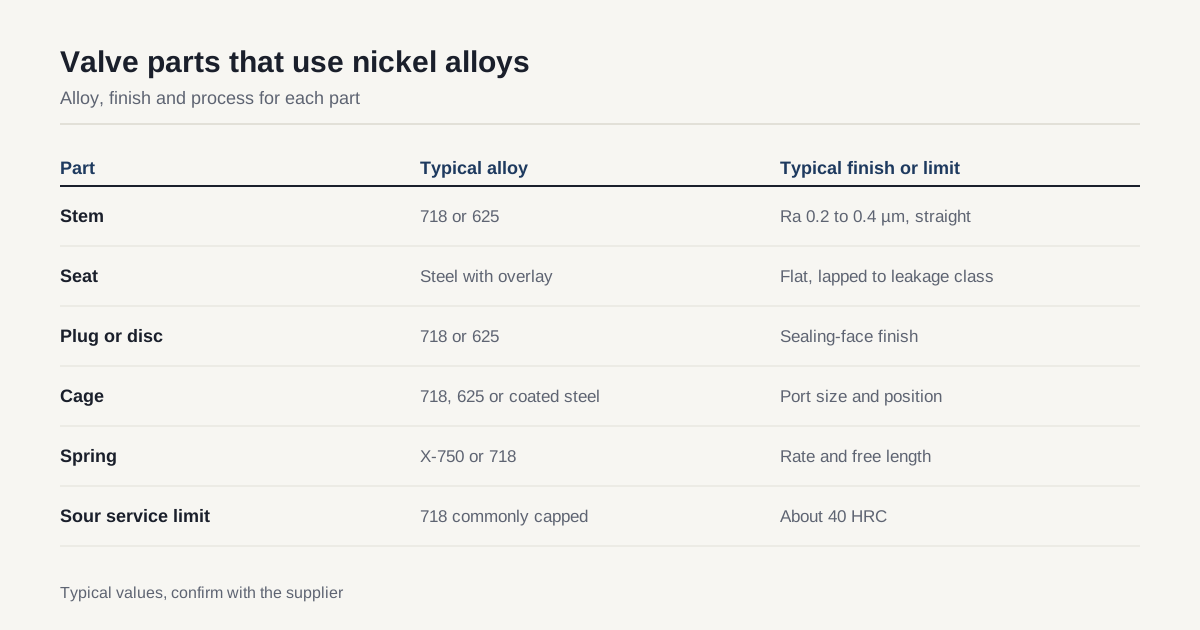
Valve makers rarely build the whole valve from nickel alloy, because it would cost too much. They use steel for the body and bonnet and spend nickel alloy where the fluid touches the metal or where strength at temperature is needed. The usual places are:
- Stems. The stem carries the load that opens and closes the valve and sits in the process fluid. Inconel 718 is common where high strength and corrosion resistance are both needed.
- Trim parts. Plugs, discs, cages and balls that sit in the flow may be solid nickel alloy or coated steel.
- Seats. Seats are often steel with a weld overlay of nickel alloy or a hard cobalt alloy on the sealing face.
- Body and bore overlays. An Inconel 625 weld overlay inside a steel body gives corrosion resistance in the wetted surfaces for a fraction of the cost of a solid body.
- Springs and fasteners. Hot service springs may be X-750 and bolts may be 718, as discussed in our note on Inconel X-750 vs 718.
Where these valves are used
Typical applications are oil and gas wellhead and subsea equipment, refinery and chemical processing, power generation and high-temperature steam or gas service. Sour oil and gas service, with hydrogen sulfide, drives much of the nickel alloy demand. Our guide to Inconel in oil and gas explains why these environments call for corrosion-resistant alloys.
Stems: long, slender and finished
A valve stem is a long round bar, often 15 to 30 times longer than its diameter. That shape is the difficulty. A slender bar bends away from the cutting tool, so shops use steady rests and follow rests, take balanced cuts and often rough, relieve stress and finish. Straightness is critical, because a bent stem binds in the packing and wears it out.
Typical steps are turning, thread rolling or cutting the drive end, then grinding or burnishing the packing surface to a fine finish, commonly in the range of Ra 0.2 to 0.4 micrometers. A rough stem tears the packing, and a scratched one leaks. Aged 718 is hard, so many shops rough in the solution-treated condition, age and then grind to size. Our note on heat treatment sequencing for 718 explains the logic.
Seats and sealing faces
A seat seals when two surfaces meet and hold pressure without leaking, so flatness and finish matter more than size. Seats are commonly made from steel with a hard overlay applied by welding, then machined and ground or lapped. The overlay can be a cobalt-chromium alloy for wear resistance or an Inconel 625 type for corrosion resistance, depending on the service.
After overlay, the seat is machined to size and then lapped against its mating part until the pair meets the leakage class in the applicable standard, such as API 598 or ISO 5208. Lapping is a hand or machine operation that takes skill. If a shop is making seats only, ask whether it laps them or hands them to the valve maker for final fit.
Sour service and hardness limits
Valves for sour oil and gas service must meet NACE MR0175 and ISO 15156, which set limits on hardness, heat treatment and cold work for nickel alloys. For Inconel 718, a common limit is about 40 HRC for sour wellhead service. That is lower than the 44 HRC an aged bar can reach, so the heat treatment is adjusted and the shop must be able to prove the final hardness. API 6A, which covers wellhead equipment, sets related material and testing rules for corrosion-resistant alloys.
If your valve part falls under one of these standards, put it on the drawing, along with the hardness limit and the test method. A shop cannot guess it, and a failed hardness test on a finished stem is an expensive surprise.
| Part | Typical alloy | Typical finish or tolerance | Process notes |
|---|---|---|---|
| Stem | 718 or 625 | Straightness within a small fraction of a mm, Ra 0.2 to 0.4 µm | Steady rest turning, grinding |
| Seat | Steel with overlay | Flatness and lapped finish | Overlay, machine, lap |
| Plug or disc | 718 or 625 | Sealing-face finish | Turning, grinding |
| Cage | 718, 625 or coated steel | Port size and position | Milling, EDM |
| Spring | X-750 or 718 | Rate and free length | Coil and age |
Control valve trim and erosion
Control valves, which throttle flow instead of simply opening and closing it, use trim parts that face harder duty. Fluid at high velocity erodes surfaces, and a drop in pressure across the trim can cause cavitation or flashing that pits metal. Plugs, cages and seat rings in these valves are often made from hard or hardfaced alloys, and sometimes from solid nickel alloys where corrosion is also present. Cages carry many ports, and these are cut by milling or by EDM, because drilling hundreds of holes in a hard alloy is slow. When you quote cage-type parts, state the port size, count and position tolerance, since those figures set the process.
Exhaust valves in engines
Engine exhaust valves are a separate case. Some high-performance engines use valves made from nickel alloys such as Inconel 751 or Nimonic grades, because exhaust valves run at very high temperature and see constant impact. These valves are normally forged and then machined, with a hardfaced seat and a hardened tip. The heat treatment and finishing are specialized, and the buyer should look for a shop with valve experience, not only nickel alloy experience.
Workholding for slender parts
Slender parts shift under the tool, and the best fixtures do not clamp them like short parts. A stem is usually held between centers or in a chuck with a tailstock, and a steady rest supports the middle. Cuts are balanced so that forces on one side are offset by the other. Between roughing and finishing, many shops let the bar rest or relieve stress, since residual stress from cutting bends the bar as it sits. For long stems, grinding between centers or centerless grinding gives the straightness and finish the packing needs. Ask any shop quoting long stems what its maximum length-to-diameter ratio is and how it holds straightness.
Wear, galling and coatings
Sliding parts in nickel alloys can gall, which means the surfaces weld together and tear. A stem running in a bushing of the same alloy is at risk, so designers pair different materials or add a surface treatment. Common choices include hard chrome plating, nitriding or a thermal spray coating on the stem, and a bushing in a dissimilar alloy. These treatments add steps after machining, and the drawing needs to state them, along with the coating thickness and finish after coating. A shop that machines the stem should know whether the coating goes on before or after final grinding, because that decides how much stock to leave.
Material specifications
Nickel alloy bar for valve parts is bought to the same specifications as other Inconel products, such as AMS 5662 and 5663 for 718 and ASTM B446 for 625. Oil and gas customers add the API and NACE requirements and often require material test reports, heat treatment records and hardness tests. Our guide to AMS specifications on Inconel drawings explains how these combine on a drawing.
Inspection and testing
Dimensional inspection of stems includes diameter, straightness, finish and thread. Seats need flatness and leakage testing, sometimes with the mating part. Material checks include hardness, positive material identification and, for critical parts, penetrant inspection. Our page on mill certificates and PMI for Inconel explains what these documents prove.
Cost and lead time
Slender stems cost more than their weight suggests, because of the grinding and straightening. Seats cost more than a plain turned part because of overlay and lapping. Lead time depends on bar availability, heat treatment and whether overlay is done in house. Repeat orders get cheaper once the shop has fixtures and a proven process.
What to include on the RFQ
- Drawing with straightness, finish and thread callouts on the stem.
- Alloy, specification and heat treatment, with hardness limits.
- For seats: base metal, overlay type, thickness and leakage standard.
- Service standards such as NACE MR0175, ISO 15156 or API 6A.
- Inspection, certificates and traceability needs.
- Quantity and expected repeat orders.
Closing checklist
Confirm that the drawing states alloy, heat treatment and hardness, that straightness and finish are stated for stems and that sealing faces carry flatness and leakage requirements. When you are ready, send an RFQ and we match you with up to three shops that already machine nickel alloy valve parts. Ask whether each has made slender stems and whether it laps seats in house.
Frequently asked questions
Which valve parts are usually made of Inconel?
Stems, trim parts exposed to the process fluid, springs and weld overlays on seats and body bores are the common ones. Whole valve bodies in solid Inconel exist but are rare and costly. Many valves use a steel body with a nickel alloy overlay in the wetted areas to get corrosion resistance at lower cost.
Why is there a hardness limit on Inconel in sour service?
Hardness and stress combine with hydrogen sulfide to cause cracking in some alloys. NACE MR0175 and ISO 15156 set limits on hardness and processing for nickel alloys in sour service, and 718 is commonly held to roughly 40 HRC. The limit changes the heat treatment, so state it on the drawing.
How straight does a valve stem need to be?
Straight enough that it moves through the packing without binding. Stem drawings usually give a straightness tolerance over the length, often a few hundredths of a millimeter per 100 millimeters, and a smooth finish on the packing surface. Long, slender stems need steady rests and a careful grinding or finishing step to hold it.
Need a quote for this part?
Send the drawing. We match you with up to 3 Inconel-capable shops and reply within 24 business hours.
Get matched with an Inconel shop