Guides / Materials
Inconel Rocket Engine Parts: Injectors, Manifolds and Chambers
October 22, 2026
A rocket engine burns propellants at pressures and temperatures that few metals survive, and it does so for seconds to minutes while pumps spin at tens of thousands of revolutions per minute. Nickel alloys such as Inconel sit at the center of the hardware that carries hot and high-pressure propellant. Commercial launch companies, research programs and test stand builders order these parts in small batches, with tight tolerances and heavy documentation. This guide explains the main part types and what shops need to know before they quote.
A note on scope and export control
This article covers civil, commercial and research liquid rocket hardware at a general level. It is not a design guide. Launch vehicle and missile hardware may fall under national export control rules, such as the US International Traffic in Arms Regulations (ITAR) or the Export Administration Regulations (EAR), and other countries have similar rules. The buyer is responsible for knowing the classification of the part and the drawing, and for telling the shop before any technical data is shared. Shops that cannot handle controlled work should say so early.
Where Inconel goes in a rocket engine
A liquid engine has a few main sections, and each uses nickel alloys differently.
- Injector. The injector sprays and mixes fuel and oxidizer in the combustion chamber. It is often made from Inconel 718 or 625, sometimes with copper or other alloys in the face.
- Manifolds and ducts. Propellant moves from the pumps to the injector through manifolds and lines, which are often 718 or 625 for strength and compatibility.
- Turbopump housings. Pump and turbine housings, volutes and inlets hold high-pressure, high-speed fluid and are commonly made from 718, cast or machined.
- Valves. Main propellant valves and igniters use nickel alloy bodies and trim.
- Thrust chamber and nozzle. The chamber wall that sees the highest heat is often a copper alloy liner for its conductivity, with an Inconel jacket or structural shell outside. Nozzle extensions use 625 and other high-temperature alloys.
Our guide on Inconel in aerospace describes the wider use of these alloys in flight hardware.
Injectors in detail
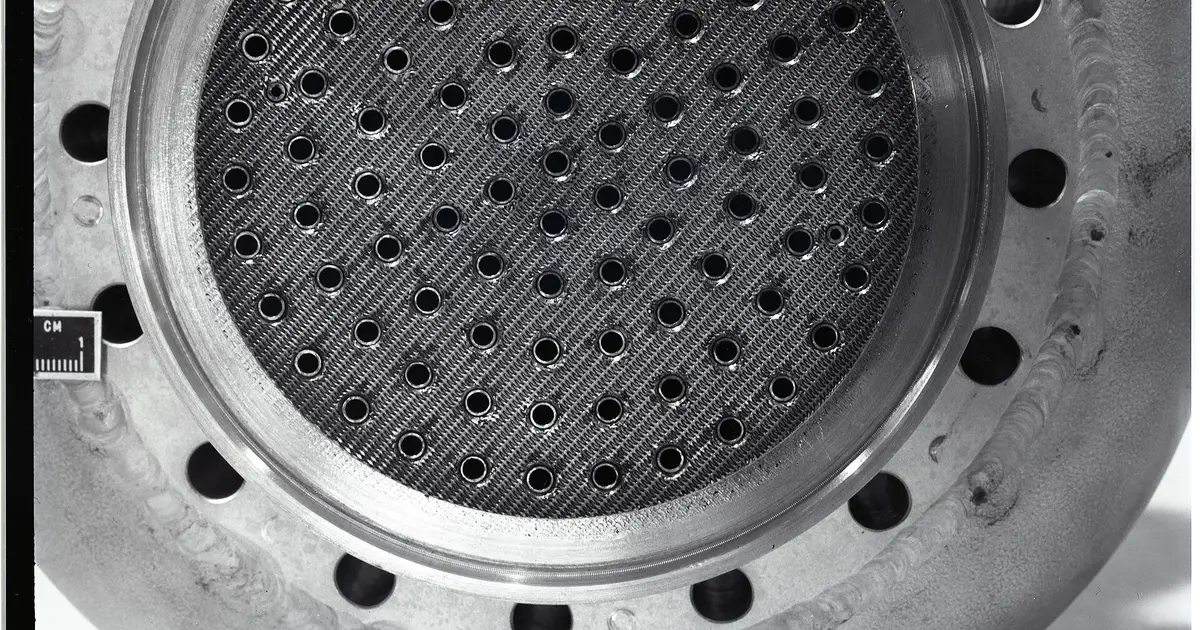
An injector is a plate or assembly pierced with many small holes, arranged in rings or patterns. Hole sizes are usually in the range of 0.5 to 2 millimeters, and tolerances on diameter run to hundredths of a millimeter. Hole angle and position set how streams collide and mix. Because combustion stability depends on uniform flow, every hole has to match the others closely.
Machining these parts is a mix of processes. The body is turned and milled, holes are drilled or cut by electrical discharge machining (EDM), and parts are joined by welding, brazing or electron beam welding. Additive manufacturing has become common for injectors and chambers in commercial launch, since it can build internal passages that machining cannot. Our note on machining 3D printed Inconel 718 explains how printed parts are finished.
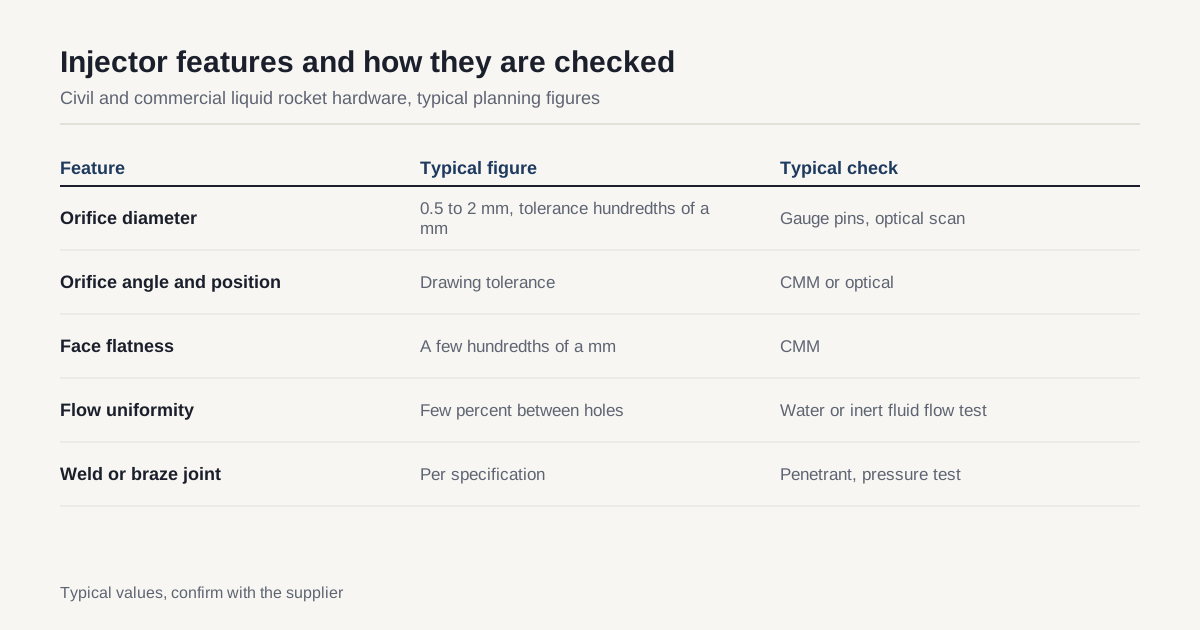
| Feature | Typical figure | Typical method | Check |
|---|---|---|---|
| Orifice diameter | 0.5 to 2 mm, tolerance hundredths of a mm | EDM or fine drilling | Gauge pins, optical scan |
| Orifice angle and position | Drawing tolerance | CNC or EDM with fixtures | CMM or optical |
| Face flatness | A few hundredths of a mm | Milling, grinding | CMM |
| Flow uniformity | Few percent between holes | Controlled by the process | Water or inert fluid flow test |
| Weld or braze joint | Per specification | Welding or brazing | Penetrant, pressure test |
These are typical ranges for planning. The design sets the real values.
Manifolds and chambers
Manifolds are machined from forgings or bar or printed, and they must hold pressure without leaking. Internal channels are drilled, milled or EDM’d, and cross-drilled holes have to meet cleanly. Chambers and jackets involve welding and brazing of nickel alloy shells to liners, with channels for coolant flow. Our page on welding Inconel for buyers explains what to ask a fabricator.
These parts carry high pressure loads, so wall thickness, weld quality and material properties are inspected and recorded. Typical checks include penetrant inspection, radiography or ultrasonic testing of welds, proof pressure tests and leak tests with helium.
Cleanliness and testing
Many rocket parts must be extremely clean. Oxygen is a common oxidizer, and traces of oil or particles can ignite in oxygen under pressure. Parts for oxygen service are cleaned to a specified level, often following practices such as ASTM G93 for oxygen-enriched environments, sealed in clean bags and handled with gloves. Shops that machine such parts use dedicated cutting fluids that can be removed completely, segregate their tools and keep records of cleaning. Ask whether the shop has done oxygen-clean work before.
Flow testing is another step that is rare elsewhere. An injector is tested with water or another inert fluid at set pressures to confirm that flow per element and total flow match the design. The test may be done by the shop, by the customer or by a third party, and the RFQ should say which.
Material and documentation
Inconel 718 and 625 are bought to the same AMS and ASTM specifications as other aerospace nickel parts, and rocket programs commonly add stricter requirements for traceability and testing. Expect requests for mill certificates, heat treatment records, inspection reports, process certificates for cleaning and welding and, in some programs, a data package for each serial number. Our guide to mill certificates and PMI for Inconel explains what these documents show.
Test hardware and flight hardware
Rocket programs build two kinds of parts. Test hardware goes on a stand, is fired many times and is often replaced after damage, so cost and speed matter most and documentation is lighter. Flight hardware flies once or a few times and carries a full data package for each serial number, with tighter inspection and more witness testing. A shop quoting for test hardware can use a lighter process than one quoting for flight hardware, and the price gap is large. Tell the shops which kind of part you are buying and whether it may be upgraded later. A part made as test hardware cannot always be converted after the fact, because records not kept at the time cannot be recreated.
Joining and the order of operations
Rocket parts are rarely made in one piece. A typical injector assembly combines a machined body, a face plate with holes, welded or brazed joints and sometimes a printed core. The order of operations matters. Drilling holes after welding risks distortion and blocked passages, and drilling before welding risks damage to the holes by weld spatter and heat. Heat treatment and brazing cycles change dimensions and must come before final machining of critical faces. Shops plan this sequence with the designer, and a drawing that leaves it open leads to surprises. Ask each shop to describe its proposed sequence on a part like yours and to point out any step where it would like design input.
Managing design changes
Early engines change often. A manifold drawn in one revision may be altered before the order is finished, and shops that have a clear revision control process handle this well. State the drawing revision on the RFQ and on the purchase order, ask the shop to flag any dimension that conflicts with another or with the model, and agree how changes after the order is placed are priced. A clear change process saves more time on a rocket program than any improvement in machining speed. Our page on writing an RFQ for Inconel parts lists the information a shop needs to quote correctly.
Quantities, schedule and cost
Rocket programs often order one to a few dozen parts at a time, and design changes between batches are normal. Setup cost is spread over few pieces, so unit prices are high. Programming, fixtures, special tooling and test fixtures all count. Lead time is dominated by material, especially forgings, and by outside processes such as heat treatment, cleaning and testing. Our guide to Inconel lead times explains how these pieces add up. Ask shops to flag any item that might change if the design revises.
What to include on the RFQ
- Drawing or model, after the export classification is settled.
- Alloy, specification, form and heat treatment.
- Tolerances on critical features such as orifices, faces and sealing surfaces.
- Cleanliness level and cleaning specification.
- Inspection, flow testing, proof testing and documentation needs.
- Quantity, serialization and expected design changes.
Closing checklist
Check that you know the export classification, that critical features are marked, that cleanliness and testing are specified and that documentation requirements are listed. When you are ready, send an RFQ and we match you with up to three shops that already machine nickel alloys. Say at the start whether the work is export controlled, so the shops that can take it answer.
Frequently asked questions
Which rocket engine parts are made from Inconel?
Injector bodies and plates, propellant manifolds, turbopump housings and ducts, valve bodies and some thrust chamber jackets and nozzles. Inconel 718 and 625 are the common grades. Combustion chamber liners that see the highest heat flux are often made from copper alloys instead, with a nickel alloy jacket outside.
Why are injectors so difficult to machine?
An injector face has many small holes that set how the propellants mix and burn. Each hole's size, angle and position affects performance, so tolerances are tight and every hole must be consistent. Holes are often made by EDM or fine drilling, then checked by flow testing, which is slow and requires a clean setup.
Are rocket engine parts subject to export controls?
They can be. Launch vehicle and missile hardware may fall under national export control rules, such as the US ITAR or EAR. The buyer is responsible for knowing the classification and for telling the shop up front. Some shops cannot or will not take controlled work, and that should be settled before drawings are shared.
Need a quote for this part?
Send the drawing. We match you with up to 3 Inconel-capable shops and reply within 24 business hours.
Get matched with an Inconel shop