Guides / Process
Grinding Inconel Parts: When Milling and Turning Cannot Hold the Finish
October 14, 2026
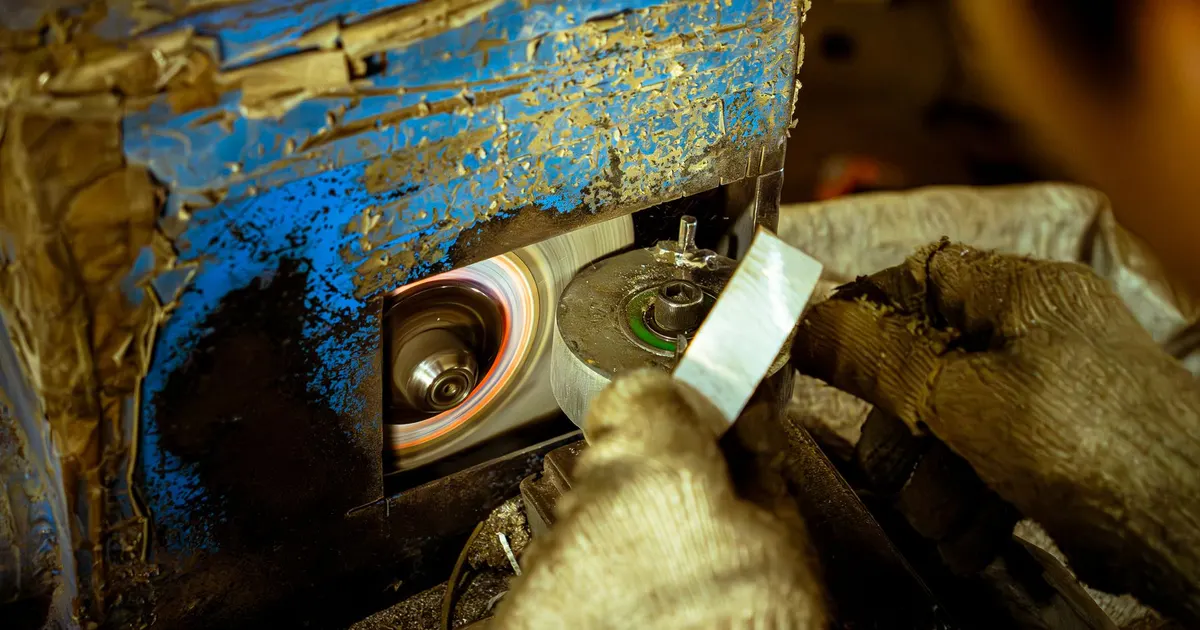
Most Inconel parts are made by turning and milling, and most never see a grinding wheel. Grinding enters the plan when the drawing asks for something a cutting tool cannot deliver: a tolerance of a few micrometers on a hardened surface, a mirror-like seal face or a profile that has to be finished after heat treatment. It is slower and more specialized than cutting, and it carries a risk that cutting does not, which is thermal damage to the surface.
When a drawing needs grinding
There are four common reasons a nickel alloy part is ground. The first is size: a fit that must hold within a few micrometers is easier to reach by grinding, because the wheel removes tiny, repeatable amounts of material. The second is surface finish. A sealing face, a bearing seat or a sliding surface often needs a roughness that normal finishing passes on a lathe do not reach. The third is hardness. After aging, Inconel 718 sits around 36 to 44 HRC, and finishing cuts that are slow and tool-hungry are sometimes faster to do by grinding. The fourth is geometry, such as the root forms of turbine blades and the faces of seal rings, where the profile is easier to produce with a shaped wheel.
If none of these applies, a good shop will tell you grinding is not needed, and that saves money. A drawing that specifies grinding by process when it only needs a certain roughness can force the shop into a slower method than necessary.
Why Inconel is hard to grind
Grinding turns a lot of energy into heat in a very small area. On steel, the part carries that heat away. Inconel conducts heat poorly, so the surface layer heats up fast and stays hot, and the grit tips dull and smear instead of cutting. Three problems follow:
- Wheel loading. Soft, gummy metal fills the wheel face and stops it cutting. The wheel then rubs, and temperature rises further.
- Grinding burn. The surface overheats, which can change the metallurgy in a thin layer and leave tensile residual stress under it.
- Cracks. In severe cases the surface forms fine thermal cracks that are invisible without inspection.
Our note on surface integrity in Inconel covers the metallurgy. In grinding, the point is that a surface can look bright and smooth and still be damaged underneath.
Wheels, coolant and parameters
Shops grind Inconel with three kinds of wheels. Conventional aluminum oxide wheels with an open structure and a soft grade handle general work, because the open structure gives chips somewhere to go. Ceramic-grain aluminum oxide wheels, which break down in a controlled way and expose fresh edges, handle heavier stock removal. Cubic boron nitride (CBN) wheels last much longer, stay sharp and run cooler, so they suit production runs and tight tolerances, at a higher wheel cost.
Coolant does real work in grinding. It lubricates the cut as well as cooling it, and many shops use straight grinding oil on CBN wheels because oil reduces friction better than water-based fluids. Flow, filtration and nozzle position matter, and a shop that treats coolant as an afterthought will struggle to hold a burn-free surface. Dressing the wheel often keeps it sharp. A dull wheel is the leading cause of burn.
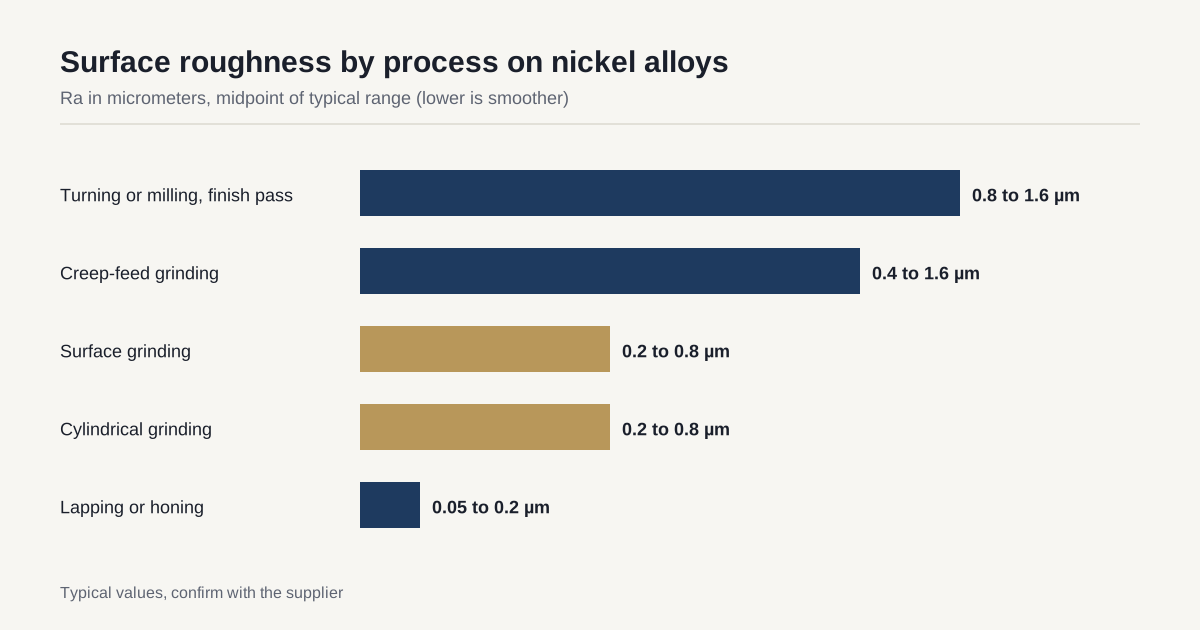
| Process | Typical tolerance | Typical Ra | Typical use on nickel alloys |
|---|---|---|---|
| Turning or milling, finish pass | 0.01 to 0.05 mm | 0.8 to 1.6 µm | Most features |
| Surface grinding | 0.005 to 0.01 mm | 0.2 to 0.8 µm | Flat faces, seal faces |
| Cylindrical grinding | 0.003 to 0.01 mm | 0.2 to 0.8 µm | Shafts, bearing seats |
| Creep-feed grinding | 0.01 to 0.02 mm | 0.4 to 1.6 µm | Deep profiles, root forms |
| Lapping or honing | 0.001 to 0.005 mm | 0.05 to 0.2 µm | Sealing faces, bores |
These are typical figures. Confirm real capability with the shop, and check whether the figures hold on your part geometry, since thin walls and long shafts move under grinding force.
Grinding methods in short
Surface grinding takes flat faces with a reciprocating or rotary table. Cylindrical grinding handles shafts and bores between centers or in a chuck, and centerless grinding produces round bar and pins in volume. Creep-feed grinding takes a deep cut at a very slow feed rate, which suits turbine blade root forms and other deep profiles in one pass. Jig grinding finishes precisely positioned holes. Each method has its own fixtures and operators, and not every shop has all of them.
Grinding or another finishing route
Grinding is not the only way to a good surface. Hard turning with a fresh ceramic or CBN insert can reach tight diameters on aged material at a lower cost per part, and a skilled operator may hold a tolerance without ever touching a wheel. Wire EDM cuts hardened profiles with no cutting force, though it leaves a recast layer that may need to be removed. Honing and lapping reach finishes that grinding cannot, and they are often the last step on bores and seal faces after grinding. Vibratory and abrasive-flow finishing improve the roughness of complex shapes where a wheel cannot reach.
The right route depends on geometry, quantity and surface requirement. A single prototype with one tight diameter is often cheapest to turn and then lap. A batch of 500 shafts with a bearing seat usually justifies cylindrical grinding with a CBN wheel. When you request quotes, ask each shop what route it proposes and why. Two shops may choose different methods for the same drawing, and the difference in price often traces back to that choice.
Controlling damage
Shops that grind nickel alloys for rotating or fatigue-loaded hardware follow a defined grinding practice. It usually fixes wheel type, dress interval, stock removal per pass, coolant and a finishing sequence that takes light final passes to remove any damaged layer. Many aerospace drawings call for a spark-out pass and a check for thermal damage after grinding. The check method depends on the alloy and the customer specification, so name it on the drawing instead of leaving it to the shop.
Parts also move during grinding. Residual stress from earlier machining is released as material is removed, so a thin part can bow when it comes off the magnet. Experienced shops rough, relieve stress, then finish grind with light cuts and measure often.
Stock allowance and sequence
Grinding is the last cutting step, so the part must arrive with the right allowance. Too little stock and the wheel cannot clean up the surface, too much and the shop spends hours removing material that a lathe could remove faster. Common practice is to leave 0.1 to 0.3 mm on diameters, depending on part size and distortion risk. The order of heat treatment matters as well, and our note on heat treatment sequencing for 718 explains why many parts are finish ground after aging.
Fixturing and measurement
Grinding fixtures are different from turning or milling fixtures. Magnetic chucks do not hold Inconel, since it is nonmagnetic, so surface grinding uses vacuum chucks, clamps or fixtures that bond the part in place. Cylindrical grinding uses centers or collets, and the centers must be accurate and clean. Measurement happens during grinding, often with an in-process gauge, because the last few micrometers decide whether the part passes. Shops that measure at the machine and compensate for wheel wear hold tolerance more reliably than those that measure only after the part is off.
Cost and lead time
Grinding adds hours per part and requires specialist machines, so it adds cost. A part that needs only one ground feature may be quoted at a small premium. A part with several ground surfaces and a damage check can double the machining time. If a feature can be held by turning with a fresh insert, say so in your discussions, but do not force a method. State the tolerance and finish you need and let the shop propose the process. Our guide to achievable tolerances in Inconel helps you separate what needs grinding from what does not.
What to put on the RFQ
Give the shop what it needs to quote grinding accurately:
- Which surfaces are ground, with tolerance, roughness and geometry callouts.
- Material condition at grinding (solution-treated or aged) and the hardness range.
- Whether thermal damage must be checked and by what method.
- Quantity and any need for repeat orders, since fixtures and wheels are set up for volume.
- Whether the part is rotating hardware or fatigue-loaded, so the shop applies its controlled practice.
Closing checklist
Before you request quotes, confirm that grinding is needed, that the drawing names the finish and tolerance instead of only the process, and that any damage check is specified. When the drawing is ready, send an RFQ and we match you with up to three shops that already grind nickel alloys. Ask each one which wheels it runs on Inconel and how it checks for burn. The answers show quickly who has done the work before.
Frequently asked questions
Why is grinding Inconel harder than grinding steel?
Inconel conducts heat poorly, so heat from the wheel stays in the surface instead of flowing into the part. That raises the risk of grinding burn, thermal cracks and tensile residual stress. The alloy also loads and dulls conventional wheels quickly, which is why shops use open-structure wheels, CBN abrasives and plenty of coolant.
What surface finish can grinding reach on Inconel?
Surface and cylindrical grinding commonly reach Ra 0.2 to 0.8 micrometers on nickel alloys, and lapping or honing can go lower. Turning and milling usually land between Ra 0.8 and 1.6 micrometers in normal production. Call out the roughness you need rather than the process, and let the shop choose the cheapest route that meets it.
Can grinding damage a part that looks fine?
Yes. Grinding burn and tensile residual stress can sit just under a surface that looks smooth. Parts with fatigue loading often require a stated grinding practice, a check for thermal damage or both. If your part is rotating or highly stressed, put the requirement on the drawing.
Need a quote for this part?
Send the drawing. We match you with up to 3 Inconel-capable shops and reply within 24 business hours.
Get matched with an Inconel shop