Guides / Process
How to Turn Inconel 718: Insert Grades, Cutting Speeds and Chip Control
October 27, 2026
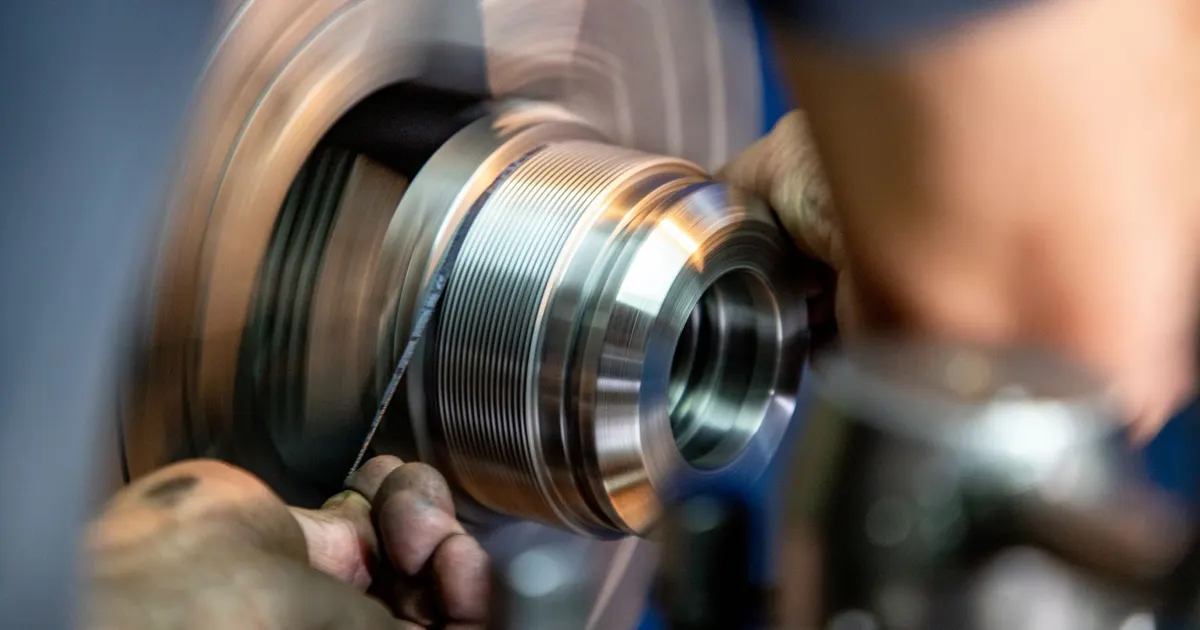
Turning Inconel 718 is a solved problem for a shop that does it every week and an expensive one for a shop that does not. The alloy keeps its strength at cutting temperature, hardens under the tool and sends nearly all the heat into the insert instead of into the chip. Four choices decide whether a turned part comes off the lathe on time: the insert shape, the insert grade, the speed and feed and how the coolant reaches the cut.
Why 718 behaves differently on a lathe
Inconel 718 is a nickel-chromium alloy strengthened by niobium-rich precipitates that form during aging. In the aged condition it is typically in the range of 36 to 44 HRC, and it holds most of that strength at several hundred degrees Celsius. Cutting tools normally rely on the workpiece softening a little in the shear zone. Here it does not, so the cutting force stays high. Low thermal conductivity adds to the problem. Heat stays at the cutting edge, and the edge wears faster than it would on steel or stainless.
The material also work-hardens. A tool that rubs instead of cutting leaves a hardened skin, and the next pass meets that skin. Our guide on why Inconel work hardens covers the mechanism. For turning, the practical rule is simple: never let the insert dwell, never take a skim cut lighter than the edge radius and change the insert before it is worn out rather than after.
Insert shape and lead angle
Round inserts are the common choice for roughing 718. A round edge spreads the cut over a long arc, so the chip is thin where the edge is loaded and the load per millimeter of edge is lower. Round inserts also have no weak corner. For finishing and for profiles that a round insert cannot reach, shops use diamond or triangular inserts with a generous nose radius.
Lead angle matters because nickel alloys wear a notch in the insert at the depth-of-cut line, where the edge meets the hardened outer skin of the bar. A lower lead angle spreads the contact and softens the notch. Some shops also vary the depth of cut slightly from pass to pass so the notch does not form in the same place each time. If the insert is notching, the fix is rarely a harder grade. It is usually a different depth of cut or a different lead angle.
Insert grades and typical speeds
Three families of insert show up on 718 jobs. Fine-grain coated carbide is the all-round choice and the only one that handles interrupted cuts and finishing well. Whisker-reinforced alumina and SiAlON ceramics cut at several times the carbide speed and suit roughing of round, uniform stock. Cubic boron nitride is occasionally used for finishing hardened material but is not a default. Our comparison of ceramic, carbide and cermet tooling goes through the trade-offs in more detail.
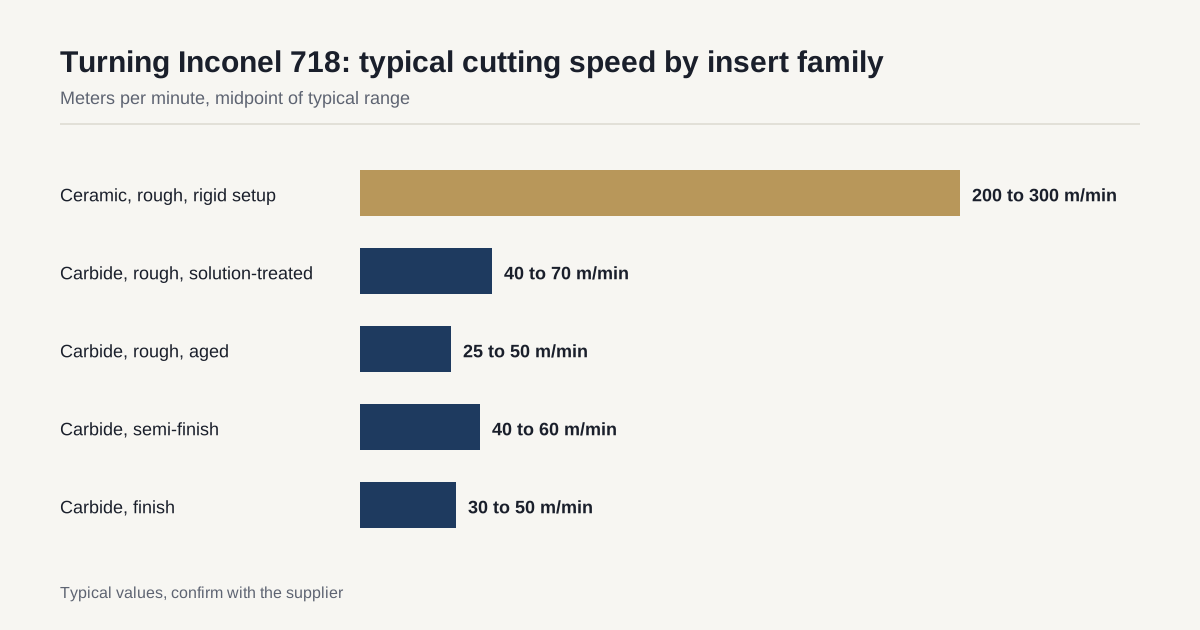
| Operation | Insert family | Typical speed | Notes |
|---|---|---|---|
| Roughing, solution-treated | Coated carbide, round | 40 to 70 m/min | High-pressure coolant helps tool life |
| Roughing, aged | Coated carbide, round | 25 to 50 m/min | Expect shorter tool life as hardness rises |
| Roughing, rigid setup | SiAlON or whisker ceramic | 200 to 300 m/min | Usually run dry, needs a continuous cut |
| Semi-finishing | Coated carbide | 40 to 60 m/min | Constant chip load, no dwell |
| Finishing | Fine-grain coated carbide | 30 to 50 m/min | Feed 0.08 to 0.15 mm/rev, fresh edge |
These are typical ranges for planning and comparing quotes. The shop sets the real values from its tooling, its machine and the bar in front of it.
Chip control and coolant
Inconel chips are tough and do not break by themselves. A long chip that wraps the part can scratch the finished surface, damage the insert and, on an unattended lathe, stop production. Shops handle it in three ways. They choose chip-breaker geometry designed for superalloys. They use through-tool or directed high-pressure coolant, commonly in the range of 70 bar or more, which cools the edge and snaps the chip. And they program feed and depth of cut so the chip is thick enough to curl and break instead of thin enough to ribbon.
Ceramic inserts are the exception. They run dry, because the thermal shock from coolant cracks them. That is one reason ceramics are reserved for roughing, where the cut is continuous and the surface left behind will be cut away anyway.
Grooving, threading and parting
Operations other than straight turning bring their own problems. Grooving puts the insert in a confined cut where the chip cannot escape, so coolant delivery and chip evacuation matter more than speed. Shops often use grooving inserts with high-pressure coolant aimed at the cutting edge, plus a peck or retract cycle on deep grooves so the chip is cleared before it packs. Parting off is similar. A narrow blade, a long overhang and a tough chip are a poor combination, and shops usually keep the overhang as short as the part allows and feed steadily without dwell.
Threading on the lathe is possible but unforgiving. A full-profile threading insert takes the whole thread form in a fixed number of passes, and on 718 each pass must be a real cut, because a light spring pass work-hardens the flank. Many shops prefer to thread-mill 718 instead, because a small milling cutter gives lighter, interrupted cuts and a thread that is easier to hold to class. For threads in an aged part that must pass a go/no-go gauge, say so on the drawing so the shop plans the method before it quotes.
How tool wear shows up in the part
The part tells you when the tool is wearing. A diameter that drifts larger or smaller along a run points to flank wear and a tool that needs indexing. A bright, smeared surface with fine tears means the edge has stopped cutting cleanly and is pushing metal. Notch wear leaves a visible ridge at the depth-of-cut line on the finished diameter. A shop that records these signs and links them to tool life limits has a process. A shop that waits for a size problem to appear at inspection does not.
Worn edges also affect more than size. They raise cutting temperature and cutting force, which can leave a thin, altered layer on the surface and tensile residual stress under it. On a static bracket this rarely matters. On rotating hardware it can. Our note on surface integrity in Inconel explains how a shop controls it.
What a good setup looks like
A shop that turns 718 well usually shows the same habits:
- A rigid, short tool overhang and a workholding method that does not let the bar move.
- Tool life limits set in advance, with inserts indexed on a schedule instead of run to failure.
- Separate tools for roughing and finishing, so the finishing edge is always fresh.
- A defined sequence for heat treatment, covered in our note on heat treatment sequencing for 718.
- A way to check the first part before the batch runs, usually a first article inspection.
Ask which insert families the shop runs on 718 and how it limits notch wear. A clear, specific answer is a good sign. A vague one suggests the shop treats 718 like a harder stainless.
What to put on the RFQ
You do not need to specify the insert. You do need to give the shop what it needs to choose one. Include the condition of the material when machined (solution-treated or aged), the specification for the bar, the finished surface roughness, the roundness and concentricity tolerances and whether the part is rotating hardware that needs controlled surface integrity. State where in the process the heat treat happens, because it changes the machining plan.
Tolerances drive cost more than most buyers expect. A diameter held to a few micrometers usually means a finishing pass on a fresh edge, a stabilized part temperature and a gauge check, and that adds time on every piece. Our page on achievable tolerances in Inconel gives typical ranges.
Closing checklist
Before you send the drawing, confirm these points:
- Material condition at machining and the AMS or ASTM spec for the bar.
- Heat treat sequence and who performs it.
- Surface roughness, roundness and concentricity callouts, with the critical ones marked.
- Quantity, so the shop can decide whether to dedicate a tool set.
- Inspection reports and mill certs you need.
When the drawing is ready, send an RFQ and we match you with up to three shops that already turn nickel alloys. Shops that run 718 daily will usually come back with a clear process and a firm lead time.
Frequently asked questions
What cutting speed is normal when turning Inconel 718?
With coated carbide, most shops run roughly 30 to 60 meters per minute on aged material and a little higher on solution-treated bar. Ceramic inserts run several times faster, often 200 meters per minute or more, but only in roughing cuts with a rigid setup. The exact number depends on the insert, the depth of cut and the condition of the bar.
Should Inconel 718 be turned before or after aging?
Many shops rough in the solution-treated condition, where the bar is softer, then age and finish. Parts with tight size or roundness requirements are often finished after aging because aging causes a small, predictable change in size. The drawing and the heat treat spec decide the sequence, so state it on the RFQ.
Why do long stringy chips matter on a nickel alloy?
Long chips wrap around the part and the tool, scratch the finished surface and can pull an insert out of the cut. Inconel produces tough, continuous chips, so shops use chip-breaker geometry made for superalloys and high-pressure coolant to snap the chip into short pieces.
Need a quote for this part?
Send the drawing. We match you with up to 3 Inconel-capable shops and reply within 24 business hours.
Get matched with an Inconel shop