Guides / Process
5-Axis Machining of Inconel Blades, Blisks and Impellers: What Buyers Should Know
October 5, 2026
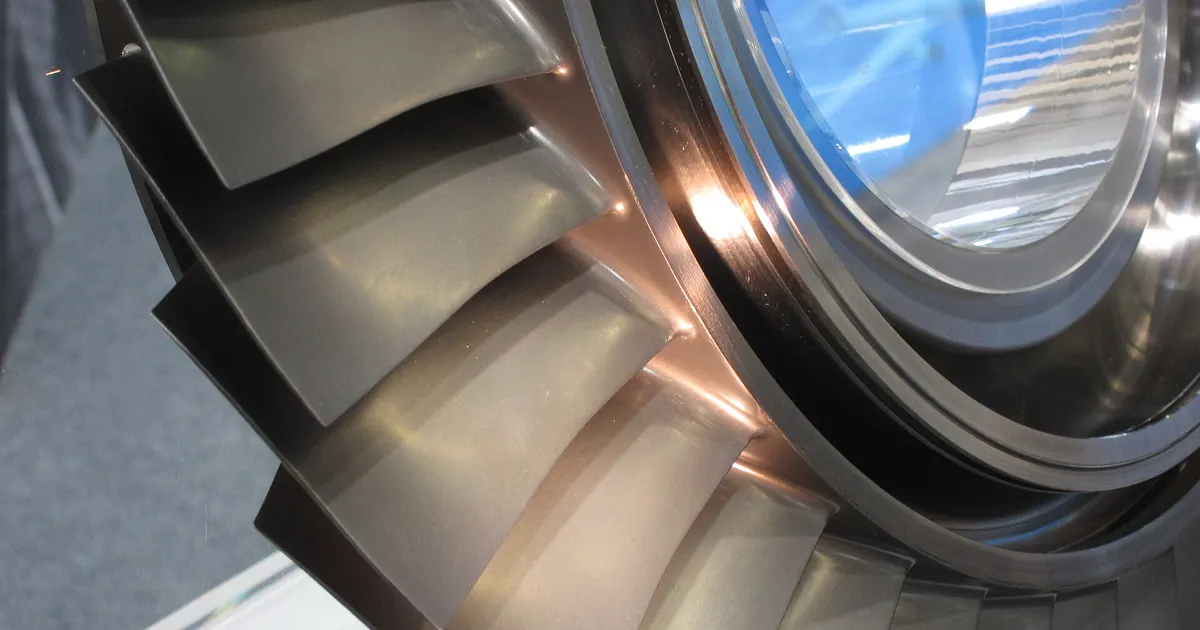
A blade, a blisk or an impeller is a part where the shape of the metal does the work. Gas flows over the surface, so the geometry has to match the model within a few hundredths of a millimeter, and the surfaces have to be smooth enough not to disturb the flow. When the alloy is Inconel, the shop must hold that shape while removing tough metal from between blades that are only millimeters apart. Five-axis machining is what makes it possible.
What these parts are
A blade is a single airfoil with a root, a platform and a tip. A blisk is a disc with its blades machined as one piece. An impeller is a rotor with curved vanes that move fluid or gas, either open (vanes exposed) or closed (a cover plate over the vanes). Inconel appears in these parts where temperature or corrosion rules out lighter metals. Nickel alloys such as Inconel 718 are common in the hotter stages of gas turbines and in some compressor stages, and in pumps and turbochargers that see hot or corrosive gas. Titanium is more common in the cooler front stages, which is a different job.
The common feature is geometry. Blade surfaces are twisted and sit close to each other, and the fillet where a blade meets the hub carries stress, so its radius and finish matter to fatigue life.
Why five axes
A three-axis machine moves a tool in X, Y and Z while the tool stays vertical. Five-axis machines add two rotations, so the tool or the part can tilt. That gives three benefits. The tool can lean into the space between two blades without touching the neighbour. It can keep a constant, favourable angle to the surface, which gives a smoother finish and more even tool wear. And the shop can use shorter, stiffer tools, because tilting brings the cutting zone closer to the spindle.
Machines are either simultaneous, where all five axes move together during the cut, or positional, where the part is indexed to an angle and then cut as a three-axis job. Blades and blisks need simultaneous motion. Our guide to Inconel machining for buyers explains how to read a shop’s machine list.
How a blisk is machined
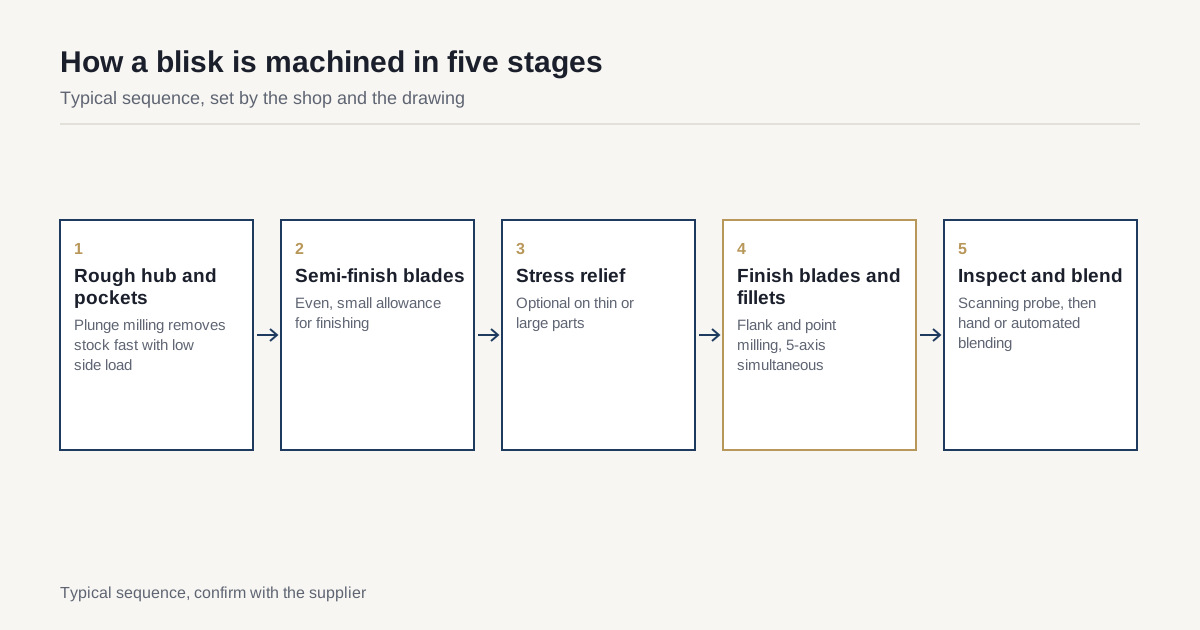
Programming drives the process as much as the machine does. A typical sequence has five stages.
- Rough the hub and blade pockets. Plunge milling, where the cutter moves up and down like a drill, removes stock quickly with low side load. It is common for nickel alloys because it keeps the tool stiff.
- Semi-finish the blade surfaces. An even, small allowance is left so the finishing cut sees consistent load.
- Stress relief. On large or thin-walled parts, some shops relieve stress between rough and finish so the part does not move afterwards.
- Finish the blades and the fillets. Flank milling uses the side of the cutter for long smooth passes, and point milling with a ball or barrel tool reaches areas the side cannot. The fillet at the hub gets its own pass.
- Inspect and polish. A scanning probe checks blade sections against the model, and hand or automated blending removes any tool marks.
What makes Inconel difficult here
Everything that makes Inconel hard to machine is worse on a blisk. Blades are thin, so they deflect and vibrate under tool force, which leaves chatter marks and size errors. The alloy work-hardens, so a tool that rubs instead of cutting hardens the surface and the next pass is harder. Heat stays in the cut and wears the tool. Our overview of why Inconel work hardens covers the material side.
Shops respond with sharp, coated carbide tools, light and constant chip loads, high-pressure coolant and toolpaths that keep the cutter engaged evenly. Tool life limits are set well below failure, because one broken tool can scrap a part that already carries many hours of machining. That is why quotes for blisks look high compared with plain turned parts.
| Stage | Typical approach | Main risk | What to ask a shop |
|---|---|---|---|
| Hub roughing | Plunge milling, carbide or ceramic | Tool breakage, heat | Tool life limits and monitoring |
| Blade semi-finish | Constant allowance, light cuts | Uneven stock, deflection | How stock is kept even |
| Blade finish | Flank or point milling, 5-axis simultaneous | Chatter, size drift | Machine accuracy, probing |
| Fillet finish | Ball or barrel tool | Stress concentrators, marks | Finish and radius checks |
| Inspection | Scanning probe or optical | Measurement uncertainty | Method and report format |
Workholding and setup
A blisk cannot be clamped like a block. The shop holds it by the bore or by a fixture that grips the hub, and the blades are cut while the part is held in a way that does not distort it. Fixture design takes real time on a first part, because the hold must be stiff enough for heavy roughing and gentle enough that the finished blades are not pulled out of shape when the clamps release. Many shops machine a datum feature, such as a bore and a face, early, then use it to re-locate the part for finishing so every stage references the same surfaces.
Machine accuracy matters here as well. Five-axis machines lose accuracy at the extremes of rotation, so shops verify the machine with a probe and a calibration routine before critical finishing. Ask whether the shop probes the part on the machine, since in-process measurement catches size drift before the last blade is cut.
Alternatives and combinations
Five-axis milling is not the only way to make these parts. Closed impellers, where a cover plate encloses the vanes, are often made by joining a machined hub to a machined cover, by electrical discharge machining (EDM) of the passages, or by additive manufacturing followed by finishing. Electrochemical machining is used for some blisks in volume, because it removes metal without cutting force, though it needs electrode tooling that only high volumes justify. Cast and forged blanks reduce the stock to be removed. Our comparison of EDM and CNC machining in Inconel shows where each process fits.
For a prototype or a low-volume run, milling from a forged or bar blank is usually the most direct route. For production, shops often combine near-net-shape blanks with milling of the critical surfaces only.
Inspection and documentation
Airfoil geometry is checked with scanning probes on a coordinate measuring machine or with an optical scanner, comparing blade sections to the model. Typical callouts include profile tolerance, leading and trailing edge shape, twist, chord, thickness and fillet radius. Blades on rotating parts also face checks of surface condition and, often, penetrant inspection to find cracks. See our note on fluorescent penetrant inspection of machined Inconel for what that involves.
Supply the model, not only a drawing. A native 3D file or a neutral format such as STEP, along with the drawing that carries the tolerances, lets the shop program directly and cuts the quoting time. State which surfaces are critical and which are not, since profile tolerance on every surface multiplies inspection cost.
Balancing and finishing after machining
Rotating parts usually go to balancing after machining, where material is removed in controlled spots to bring the center of mass onto the axis. Blades may then be blended by hand or by an automated polishing cell to remove tool marks and meet the surface requirement. Shot peening of blade roots and fillets is common on fatigue-critical parts and comes after penetrant inspection. Each of these steps may happen at a different supplier, so ask the shop which finishing steps it handles and which it subcontracts.
Cost and lead time
Three factors drive price. The first is programming and proving time, which is a large fixed cost for the first part and shrinks per piece as quantity grows. The second is machine hours, because five-axis finishing of blades is slow. The third is risk, since a scrapped part late in the process carries all the material and machining already invested. A one-off blisk therefore costs far more per piece than a batch of twenty, and a shop that has made similar parts will price lower and more accurately than one that has not.
Lead time depends on material availability as well. A forged blank may take weeks to arrive, so ask each shop when it can start, not only how long machining takes.
What to include on the RFQ
- A 3D model and a drawing with the profile and fillet tolerances.
- Material, specification and condition, with certificates required.
- Quantity, and whether you will place repeat orders.
- Inspection requirements, including penetrant inspection and report format.
- Any balancing, coating or surface treatment after machining.
Closing checklist
Check that the model matches the drawing, that critical airfoil surfaces are marked and that heat treatment and inspection are specified. Ask each shop about its five-axis machines, its experience with thin-walled nickel parts and its tool management. When you are ready, send an RFQ and we match you with up to three shops that run five-axis work in nickel alloys.
Frequently asked questions
What is a blisk?
A blisk, short for bladed disk, is a rotor in which the disc and its blades are one piece instead of separate blades fixed into slots. It removes the attachment hardware and weight and is common in compressor and turbine stages. The trade-off is that damage to one blade is harder to repair than swapping a single blade.
Why does a blade or impeller need five axes?
The surfaces are curved in three dimensions and the blades are close together. A five-axis machine tilts the tool so the cutter can reach between blades without hitting the next one, and so the cutter side or tip stays at the best angle to the surface. A three-axis machine cannot reach most of those surfaces.
How long does a first blisk take to make?
It depends on size, alloy and programming effort, but plan for weeks, not days. Toolpath programming and proving, fixture design and first-article inspection take a large share of the time. Repeat parts move much faster once the program and tooling are proven.
Need a quote for this part?
Send the drawing. We match you with up to 3 Inconel-capable shops and reply within 24 business hours.
Get matched with an Inconel shop