Guides / Materials
Inconel 617 Machining: What Buyers Need to Know for High-Temperature Service
October 17, 2026
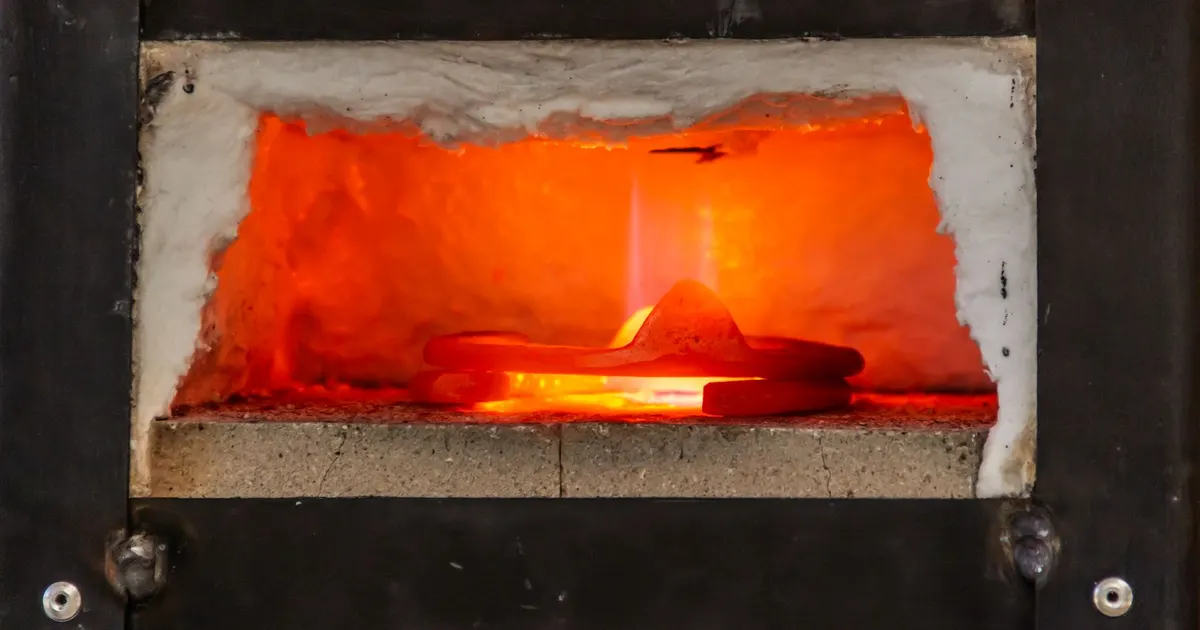
Some parts spend their working life at temperatures where steel and even stainless steel give up. Combustor liners, high-temperature heat exchangers and hot gas ducting all call for an alloy that keeps its strength and its oxide layer at 900 to 1,100 degrees Celsius. Inconel 617 is one of the alloys made for that range. For a buyer, the questions are how it differs from the grades they already know and what it means for machining cost and lead time.
What Inconel 617 is
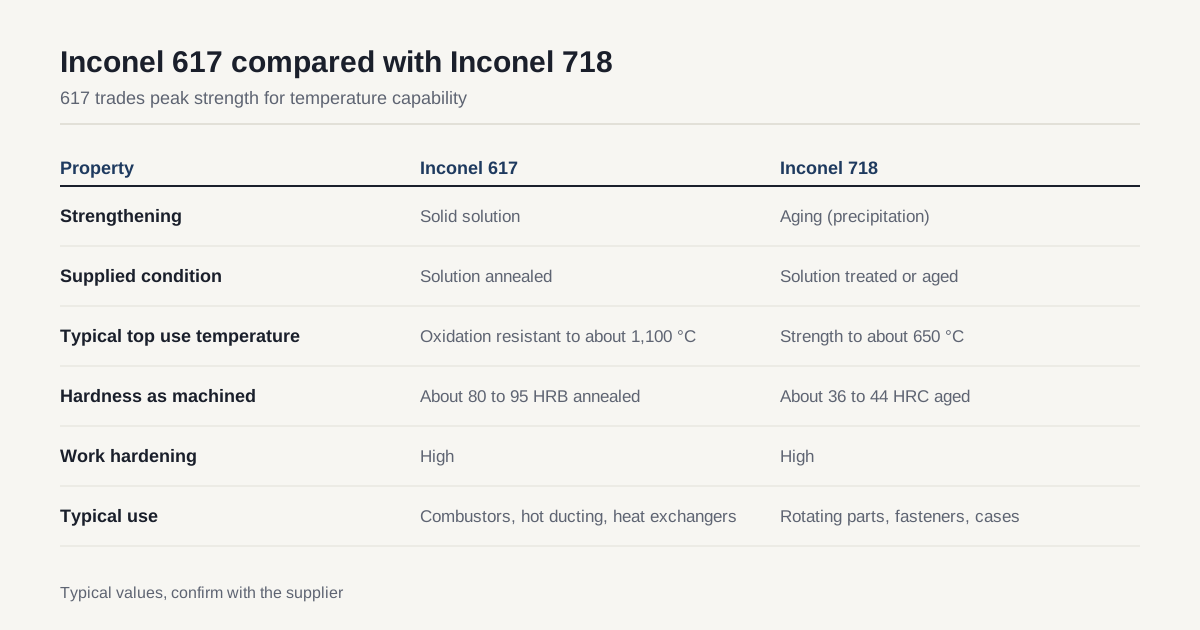
Inconel 617 (UNS N06617) is a nickel-chromium-cobalt-molybdenum alloy. A typical composition is about 22 percent chromium, 12 percent cobalt, 9 percent molybdenum and 1 percent aluminum, with nickel as the balance. It is strengthened mainly by solid solution, meaning the alloying elements dissolved in the nickel matrix make it strong, with a small contribution from carbides. Unlike 718, it does not rely on an aging heat treatment to reach its properties, so it is supplied solution annealed.
The alloy is chosen for three properties. It keeps useful strength and creep resistance at very high temperature. It forms a stable oxide layer that resists oxidation up to around 1,100 degrees Celsius. And it fabricates and welds well. Our comparison of Inconel 625 and 718 shows how those grades differ, and 617 sits above both in temperature capability.
Where it is used
Typical uses include gas turbine combustors and transition ducts, high-temperature ducting and exhaust systems, heat exchangers in advanced nuclear and process designs, and components for power plants that run at very high steam or gas temperatures. Parts include fabricated liners, flanges, rings, manifolds, tubesheets and machined fittings. Many of these are welded assemblies, and some are machined from plate, bar or ring forgings.
Because 617 is used in demanding service, parts often come with strict documentation. Pressure-containing parts may fall under a design code, and the code decides which forms and heat treatment are allowed. Check the code requirements before you request quotes, since a shop cannot choose them for you.
Material specifications
Product forms are covered by ASTM specifications. ASTM B166 covers rod, bar and wire. B168 covers plate, sheet and strip. B564 covers forgings. Seamless tube and pipe have their own specifications. Quote the one that applies, along with the condition required, which is usually solution annealed.
| Form | Common ASTM spec | Typical use |
|---|---|---|
| Rod and bar | B166 | Machined fittings, rings, shafts |
| Plate and sheet | B168 | Fabricated liners, flanges, tubesheets |
| Forgings and rings | B564 | Heavy sections, rotating or pressure parts |
| Seamless tube | B167 | Heat exchanger tubing |
Mill certificates should show the heat number, chemistry and mechanical results, and positive material identification checks the finished part. Our guide to mill certificates and PMI for Inconel explains what to request.
How 617 machines
617 machines in the solution-annealed condition, which is softer than aged 718, but softness does not make it easy. Three behaviors drive the process.
Work hardening. The alloy hardens quickly under the tool. A light, rubbing pass leaves a hard skin, and the next pass meets it. Cuts must be deep enough to get under the hardened layer, and tools must not dwell.
Heat at the edge. Thermal conductivity is low, so heat concentrates at the cutting edge, as with other nickel alloys.
Tough chips. Chips are long and stringy and need chip-breaking geometry or high-pressure coolant to control them.
Our note on why Inconel work hardens covers the mechanism in detail.
Typical machining parameters
Shops usually run 617 with coated carbide at speeds in the same range as 625 and annealed 718, which is a few tens of meters per minute. Ceramic inserts can rough at higher speeds on stable setups. Feed and depth of cut are set to keep the tool cutting and to avoid skimming. High-pressure coolant helps tool life and chip control, and rigid fixturing prevents chatter.
| Operation | Tool | Typical speed | Notes |
|---|---|---|---|
| Turning, rough | Coated carbide | 25 to 45 m/min | Round inserts, high-pressure coolant |
| Turning, finish | Fine-grain carbide | 25 to 40 m/min | Fresh edge, steady feed |
| Milling, rough | Carbide end mill | 20 to 35 m/min | Light radial engagement, climb milling |
| Drilling | Solid carbide | 15 to 30 m/min | Through-tool coolant, no dwell |
| Thread milling | Carbide thread mill | 20 to 35 m/min | Preferred to tapping |
These are planning ranges only. The shop’s tested numbers are the ones that matter.
Welding and fabrication
Many 617 parts are fabricated by welding sheet, plate or tube before or after machining. A matching filler metal, designated ERNiCrCoMo-1 in AWS terms, is the standard choice, and welding follows a qualified procedure. Parts that are welded and then machined need to allow for distortion, and parts that are machined and then welded need clean, burr-free weld preparation. Our note on welding Inconel for buyers explains the general points.
Heat treatment after fabrication depends on the code and on the part. Some 617 assemblies are used in the as-welded condition. Others are stress relieved or solution annealed. State the requirement on the drawing so that the shop can plan machining before or after it.
Service behavior to know about
617 can lose some ductility after long exposure in an intermediate temperature range, roughly 650 to 800 degrees Celsius, because carbides precipitate in the grain structure. Designers account for this in the design, and a buyer does not usually need to, but it is a reason to follow the specification and not to substitute grades. Do not replace 617 with 625 or 718 because they are easier to find. Their temperature limits are lower, and a part that runs hot may fail early.
Fixturing and distortion
Many 617 parts are thin-walled rings, liners and ducts, and they move when material is removed. Rolled and welded rings hold residual stress from forming and welding, and machining releases it. Shops deal with this by roughing first, leaving generous stock, letting the part rest or relieving stress where the specification allows, and then taking light finishing cuts in a gentle fixture. Soft jaws, expanding mandrels and vacuum or low-force clamping all help avoid squeezing a thin wall out of round. Ask any shop how it holds a ring-shaped part and whether it checks roundness before and after the final clamp release.
Surface finish and inspection
Hot-section parts often need a defined finish on sealing faces and on features that mate with other parts, and they commonly need penetrant inspection of welds and machined edges. Typical finishing passes reach Ra 0.8 to 1.6 micrometers with a fresh insert. Dimensional inspection of large rings and ducts uses a coordinate measuring machine or portable arm, and the temperature of the part matters, since a large nickel alloy ring changes size noticeably with a few degrees. Our page on achievable tolerances in Inconel shows what is realistic for diameter and position on different sizes.
When another alloy is a better fit
617 earns its price only when the temperature or the design code calls for it. If the part runs below about 800 degrees Celsius and carries load, 718 or 625 may serve at lower cost, though only the designer can decide. If the environment is corrosive and not just hot, an alloy such as 625 or a Hastelloy grade may be better. If the part sees very high temperature but low load, a heat-resistant stainless or a lower-cost iron-nickel alloy may do. Buyers should not choose among these alone. They should ask the designer which alloys are approved for the part and quote only those.
Cost and lead time
617 is more expensive than 625 per kilogram because of its cobalt and molybdenum content, and stock is more limited. Plate and bar sizes may be less common on the shelf, so mill lead time can be a factor. Machining cost is similar to other solution-annealed nickel alloys, with high tool use and slow speeds. Our guide on why Inconel 718 costs so much to machine breaks down the cost drivers that apply here too.
Inspection and traceability
Because 617 parts run in demanding service, they usually come with a full set of records. Expect mill certificates showing chemistry and mechanical properties, solution anneal records, dimensional inspection reports and penetrant results on welds and machined edges. Positive material identification on the finished part confirms the alloy. Keep the heat number with the part through every step, since a lost heat number can make a finished part unusable. Our guide to first article inspection for Inconel parts describes a typical release package.
What to include on the RFQ
- Alloy, UNS number and ASTM specification, with form and condition.
- Design code or customer specification, if any.
- Welding requirements and filler metal, if the part is fabricated.
- Heat treatment before or after machining.
- Service temperature, so the shop understands the part’s duty.
- Certificate and inspection requirements.
Closing checklist
Before you send the drawing, confirm the alloy and form, state the specification and condition, mark welds and name the heat treatment. When you are ready, send an RFQ and we match you with up to three shops that already machine nickel alloys. Ask whether each has run 617 and how it handled work hardening on that job. For where 617 sits among the other hot grades and why its limit needs producer data, see high temperature nickel alloys.
Frequently asked questions
What is Inconel 617 used for?
Inconel 617 is used where a part must hold strength and resist oxidation at very high temperatures, commonly above 900 degrees Celsius. Typical uses include gas turbine combustor parts, high-temperature ducting, heat exchangers and components for advanced power generation and process plants.
Is 617 harder to machine than 718?
It is different, not simply harder. 617 is supplied solution annealed and is not hardened by aging like 718, so it is softer on the bench. It still work-hardens quickly and holds heat at the cutting edge, so speeds stay in the same low range as other nickel alloys. Tool control matters more than raw hardness.
Can 617 be welded?
Yes. 617 welds well with matching filler metal, and it is a standard choice for fabricated high-temperature assemblies. The weld procedure, heat input and post-weld treatment should follow the code or customer specification, and the procedure should be qualified before production.
Need a quote for this part?
Send the drawing. We match you with up to 3 Inconel-capable shops and reply within 24 business hours.
Get matched with an Inconel shop