Guides / Materials
Incoloy 800H and 800HT: Grades, Specs and Machinability for Buyers
October 16, 2026
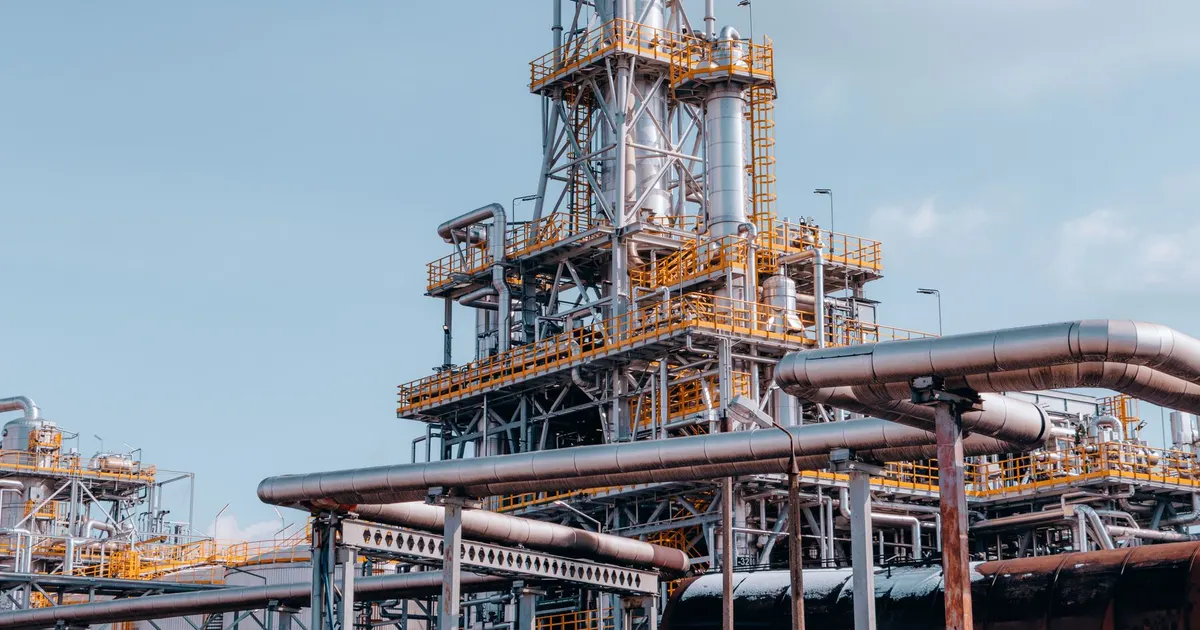
Incoloy 800H and 800HT show up on furnace, reformer and heat exchanger drawings, and they sit in the cost range between stainless steel and the Inconel grades. They are easier to machine than 718 or 625, but they come with a set of grade rules that trips up buyers. Pick the wrong version and the part can fail a code review or fail early in service.
The alloy family
Incoloy is a Special Metals trademark. The 800 family is an iron-nickel-chromium alloy with roughly 30 to 35 percent nickel, 19 to 23 percent chromium and the balance mostly iron. It resists oxidation, carburization and many corrosive environments at high temperature, and it is austenitic, meaning its structure stays stable up to the melting point. A small addition of titanium and aluminum gives modest hardening and stability.
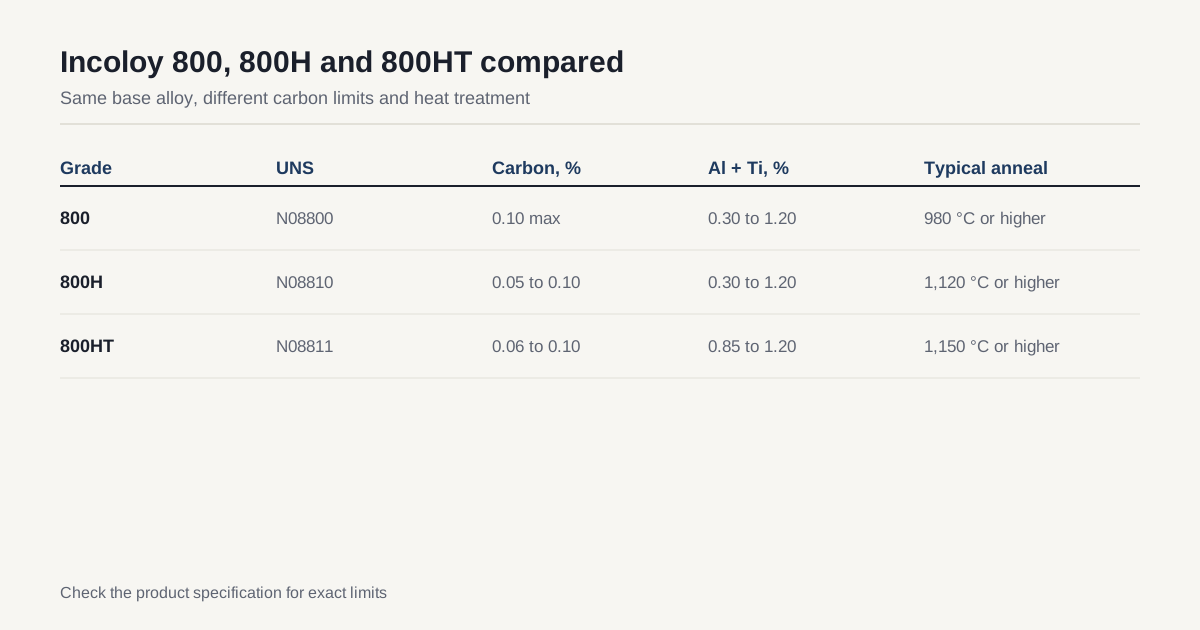
Three versions matter to buyers: 800, 800H and 800HT. Their chemistry is nearly the same, but their carbon limits, minimum titanium plus aluminum and required heat treatment differ. Those differences control creep strength, the slow stretching of metal under load at high temperature. Our buyer’s guide to Inconel machining covers the more common nickel-based grades for comparison.
Grades compared
| Grade | UNS | Carbon | Al + Ti | Typical anneal | Main use |
|---|---|---|---|---|---|
| 800 | N08800 | 0.10 max | 0.30 to 1.20 | About 980 °C or higher | Moderate temperature, general corrosion |
| 800H | N08810 | 0.05 to 0.10 | 0.30 to 1.20 | About 1,120 °C or higher | High-temperature creep service |
| 800HT | N08811 | 0.06 to 0.10 | 0.85 to 1.20 | About 1,150 °C or higher | Highest creep strength |
Check the product specification for exact limits, because they vary slightly by form. The point for a buyer is that the three grades are not interchangeable on a drawing. A designer who chooses 800H for creep service wants its coarse grain and its controlled carbon. A material certificate for plain 800 does not satisfy that requirement even though the alloy looks the same.
Where it is used
Typical uses are in hydrocarbon and chemical processing and in power generation. Examples include outlet headers and pigtails on steam methane reformers, process heater and furnace components, heat exchanger tubes and tubesheets, superheater tubing and hardware inside high-temperature process vessels. Machined parts include flanges, nozzles, rings, fittings, supports and fixtures. Many parts are fabricated by welding before or after machining.
Design codes control temperature limits. 800H and 800HT carry higher allowable stresses than 800 at temperatures where creep governs, which is why the grade call-out matters to the engineer. Check the governing code or customer specification, and quote only the grades it allows.
Material specifications
Product forms are covered by ASTM specifications. B408 covers rod and bar. B409 covers plate, sheet and strip. B564 covers forgings. Seamless pipe and tube fall under B407, condenser and heat exchanger tube under B163 and welded pipe and tube under B514 and B515. Quote the specification and the grade, and ask for certificates showing the heat number, chemistry, mechanical properties, grain size and heat treatment.
Some mills dual-certify a heat to more than one grade when it meets both. That is legitimate, but you should confirm that the certificate covers the grade your drawing calls for. Our note on mill certificates and PMI for Inconel explains what each document proves. Positive material identification confirms the alloy family but cannot always separate 800 from 800H, since the difference is mostly carbon, so the certificate carries the proof.
How it machines
Incoloy 800H is an austenitic alloy that work-hardens, so it needs sharp tools and a steady cut, but it is much less demanding than aged Inconel 718. It machines more like a tough austenitic stainless steel such as 316 than like a precipitation-hardened superalloy. It is gummy, forms long chips and builds up an edge on the tool at low speeds.
Typical practice uses coated carbide at speeds somewhat lower than for 316, high-pressure coolant where available and positive-rake geometry. Heavy enough feeds keep the tool under the hardened layer. Our note on why Inconel work hardens covers the mechanism, and 800H shows it at a milder level.
| Operation | Tool | Typical speed | Notes |
|---|---|---|---|
| Turning, rough | Coated carbide | 40 to 80 m/min | Positive rake, chip breaker |
| Turning, finish | Fine-grain carbide | 50 to 90 m/min | Sharp edge, steady feed |
| Milling | Carbide end mill | 30 to 60 m/min | Climb milling, rigid setup |
| Drilling | Solid carbide | 20 to 40 m/min | Through-tool coolant |
| Thread milling | Carbide thread mill | 30 to 60 m/min | Preferred for large threads |
These are typical planning ranges. Real values come from the shop’s tooling and experience.
Grain size and condition
800H and 800HT are supplied solution annealed to a coarse grain, which gives creep strength. The coarse grain is not a machining problem, but it matters for finishing. Coarse-grained material can show a slightly rougher surface after cutting, and thin parts can show variation in properties between grains. Heavy cold work from machining followed by high-temperature service can lead to local grain changes, so some specifications call for a stress relief or restrict the amount of cold work. If your part has such a requirement, it will be in the specification, so quote it.
Welding and fabrication
800H and 800HT weld well with matching or compatible nickel-base filler metals, and welded fabrication is common. Weld procedures should follow the governing code and be qualified for the grade. Post-weld heat treatment is sometimes required for creep service. Our guide on welding Inconel for buyers outlines the general points that apply to the 800 family as well.
Thermal expansion and size
Alloys in this family expand more than carbon steel when heated, roughly 15 to 17 micrometers per meter per degree Celsius against about 12 for steel. For a flange or ring that mates with a carbon steel part, the difference matters at operating temperature, and designers allow for it in the clearances. For the shop, the effect shows up in measurement. A large ring measured warm from the machine reads larger than the same ring at 20 degrees Celsius, so shops stabilize parts and measure in a controlled room. If your tolerance is tight on a large diameter, say what temperature the dimension applies at, which is normally 20 degrees Celsius.
Typical parts
| Part | Typical form | What matters to the shop |
|---|---|---|
| Reformer outlet header or pigtail | Pipe or forging | Wall thickness, weld preparation, grade traceability |
| Furnace support or hanger | Plate or bar | Hole position, many identical parts |
| Heat exchanger tubesheet | Plate or forging | Drilled hole pattern, flatness, ligament control |
| Flange or nozzle | Forging or plate | Bore size, sealing face finish |
| Process vessel internals | Plate, bar | Welds, fit-up, cleanliness |
Many of these parts are large and heavy, and some shops lack the machine size to handle them. Ask about maximum swing and table size, and about crane capacity, before you send a quote request for a large item.
Inspection and documentation
Typical inspection covers dimensions, surface finish, weld inspection and a review of material documents. Parts for pressure service can call for penetrant testing of welds and machined edges and for hydrostatic or pneumatic pressure tests of the finished assembly. Heat treatment records and grain size reports come from the mill or an outside lab. Our page on first article inspection for Inconel parts shows how a release package is normally assembled, and the same approach works for 800H parts.
Cost and lead time
Incoloy 800H costs less per kilogram than Inconel 625 or 718, because it contains less nickel. Bar, plate and tube in common sizes are stocked by distributors, and lead times for standard items are shorter than for superalloys. Machining cost is moderate: tool wear is lower than on Inconel, but work hardening and long chips still call for good practice. Large rings and forgings, however, can take weeks or months from the mill.
Why the grade call-out saves money
Buyers sometimes ask whether plain 800 would do instead of 800H to save cost or time. The price difference between grades is usually small, and the risk is large. A part made from the wrong grade can be rejected at inspection, which costs the whole machining spend, or it can pass inspection and fail early in service, which costs far more. Quote the grade the drawing names, ask the designer in writing before accepting any substitute, and keep the certificate that proves the grade with the part records. The same discipline applies to stock that sits in a warehouse for months, since bars with similar looks and different grades share the same racks.
What to include on the RFQ
- Grade name and UNS number, such as 800H (N08810) or 800HT (N08811).
- Product specification and form, with heat treatment condition.
- Grain size requirement, if the specification sets one.
- Design code or customer specification.
- Welding requirements and filler metal, if fabricated.
- Certificates, PMI and inspection needs.
Closing checklist
Check that the drawing names one grade, with a specification and condition, that the certificate you require lists that grade, and that welding and heat treatment are stated. When you are ready, send an RFQ and we match you with up to three shops that already machine nickel alloys. Ask each whether it has run 800H or 800HT and how it checks the grade on the incoming certificate. For the other grades used above 600°C, read our guide to high temperature nickel alloys.
Frequently asked questions
What is the difference between Incoloy 800, 800H and 800HT?
They are three versions of the same base alloy with different carbon limits and heat treatment. 800 (UNS N08800) has the widest carbon range and is used at moderate temperatures. 800H (N08810) has a higher, narrower carbon range and a coarser grain for creep strength. 800HT (N08811) tightens carbon and adds a minimum for aluminum plus titanium for the highest creep strength.
Is Incoloy 800H an Inconel?
No. Incoloy and Inconel are separate trademarks of Special Metals. Incoloy 800H is an iron-nickel-chromium alloy with roughly 30 to 35 percent nickel, while the Inconel alloys are nickel-based with higher nickel content. It costs less than most Inconel grades and machines more easily.
Can a mill certificate cover more than one grade?
Yes. Some mills certify a heat to more than one grade, for example 800H and 800HT, if it meets both sets of limits. Check that the certificate lists the grade, specification and heat treatment named on your drawing, and ask the shop to confirm it before cutting.
Need a quote for this part?
Send the drawing. We match you with up to 3 Inconel-capable shops and reply within 24 business hours.
Get matched with an Inconel shop