Guides / Materials
Hastelloy C-276 Machining: How It Differs From Inconel and What to Plan For
October 15, 2026
Buyers who know Inconel often meet Hastelloy C-276 for the first time on a chemical plant drawing, and they ask whether it machines the same way. The short answer is that it behaves like a tougher, gummier cousin. The longer answer matters for pricing, for tooling and for what to ask a shop before you place an order.
What C-276 is
Hastelloy C-276 (UNS N10276) is a nickel alloy with roughly 15 to 17 percent molybdenum, 14.5 to 16.5 percent chromium and 3 to 4.5 percent tungsten, with small amounts of iron and cobalt. Carbon and silicon are kept very low. The high molybdenum content gives it outstanding resistance to pitting and crevice corrosion, and the low carbon prevents harmful carbide formation in welds, so it can be used as welded without heat treatment.
It resists a wide range of aggressive media, including wet chlorine, hypochlorite and chlorine dioxide solutions, ferric and cupric chlorides and hot contaminated mineral acids. Typical uses are in chemical processing, pollution control scrubbers, pulp and paper plants and some oil and gas service. Hastelloy is a registered trademark of Haynes International, and the alloy is also sold under the generic name alloy C-276.
How it differs from Inconel
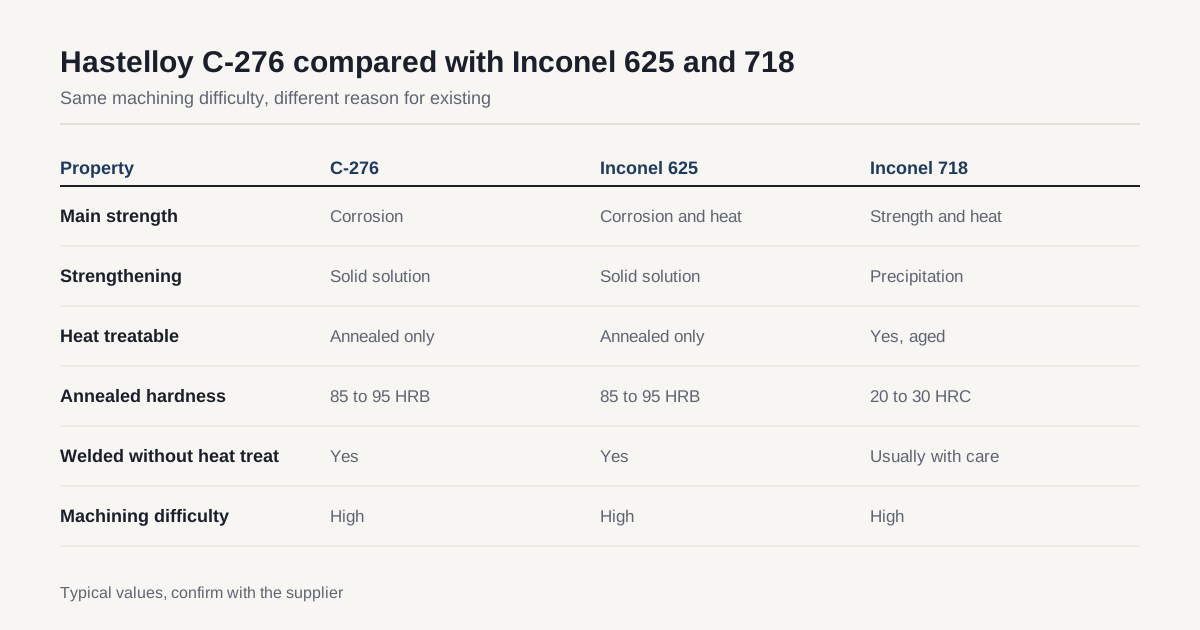
The key difference is the reason each alloy exists. The Inconel grades most buyers order, such as 718, 625 and 600, are chosen for strength, heat resistance or both. C-276 is chosen for corrosion. It is not designed to carry high loads at high temperature, and it does not harden by aging. Our buyer’s guide to Inconel machining places the common grades by their main job.
| Property | Hastelloy C-276 | Inconel 625 | Inconel 718 |
|---|---|---|---|
| Main strength | Corrosion resistance | Corrosion and heat | Strength and heat |
| Strengthening | Solid solution | Solid solution | Precipitation (aging) |
| Heat treatable | No, annealed only | No, annealed only | Yes |
| Typical annealed hardness | About 85 to 95 HRB | About 85 to 95 HRB | About 20 to 30 HRC |
| Typical aged hardness | Not applicable | Not applicable | About 36 to 44 HRC |
| Weld without post-weld heat treat | Yes | Yes | Usually with care |
| Machining difficulty | High | High | High |
Values are typical, and certificates for a given lot show the real figures.
Material specifications
C-276 is covered by ASTM specifications that match the product form. ASTM B574 covers rod and bar, B575 covers plate, sheet and strip, B622 covers seamless pipe and tube, B564 covers forgings and B366 covers wrought fittings. For sour oil and gas service, NACE MR0175 and ISO 15156 list C-276 as acceptable within stated limits. Quote the specification that applies to your part, along with the condition, which is solution annealed.
How C-276 machines
C-276 machines in the solution-annealed condition, where it is soft but tough. Three features define the work.
Rapid work hardening. The surface hardens under the tool faster than many steels and about as fast as 625. A light cut or a dwell leaves a hard skin that wears the next pass.
Gummy chips. The metal is ductile and tends to stick to the tool, forming a built-up edge. Chips are long and tough, so chip-breaking geometry and plenty of coolant matter.
Heat at the edge. Thermal conductivity is low, so heat stays in the tool.
Our page on why Inconel work hardens covers the shared mechanism. For C-276, the practical rules are to use sharp positive-rake tools, keep a steady feed that goes beneath the work-hardened layer and avoid stopping the tool in the cut.
Typical parameters
Speeds are usually a little below those used for 625, because the built-up edge limits what the tool can take. Coated carbide is the normal choice, with high-pressure coolant where available.
| Operation | Tool | Typical speed | Notes |
|---|---|---|---|
| Turning, rough | Coated carbide | 20 to 40 m/min | Positive rake, heavy enough feed |
| Turning, finish | Fine-grain carbide | 25 to 40 m/min | Fresh sharp edge |
| Milling | Carbide end mill | 15 to 30 m/min | Climb milling, rigid setup |
| Drilling | Solid carbide | 10 to 25 m/min | Through-tool coolant, no dwell |
| Thread milling | Carbide thread mill | 15 to 30 m/min | Preferred to tapping |
These are planning values, not guarantees.
Welding, heat treatment and cleanliness
Many C-276 parts are welded, and the alloy is well suited to it. Matching filler metal is standard, and welded parts normally go into service without post-weld heat treatment. Our note on welding Inconel for buyers covers general welding points that also apply.
Two cautions affect machining plans. First, C-276 can form harmful phases if it is held for long periods between about 650 and 1,100 degrees Celsius, so stress relief in that range is avoided, and any heat treatment follows the specification, which is usually a solution anneal and rapid cooling. Second, nickel alloys must be clean before any heat treatment. Residual cutting oil, marking ink, lubricants and other contaminants containing sulfur, lead or zinc can cause damage at temperature. A shop that machines C-276 should clean parts thoroughly and tell the heat treater what the part carries.
Surface finish and corrosion performance
For parts in corrosive service, surface condition matters as much as dimensions. Embedded iron from steel tools, fixtures or abrasive wheels can start corrosion on a nickel alloy surface. Shops that machine corrosion-resistant alloys keep dedicated tooling and brushes, avoid carbon steel contact and often passivate or pickle parts afterwards. If your part will see wet corrosive media, ask for cleaning and passivation to a named standard and make sure the shop understands why.
Typical parts made from C-276
C-276 parts are mostly about containing or moving aggressive fluids. Machined examples include valve bodies, stems and seats, pump casings and impellers, flanges and fittings, tubesheets, agitator shafts, spargers and instrument fittings. Fabricated examples include scrubber liners and ducting, where sheet is formed and welded. Machined parts usually start as bar, plate or forged blanks, and wall thickness and pressure rating come from the process design. Because these parts sit in service for years, shops are asked for full traceability and a clean, uncontaminated surface.
| Part | Typical form | Machining note |
|---|---|---|
| Valve body or flange | Forging or plate | Large bores, sealing faces, many holes |
| Valve stem | Bar | Straightness, finish on the packing surface |
| Impeller | Cast or machined from bar | Balance, surface finish |
| Tubesheet | Plate or clad plate | Drilled hole pattern, ligament control |
| Instrument fitting | Bar | Small threads, deburring |
Tooling and workholding practice
Shops that run C-276 well keep a short list of proven tools and replace them on a schedule. They favor sharp, positive-rake carbide with coatings made for nickel alloys, and they avoid tool nose radii that are too small for the cut. Heavy, steady feeds keep the edge under the hardened layer. Workholding must be rigid, because chatter hardens the surface and leaves marks. Coolant concentration and filtration matter too, because chips and fines recirculating through the pump scratch finished surfaces. None of this is exotic, but it separates a shop that runs the alloy every month from one that tries it once a year.
What to ask a shop
A few direct questions reveal a lot. Ask how many C-276 jobs it ran in the past year and what parts they were. Ask what insert grades and coolant it uses. Ask how it prevents iron contamination, and whether it passivates or pickles after machining. Ask how it documents material traceability from the mill certificate through to the finished part. Ask how it plans to avoid heat treatment in the sensitizing range if the part is welded. Specific answers point to a shop with real experience. General statements about quality systems do not.
Deburring and edge condition
Burrs on C-276 are tough and stay attached, and a sharp edge can trap liquid or start a crevice in service. Drawings for corrosion service often state an edge break on every machined edge, for example 0.2 to 0.5 millimeters, and a smooth finish on sealing and crevice-prone surfaces. Deburring by hand with dedicated stainless or nylon tools avoids iron pickup. Make sure the edge break appears on the drawing, because a shop will price it as extra labor and a missing callout leads to disputes on delivery.
Cost and lead time
C-276 costs more than 625 per kilogram because of its high molybdenum content and lower production volume. Bar and plate are available from distributors in common sizes, and special forms can take weeks from the mill. Machining cost is high, driven by slow speeds and tool wear. Our guide on why Inconel 718 costs so much to machine outlines the cost drivers that apply here too.
What to include on the RFQ
- Alloy, UNS number, ASTM specification and product form.
- Condition, normally solution annealed.
- Whether the part is welded and which filler and procedure apply.
- Corrosive service and any cleaning or passivation requirements.
- Certificates, PMI and any NACE or other service requirements.
- Surface finish, tolerances and inspection needs.
Closing checklist
Check that the drawing names C-276 with its specification and condition, that cleaning and passivation are stated and that no heat treatment in the sensitizing range is implied. When you are ready, send an RFQ and we match you with up to three shops that already machine nickel alloys. Ask each about its experience with C-276 and how it keeps iron contamination off finished parts. To compare C-276 with 625 and 825 on pitting, acid and welding data, see nickel alloy selection.
Frequently asked questions
Is Hastelloy C-276 an Inconel?
No. Inconel is a trademark of Special Metals, and Hastelloy is a trademark of Haynes International. Both are nickel alloys, but C-276 is a nickel-molybdenum-chromium alloy made for corrosion resistance, while the Inconel grades most buyers know, such as 625 and 718, are made for strength and heat resistance.
Can C-276 be heat treated to higher hardness?
No. C-276 does not harden by aging. It is supplied solution annealed and quenched, and its strength comes from the alloying elements in solid solution. It can be cold worked to raise strength, but not hardened the way 718 is.
Is C-276 harder to machine than Inconel 625?
They are close, and both are difficult. C-276 work-hardens quickly and is gummy, so many shops run it at somewhat lower speeds than 625 and take heavier feeds below the hardened layer. The difference matters less than the shop's experience with nickel alloys in general.
Need a quote for this part?
Send the drawing. We match you with up to 3 Inconel-capable shops and reply within 24 business hours.
Get matched with an Inconel shop