Home / Alloy specifications
Nickel Alloy Specifications: Which Standard for Which Alloy and Sector
Reference hub · Last reviewed 20 October 2026
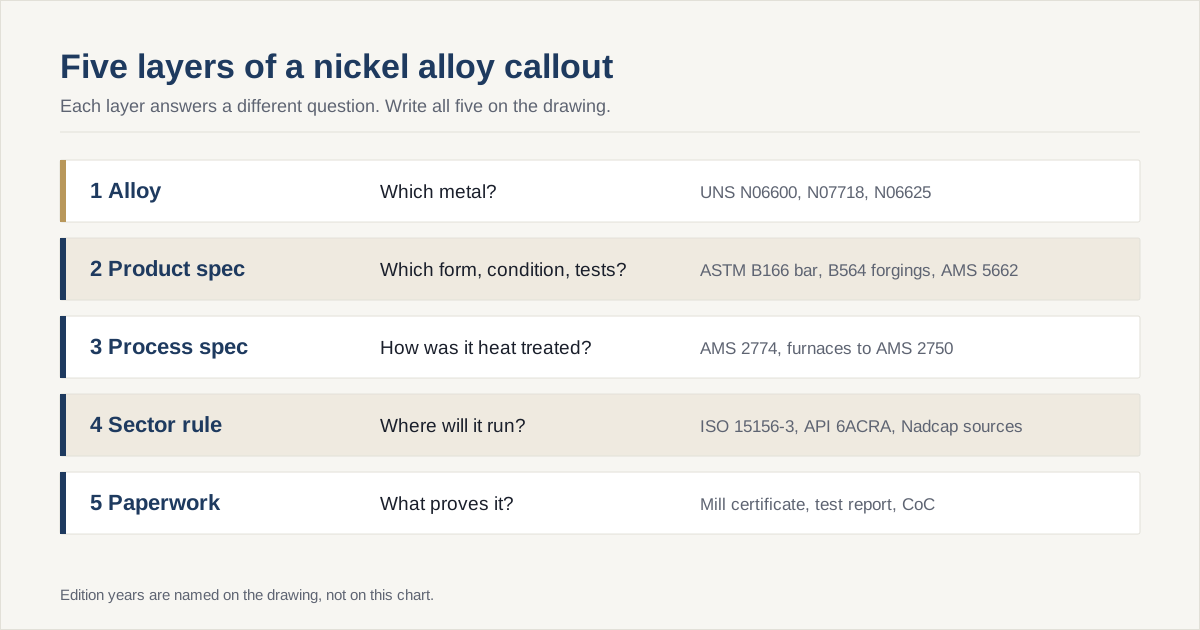
Nickel alloy parts are bought to a stack of documents: the UNS number picks the alloy, an ASTM or AMS specification picks the product and condition, and sector rules such as sour service or aerospace special processes add tests and paperwork on top. This hub shows which family usually applies and points to the detail pages.
| Layer | Question | Examples |
|---|---|---|
| Alloy | Which metal? | UNS N06600, N07718, N06625 |
| Product spec | Which form, condition and tests? | ASTM B166 bar, B564 forgings, AMS 5662 and 5663 |
| Process spec | How was it heat treated? | AMS 2774, with AMS 2750 for furnaces |
| Sector rule | Where will it run? | NACE MR0175 / ISO 15156, API 6ACRA, aerospace Nadcap sources |
| Paperwork | What proves it? | Mill certificate, test report, certificate of conformance |
Editions are named on this page only where we saw them in a standards catalogue. Your drawing’s edition governs.
Alloy by specification family
The table lists the usual product specifications for the common grades. “Check” means we could not confirm the current edition or scope from the issuing body, so read the listing before you cite it. German W.Nr numbers and more grades are on the alloys page.
| Alloy (UNS) | Bar and rod, ASTM | Forgings, ASTM B564 scope list | Aerospace, AMS | Oil and gas |
|---|---|---|---|---|
| Inconel 600 (N06600) | B166, B166-25 | Named | AMS 5665, check revision | None specific |
| Inconel 601 (N06601) | B166-25 | Not named | Not covered here | None specific |
| Inconel 690 (N06690) | B166-25 | Named | Not covered here | None specific |
| Inconel 625 (N06625) | B446 (B446-26) | Named | AMS 5666 (revision K, July 2022) | ISO 15156-3, check tables |
| Inconel 718 (N07718) | B637 covers bar and forgings, check edition | Not named; B637 covers 718 forgings | AMS 5662 and 5663, check revisions | API 6ACRA (successor to 6A718), ISO 15156-3 |
| Incoloy 800H (N08810) | B408 (B408-22) | Named | Not covered here | None specific |
| Incoloy 825 (N08825) | B425 (B425-26e1) | Named | Not covered here | ISO 15156-3, check tables |
| Hastelloy C-276 (N10276) | B574 (B574-23) | Named | Not covered here | ISO 15156-3, check tables |
| Monel 400 (N04400) | B164 (B164-26) | Named | Not covered here | None specific |
| Monel K-500 (N05500) | B865, active as B865-25 (an older edition was withdrawn in 2020 and replaced) | Not listed | Not covered here | None specific |
The ASTM B564 column comes from the UNS list on ASTM’s B564-25 record. It is a scope list, not a promise that a mill makes the forging.
Sector by standards and records
| Sector | Spec families usually named | Records usually asked for | Detail pages |
|---|---|---|---|
| Aerospace engines and structures | AMS bar specs, AMS 2774 heat treatment, AMS 2750 furnaces | Melt route, special process sources, certification package | Melt practice, A-286 AMS specs, AMS 2774, Nadcap, Certification package |
| Oil and gas, sour service | ISO 15156-3, API 6ACRA, API 6A | Hardness, test reports, API license status | NACE MR0175, API 6A718, API Q1, TM0177 |
| Nuclear and SMR | ASTM B166 and B564 for 690, ASME SB twins | Quality program wording set by the customer | B166 and B564, ASME SB |
| Chemical process and power | ASTM B446, B574, B425, B408, B164, ASME SB twins, PED for EU pressure parts | Material certificate, PMI, market rules | B574 and B462, B425 and B408, ASME SB, PED, Market rules |
| Space and rocket | ASTM B637, AMS 5662 and 5663 | Melt route, special process sources, export classification | Melt practice |
| Furnace and heat treat fixtures | ASTM B166 and B408 | Material certificate, weld records | B166 and B564 |
Rocket, engine and other launch or defense hardware can fall under export control rules such as the US ITAR or EAR, and other countries have similar rules. The buyer classifies the part and tells the shop before technical data is shared. These pages cover civil and commercial practice at a general level.
How to read a callout
- Alloy by UNS number. The trade name is a producer’s name. UNS fixes the chemistry range. See UNS numbers for nickel alloys.
- Specification with edition. The edition decides tables and tests.
- Product form. Bar, forging, plate and tube sit in separate specs. See Inconel bar, plate and forging stock form.
- Condition. Annealed, solution treated, aged or as worked. It sets hardness and machinability.
- Supplements. Melt practice, grain size, microstructure, hardness limits and test coupons.
- Certificate type. Mill certificate, test report or conformance statement. See mill certs and PMI testing.
For aerospace drawings see AMS specifications on Inconel drawings. For equivalents across trade names see Inconel equivalent alloy cross reference. The certificate and test record side has its own hub: inspection records.
Guide to the detail pages
| Page | Question it answers |
|---|---|
| ASTM B166 and B564 for 600, 601 and 690 | Which spec covers bar and which covers forgings, and why 601 forgings need a question |
| API 6A718 and 6ACRA | How oilfield 718 differs from aerospace 718 and which document replaced the old number |
| NACE MR0175 and ISO 15156 | What the sour service standard is, which edition is in use and what it cannot certify |
| VIM, VAR and ESR melt practice | How to read the melt route on a certificate |
| ASTM B425 and B408 | Which spec covers Incoloy 825 and which covers 800H, and the 593 C split |
| ASTM B574 and B462 | C-276 bar versus forged flanges, fittings and valve parts |
| ASTM B164 and B865 | Monel 400, R-405 and K-500, and whether B865 is current |
| ASME SB specs | What SB-166 and SB-564 add to the ASTM text on code jobs |
| AMS 5731, 5732 and 5737 | Which A-286 aerospace bar spec to order |
| German callouts | What 2.4668, EN 10095 and EN 10302 do and do not cover |
| JIS NCF and NW callouts | JIS G 4901 for bar, G 4902 for plate and how to read the symbol |
| PED and nickel alloys | The three material routes and the certificate type by part |
| REACH, CLP and Prop 65 | How market chemical rules look at a nickel alloy part |
Mistakes that repeat across specifications
- Trade name instead of UNS number. Inconel, Incoloy, Monel and Hastelloy are producers’ names. The UNS number fixes the alloy.
- Specification without an edition. ASTM, AMS and ISO documents are revised, and the dates above show recent changes.
- Wrong product form. Bar, forging and plate sit in different specifications with different test sampling.
- Condition left open. Annealed, solution treated and aged bar differ in hardness and in how they cut. See why Inconel work hardens.
- Aerospace bar for an oilfield part. The two products share an alloy name and differ in chemistry, heat treatment and microstructure rules.
- A certificate treated as a specification. A certificate reports results against a specification. It does not set the requirement.
What this hub does not cover
The pages here do not give clause numbers or reproduce tables from licensed standards. They do not cover nuclear quality program wording or national pressure codes other than the ASME and EU routes described on the detail pages. Where a customer needs those, the customer’s specification governs, and a shop’s answer should come with the document it relied on.
A note on this site. InconelCNC is a matching service. It does not write, hold or issue any of these specifications or certificates. The standards are cited as references. Confirm the edition and current status with the issuing body, and ask suppliers for original documents.
Frequently asked questions
What do I write on a drawing for a nickel alloy part?
The alloy name, the UNS number, the specification with its edition, the product form, the condition and the certificate type. The trade name alone does not fix any of these. The UNS number fixes the alloy, the specification fixes the product and the condition fixes the properties.
Do ASTM and AMS specs compete?
They overlap for some alloys. ASTM B specs are general industrial and commercial product specifications. AMS specs are written for aerospace and add tighter chemistry, testing and melt requirements. Your customer's drawing says which family applies; do not substitute one for the other.
Which edition should I use?
The one your customer names. Editions change: ASTM B166 and B564 were both revised in 2025, B446 in 2026, AMS 2774 in 2024, and the ISO 15156 series is being rewritten. Without an edition the shop and the mill may work to different texts.
Sources
- ASTM B164-26 record (Monel 400 and 405 rod, bar and wire)
- ASTM B865-25 record (Monel K-500 bar, forgings and wire, active)
- ASTM B425-26e1 record (Incoloy 825 rod and bar)
- ASTM B166-25 record (rod, bar and wire in nickel-chromium alloys)
- ASTM B564-25 record (nickel alloy forgings, UNS scope list)
- ASTM B446-26 record (UNS N06625 rod and bar)
- SAE Mobilus: AMS5666K (625 bars and forgings, July 2022)
- SAE Mobilus: AMS5663N (718 aged bar, melt practice in the title)
- SAE Mobilus: AMS2774H and AMS2750H
- DIN Media listing of API STD 6ACRA (edition history)
- SAI Global listing of ASTM B408-22 (nickel-iron-chromium rod and bar)
- AFNOR listing of ASTM B574-23 (Ni-Cr-Mo rod)
- Wikipedia: Unified numbering system
Standards and rules are cited as references. They are not claims about inconelcnc.com or any shop. Confirm the edition and current status with the issuing body.
Send the drawing and the spec callout
Tell us the alloy, condition, standard with its edition and the paperwork you need. We match you with up to 3 shops that already cut nickel alloys, first reply within 24 business hours.
Send your RFQ