Home / Inspection records
Nickel Alloy Certificates and Inspection Records: Who Holds Which Document
Reference hub · Last reviewed 20 October 2026
A nickel alloy part comes with several kinds of paper, and each answers a different question. A mill certificate describes a heat of bar. An accreditation describes how a process is controlled at one site. A license describes a product mark. A test report describes what a laboratory did to specimens. This hub sorts them and shows where to check each one.
| Document | What it describes | Who issues it | Where to check |
|---|---|---|---|
| Mill certificate | Chemistry and properties of a heat | The mill | The heat number on the bar; positive material identification |
| Nadcap accreditation | One special process at one site | PRI through Nadcap audits | Nadcap listing on eAuditNet. See Nadcap for nickel alloys |
| Heat treatment record | The cycle run on a load | The heat treater | Furnace chart, load identity, hardness. See AMS 2774 |
| API Q1 registration | A quality management system | API (APIQR) | API Composite List. See API Q1 and the Monogram |
| API Monogram license | A product mark at a facility | API | API Composite List |
| Sour service test report | Lab test of specimens in H2S | A laboratory | The lab’s accreditation scope. See TM0177 reports |
| Certificate of conformance | A supplier’s statement about a lot | The supplier | The supplier; compare with the mill certificate. See the certification package |
None of these replaces another. A shop with a license and a clean accreditation can still ship a part that does not match the drawing, and a shop with neither can ship a perfect part. The point is to know which question a document answers.
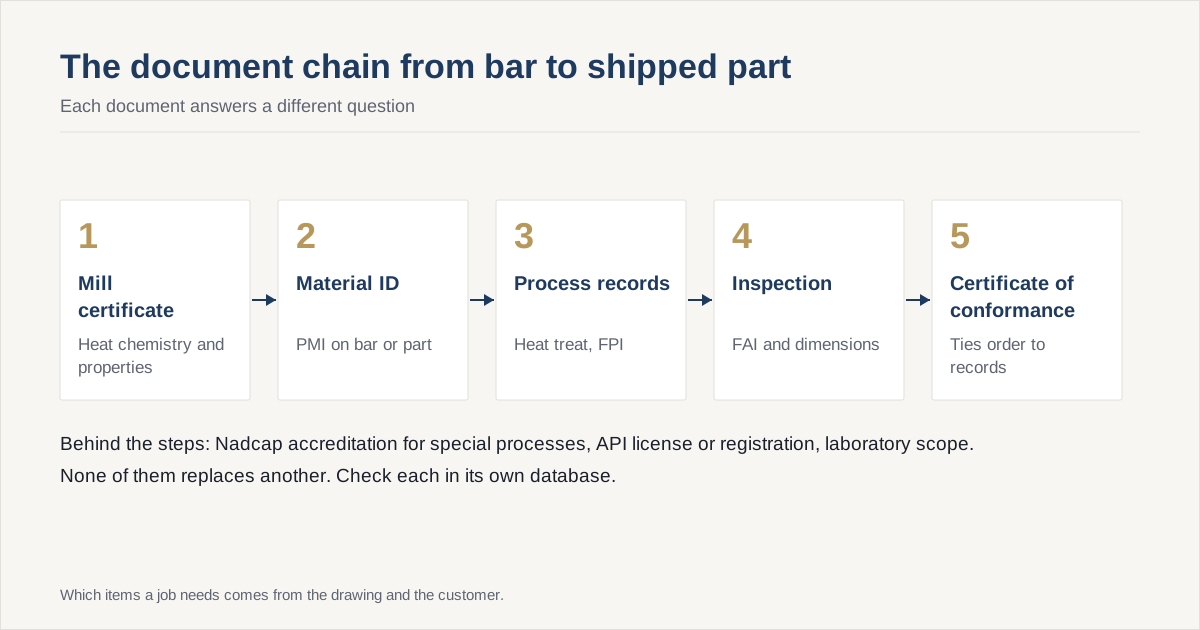
Order of documents on a typical job
- Mill certificate for the bar, with heat number, chemistry and properties. See mill certs and PMI testing.
- Positive material identification on the received bar or the finished part.
- Process records for outside steps such as heat treatment and penetrant inspection. See controlling subcontract heat treat and FPI.
- First article and dimensional reports. See first article inspection.
- Certificate of conformance that ties the order to these records.
- Heat identity kept from bar to part. See heat lot traceability.
Reading rules
- Original, not a copy of a copy. Ask for the original and check the number in the issuing body’s listing.
- Scope, site and date. Match the process, the address and the expiry to the job.
- Customer lists win. A prime may keep its own approved sources.
- Fakes exist. API publishes an unlicensed facilities list and a fraud alerts page. Check numbers rather than logos.
- Aerospace and launch hardware. Some of it falls under export control rules such as the US ITAR or EAR. The buyer classifies the part and tells the shop before technical data is shared.
For the standards behind the material see the alloy specifications hub.
Guide to the detail pages
| Page | Question it answers |
|---|---|
| Nadcap for nickel alloy parts | What heat treat and NDT accreditation shows and how to look a source up |
| API Q1, the Monogram and ISO 29001 | Which API or ISO document answers which question, and how to check it |
| AMS 2774 heat treatment | What the process standard covers and which records to ask a heat treater for |
| NACE TM0177 test reports | What the four sulfide stress cracking methods measure and how to read a report |
| Certification package for machined parts | For shops: the eight documents that ship with a part, in order, and what ties them together |
| API Q1 preparation for a machine shop | For shops: what the 10th edition asks of an outside supplier and how to describe the result |
| AMS 2750 pyrometry | What furnace classes, system accuracy tests and uniformity surveys mean on a heat treat record |
| Stress-rupture and creep tests | What E139 and E292 results show and the fields to read in a report |
| ASTM G28 intergranular corrosion | The two boiling-acid methods, test times by alloy and what a rate means |
| Grain size and ALA | Which way the ASTM number runs and where nickel alloy specifications care |
| Choosing a testing laboratory | Scope of accreditation, Nadcap materials testing and report checks |
| Nuclear parts: NCA-3800 and NQA-1 | Who holds which nuclear quality document |
| Nuclear-grade requests for shops | For shops: what can be said without a nuclear program and when to decline |
| Engine OEM approved sources | For shops: the usual steps to an approved source list |
Questions to put to any shop about records
- Which of these documents will ship with my parts, and in what form?
- Which outside processors will touch the parts, and what approvals do they hold?
- How is the heat number carried from bar to finished part?
- Who signs the certificate of conformance, and what does it refer to?
- How long are the records kept, and can they be produced on request?
- If a result is out of limits, who is told and what is recorded?
Shops that cut nickel alloys regularly can usually answer each in a sentence. A vague answer is a reason to ask for a sample record from a previous job, with the customer details removed.
Why records get lost
Records go missing at hand-offs. Bar changes owner from mill to distributor to shop, parts leave for heat treatment and return, and an inspection report is written against a drawing revision that later changes. The fixes are dull and effective: carry the heat number on the traveler, attach each outside record to the order when it returns, and name the drawing revision on every report. Read heat lot traceability for the shop-side practice and qualifying a shop for Inconel work for the buyer’s checklist.
A note on this site. InconelCNC is a matching service. It does not hold or issue any certificate, accreditation or license, and it does not test or certify parts. Ask each supplier for its original documents and check them in the named database.
Frequently asked questions
Which document proves the material is the alloy I ordered?
The mill certificate for the heat, together with positive material identification on the finished part. Accreditations and licenses describe a process or a company. They do not describe a lot of bar.
Can I trust a certificate that a supplier emails me?
Treat it as a lead. Check the number and scope in the issuing body's listing, for example the API Composite List or the Nadcap listing run by PRI. Accreditation scope, site address and expiry all matter.
Does InconelCNC hold any of these certificates?
No. InconelCNC is a matching service. It does not machine, heat treat, test or certify parts and does not hold or issue any certificate. Ask each shop for its originals.
Sources
- PRI: About Nadcap
- API Composite List
- API: API releases 10th edition of Spec Q1
- SAE Mobilus: AMS2774H, Heat Treatment, Nickel Alloy and Cobalt Alloy Parts
- ASTM: G28-22 abstract (Methods A and B)
- AMPP store: NACE TM0177-2024
Standards and rules are cited as references. They are not claims about inconelcnc.com or any shop. Confirm the edition and current status with the issuing body.
Send the drawing and the spec callout
Tell us the alloy, condition, standard with its edition and the paperwork you need. We match you with up to 3 shops that already cut nickel alloys, first reply within 24 business hours.
Send your RFQ