Home / Alloy families
Types of nickel alloys
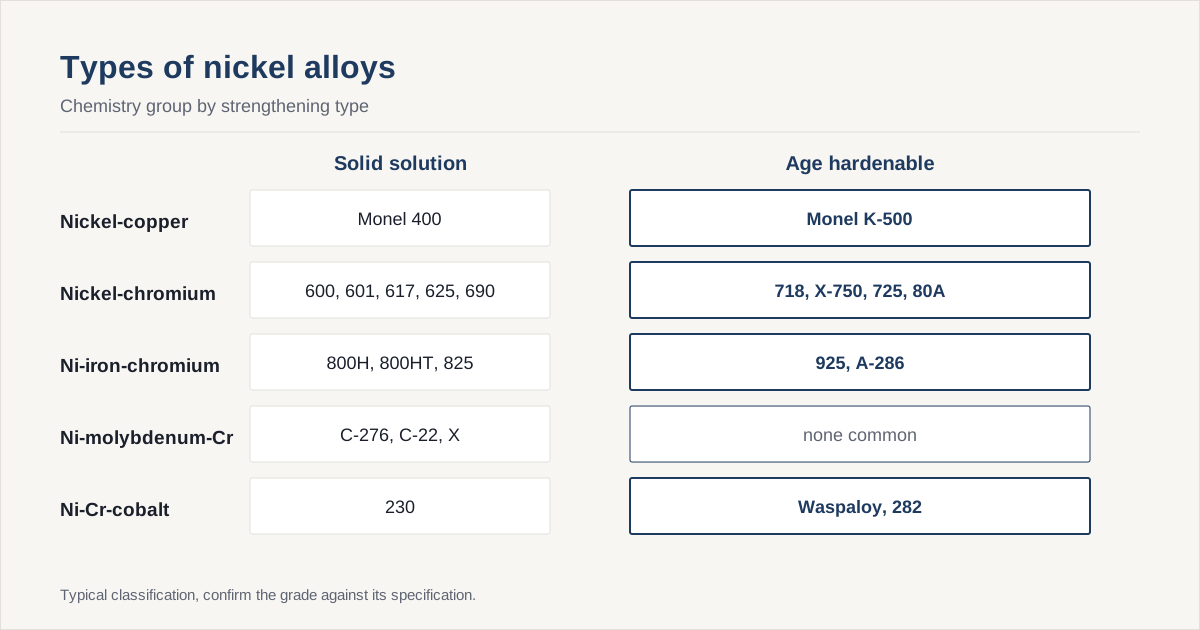
Nickel alloys sort two ways. By chemistry they fall into five groups: nickel-chromium, nickel-iron-chromium, nickel-molybdenum-chromium, nickel-copper and the high-strength superalloys. By strengthening they are either solid solution alloys, used annealed or cold worked, or age-hardenable alloys that need a heat treatment to reach full strength. The trade names Inconel, Incoloy, Hastelloy, Monel and Nimonic map onto these groups only roughly, so this page sorts by both.
The families at a glance
Temperature bands are typical service ranges from producer literature, an orientation rather than a design limit. Confirm grade data with the mill and your design code.
| Family | Base chemistry | Strengthening | Typical service band | Common grades |
|---|---|---|---|---|
| Inconel | Nickel-chromium, often with molybdenum, niobium or iron | Both. 600, 601, 625 and 690 are solid solution; 718, X-750 and 725 age harden | Cryogenic to about 1,100 °C for oxidation, strength to about 650 to 700 °C for 718 | 600, 601, 617, 625, 690, 718, X-750, 725 |
| Incoloy | Nickel-iron-chromium, more iron and less nickel than Inconel | Mostly solid solution; 925 ages | Ambient acid service (825) to creep service near 1,000 °C (800H, 800HT) | 800H, 800HT, 825, 925 |
| Hastelloy | Nickel-molybdenum-chromium, or nickel-chromium-iron-molybdenum for X | Solid solution | Ambient to boiling acids (C-276, C-22); oxidation to about 1,200 °C (X) | C-276, C-22, X |
| Monel | Nickel-copper | 400 by cold work only; K-500 ages | Seawater and hydrofluoric acid at moderate temperature | 400, R-405, K-500 |
| Nimonic | Nickel-chromium, some with cobalt | Mostly age hardening; 75 is solid solution | Creep and relaxation service roughly 650 to 850 °C | 75, 80A, 90 |
| Haynes and Waspaloy | Nickel-chromium-cobalt or nickel-chromium-tungsten | 282 and Waspaloy age; 230 is solid solution | Hot-section creep and oxidation, about 700 to 1,150 °C | 230, 282, Waspaloy |
| Iron-nickel superalloys | Iron base with about 25 percent nickel | Age hardening | Fasteners and rings to about 650 to 700 °C | A-286 |
Why trade names do not sort the alloys cleanly
Inconel, Incoloy, Monel and Nimonic are trade names of Special Metals Corporation. Hastelloy and Haynes are trade names of Haynes International. Each brand grew over decades and holds alloys that behave very differently. Inconel 600 is a soft, annealed oxidation alloy; Inconel 718 is an aged superalloy with roughly three times the yield strength. Incoloy 800H is a creep alloy for furnaces; Incoloy 825 is an acid alloy for downhole tubing.
Other mills make the same chemistries under generic names such as alloy 625 or alloy C-276, or under their own brands. The UNS number is what fixes the chemistry. A drawing that says only "Inconel" is not a material callout.
Solid solution or age hardening
This split matters more to a buyer than the brand, because it decides what goes on the drawing besides the grade.
| Point | Solid solution alloys | Age-hardenable alloys |
|---|---|---|
| Where strength comes from | Molybdenum, chromium, tungsten or niobium dissolved in the nickel matrix; cold work | Fine gamma prime or gamma double prime precipitates formed from aluminum, titanium and niobium during ageing |
| Supplied condition | Annealed or solution annealed, sometimes cold worked | Solution treated, or solution treated and aged |
| Typical annealed yield | About 170 to 520 MPa | About 700 to 1,100 MPa after ageing |
| Heat treatment after machining | Rarely, a stress relief at most | Often: rough, age, then finish critical features |
| Welding | Usually straightforward with matching filler | Weldable for 718; strain-age cracking risk for high gamma prime grades |
| Examples | 600, 601, 617, 625, 690, 800H, 825, C-276, X, 230, Monel 400 | 718, X-750, 725, 925, K-500, 80A, Waspaloy, 282, A-286 |
For an age-hardenable part, write the condition and the ageing treatment, or the specification that fixes them, on the drawing. The comparison of precipitation-hardened and solid solution alloys covers the machining sequence, and the Inconel 718 page shows it for the most common aged grade.
The grades on this site by family
Where a grade has its own reference page, the name links to it. Werkstoff numbers are the German material numbers used on EN drawings.
| Grade | UNS | W.Nr | Family | Strengthening |
|---|---|---|---|---|
| Inconel 600 | N06600 | 2.4816 | Inconel | Solid solution |
| Inconel 601 | N06601 | 2.4851 | Inconel | Solid solution |
| Inconel 617 | N06617 | 2.4663 | Inconel | Solid solution |
| Inconel 625 | N06625 | 2.4856 | Inconel | Solid solution |
| Inconel 690 | N06690 | 2.4642 | Inconel | Solid solution |
| Inconel 718 | N07718 | 2.4668 | Inconel | Age hardening |
| Inconel X-750 | N07750 | 2.4669 | Inconel | Age hardening |
| Inconel 725 | N07725 | none common | Inconel | Age hardening |
| Incoloy 800H / 800HT | N08810 / N08811 | 1.4958 / 1.4959 | Incoloy | Solid solution |
| Incoloy 825 | N08825 | 2.4858 | Incoloy | Solid solution |
| Incoloy 925 | N09925 | none common | Incoloy | Age hardening |
| Hastelloy C-276 | N10276 | 2.4819 | Hastelloy | Solid solution |
| Hastelloy C-22 | N06022 | 2.4602 | Hastelloy | Solid solution |
| Hastelloy X | N06002 | 2.4665 | Hastelloy | Solid solution |
| Monel 400 | N04400 | 2.4360 | Monel | Solid solution, cold work |
| Monel K-500 | N05500 | 2.4375 | Monel | Age hardening |
| Nimonic 80A | N07080 | 2.4952 | Nimonic | Age hardening |
| Haynes 230 | N06230 | 2.4733 | Haynes | Solid solution |
| Haynes 282 | N07208 | none common | Haynes | Age hardening |
| Waspaloy | N07001 | 2.4654 | Waspaloy | Age hardening |
| A-286 | S66286 | 1.4980 | Iron-nickel | Age hardening |
Chemistry groups, and what each one is for
Nickel-chromium
Chromium gives oxidation resistance at heat and resistance to oxidizing media. Inconel 600 is the plain version. 601 adds aluminum for scale resistance, 690 raises chromium to about 30 percent for nuclear water, 625 adds molybdenum and niobium for strength and pitting resistance, and 617 adds cobalt and molybdenum for creep strength.
Nickel-iron-chromium
Iron lowers cost. Incoloy 800H and 800HT are controlled for carbon and grain size so they hold creep strength in furnaces and petrochemical heaters. Incoloy 825 adds molybdenum and copper for sulfuric and phosphoric acid and for chloride stress corrosion cracking resistance.
Nickel-molybdenum-chromium
The Hastelloy C family. High molybdenum, around 15 to 17 percent in C-276, resists reducing acids and pitting in hot chloride. Carbon and silicon are kept very low so weld heat does not ruin the corrosion resistance.
Nickel-copper
Monel 400 resists seawater, brines and hydrofluoric acid at moderate temperature and machines more easily than the other families. K-500 adds aluminum and titanium so it can be aged for pump shafts and fasteners.
Age-hardening superalloys
Inconel 718 dominates by volume. X-750, Nimonic 80A, Waspaloy and Haynes 282 carry more gamma prime for higher temperatures. 725 and 925 are aged corrosion alloys for oil and gas, where strength and sour service resistance are both needed.
How to pick a family
- Start from the environment. Heat and air point to nickel-chromium or the superalloys; acids to nickel-molybdenum-chromium or 825; seawater to Monel or 625; wet H2S to the alloys listed in ISO 15156-3.
- Then the load. If the part carries high stress, the age-hardenable grades come in, and with them a heat treat step and a condition on the drawing.
- Then the paperwork. Aero parts follow AMS specs, process plant parts ASTM B and ASME SB, oil and gas parts API and ISO 15156. The alloy specifications hub maps them.
- Then cost to buy and cut. Within the families that pass, nickel content and machinability set the price. The selection guide walks from service condition to grade.
The blog guide to Inconel, Monel, Hastelloy and Incoloy compares the four best-known brands in plain terms.
Frequently asked questions
What are the main types of nickel alloys?
Sorted by what is added to nickel: nickel-chromium (Inconel 600, 625, Nimonic), nickel-iron-chromium (Incoloy 800H, 825), nickel-molybdenum-chromium (Hastelloy C-276, C-22), nickel-copper (Monel 400, K-500) and the age-hardening superalloys (718, X-750, Waspaloy, 282). A second split runs across all of them: solid solution alloys versus age-hardenable alloys.
Is Inconel a type of nickel alloy or a brand?
Both. Inconel is a trade name of Special Metals Corporation for a group of nickel-chromium alloys. The same chemistries are made by other mills and sold as alloy 625, alloy 718 and so on. The UNS number, for example N06625, names the chemistry independent of the brand.
What is the difference between solid solution and age-hardenable nickel alloys?
Solid solution alloys get their strength from elements dissolved in the nickel matrix and are used annealed or cold worked. Age-hardenable alloys contain aluminum, titanium or niobium that form fine precipitates during an ageing heat treatment, which roughly doubles yield strength. The condition and the ageing cycle then belong on the drawing.
Which nickel alloy family is easiest to machine?
Monel 400, and especially the free-machining Monel R-405, cuts most easily. Incoloy 825 and Inconel 600 follow. Inconel 625, Hastelloy C-276 and aged 718 are harder on tools, and aged Waspaloy and 282 are among the slowest.
Are Incoloy alloys nickel alloys?
Most are. Incoloy 825 and 925 have more nickel than iron. Incoloy 800H and 800HT carry about 30 to 35 percent nickel and more iron than nickel, so some standards file them with iron-nickel-chromium alloys. A-286 is an iron-base superalloy with about 25 percent nickel.
Sources
- Wikipedia: Superalloy (strengthening mechanisms)
- Wikipedia: Unified numbering system
- Wikipedia: Inconel (trade name and grades)
- Wikipedia: Monel
- Haynes International: alloy list (Hastelloy and Haynes)
Trade names belong to their owners. Figures are typical published values, not a promise from inconelcnc.com or any shop.
Reference hub · Last reviewed 22 October 2026
Not sure which family fits?
Describe the temperature, the medium and the load in the RFQ and leave the grade open if you need to. We are a matching service: we pass it to up to 3 shops that cut nickel alloys, first reply within 24 business hours.
Send your RFQ